Astronomy, Space & Remote Sensing
Featured Articles
MISSE (Materials International Space Station Experiment), a joint project between NASA and Boeing
Our BLUE-Wave spectrometers were launched into space and mounted on the ISS as part of the MISSE-7 experiment, designed to take real-time spectra to provide insight on how the environment of space affects different optical properties of materials. Many of the materials were designed for space exposure and are considered next generation materials for space travel.
StellarNet Customer Spotlight – Launching Spectrometers and Careers
The Harding University Atmospheric and Space Research Team operates under the leadership of Dr. Ed Wilson, Professor of Chemistry in Harding University’s Department of Chemistry and Biochemistry, and longtime StellarNet customer. The team’s research has been funded by several sources over the years, including NASA Astrobiology Science and Technology Instrument Development (ASTID), NASA Experimental Program to Stimulate Cooperative Research (EPSCoR), and the Arkansas Space Grant Consortium…
The SpectraWizard Goes Stellar- AstroSpectroscopy Basics
Spectroscopy is one of the most valuable tools that an astronomer has for studying the Universe. Spectrometers help us determine the chemical compositions, physical properties, and velocities of astronomical bodies light-years away…
Customer Research & Publications
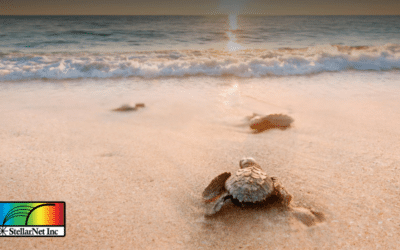
Why Turtle Safe Lighting Matters for Sea Turtle Survival + An Interview with FWC Experts
Why Turtle Safe Lighting Matters for Sea Turtle Survival + An Interview with FWC Experts Artificial lighting along coastlines is a well-documented threat to sea turtle populations. Species such as...
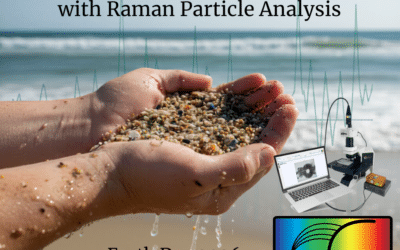
Earth Day 2026: Advancing Microplastics Detection with Raman Particle Analysis
Introduction: A Growing Environmental Challenge As global attention turns toward sustainability and environmental stewardship, microplastics have emerged as one of the most pervasive and least...
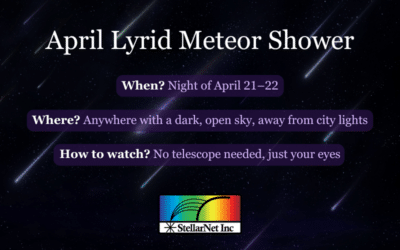
2026 April Lyrid Meteor Shower Spectroscopy with StellarNet
The Lyrid meteor shower and spectroscopy intersect in the study of meteors' chemical composition and physical properties. When a meteor from the Lyrid shower enters Earth's atmosphere, it heats up...
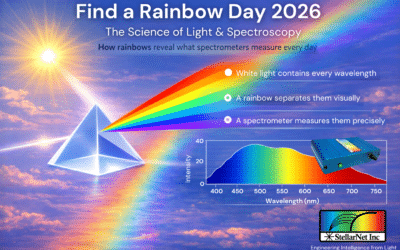
Find a Rainbow Day Spectroscopy
The Science Behind Rainbows Rainbows form when sunlight interacts with water droplets in the atmosphere. As light enters a droplet, it refracts (bends) due to the change in medium from air to water,...
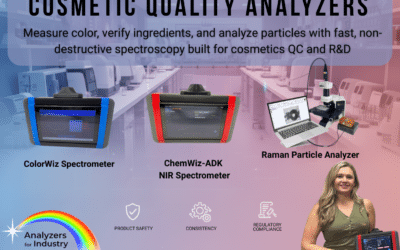
Cosmetic Ingredient Quality Analyzers
Our Cosmetic Industry Analyzers help streamline incoming inspection and quality control for blending, formulation, and final product verification. By combining NIR (ChemWiz-ADK), color measurement...
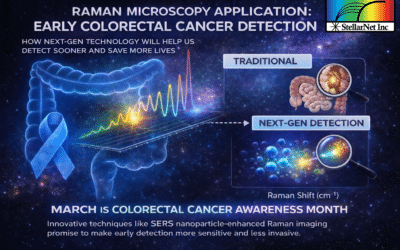
Raman Microscopy in Early Colorectal Cancer Detection
Colorectal cancer remains one of the most common malignancies worldwide, and early detection is key to improving patient outcomes. Traditional colonoscopy methods, while effective, are invasive and...
Key Application Areas
Food Safety & Quality
Advanced & quantum materials
Thin Films & Optical Coatings
Pharmaceuticals & Nutraceuticals
Biomedical & Life Sciences
Environmental & Microplastics
Industrial & Process Analysis
Lighting, Displays & Radiometry
products & systems
Learn More
Explore Raman spectroscopy through practical guides, application notes, videos, technical resources, and real-world research. From understanding the fundamentals to exploring material identification, quality control, and advanced analysis, the Raman Learning Center provides resources to help you get more from your spectroscopy measurements.
- Raman Guides & Tutorials — Learn the fundamentals and explore practical measurement techniques.
- Application Notes & Research — See how Raman spectroscopy is used across real-world applications.
- Videos, Labs & Technical Resources — Explore demonstrations, experiments, software resources, and measurement tips.