Introduction: A Growing Environmental Challenge
As global attention turns toward sustainability and environmental stewardship, microplastics have emerged as one of the most pervasive and least visible forms of pollution. These particles, typically defined as plastics smaller than 5 mm, are now widely distributed across oceans, freshwater systems, agricultural soils, and even the atmosphere. Increasingly, they are also being detected within biological systems, including food products and drinking water.
This growing body of evidence has elevated concern among researchers, regulators, and manufacturers alike. Microplastics are not only persistent in the environment, but they also serve as carriers for chemical contaminants, raising important questions about long-term exposure and ecological impact. As a result, there is a clear and urgent need for analytical technologies capable of accurately identifying and characterizing these materials at increasingly smaller scales.
In recognition of Earth Day 2026, StellarNet, Inc. highlights the role of Raman Spectrometers and Raman-based particle analysis in advancing microplastics research and supporting food quality applications.
Microplastics: Formation, Composition, and Distribution
Microplastics originate through two primary pathways. Some are intentionally manufactured at microscopic sizes for use in industrial or consumer products, while others are generated through the gradual degradation of larger plastic materials exposed to environmental stressors such as ultraviolet radiation, mechanical abrasion, and chemical weathering.
Over time, these processes produce a diverse population of particles that vary widely in size, shape, and composition. Common polymers encountered in environmental samples include polyethylene, polypropylene, polystyrene, and polyethylene terephthalate. As these materials age, their surfaces become increasingly irregular, and their chemical signatures can be influenced by oxidation, additives, and absorbed contaminants.

This variability presents a significant analytical challenge. Microplastics are rarely uniform, and their identification requires techniques capable of resolving both chemical composition and physical morphology at the micron scale.
Implications for Human Health and the Environment
The widespread distribution of microplastics has led to growing concern about their impact on both ecosystems and human health. In aquatic environments, microplastics are readily ingested by marine organisms, where they can accumulate and move through the food chain. Similar pathways are now being explored in terrestrial systems, where microplastics have been detected in soils and plant tissues.
From a human health perspective, exposure is most likely to occur through ingestion or inhalation. While research is ongoing, early studies suggest that microplastics may contribute to inflammatory responses and act as vectors for other environmental toxins. Their small size allows them to interact with biological systems in ways that are not yet fully understood, making accurate detection and characterization essential for risk assessment.
In agricultural and food production settings, the presence of microplastics introduces additional complexity. Contamination may originate from water sources, processing environments, or packaging materials, reinforcing the need for reliable analytical tools that can support both research and quality control efforts.
Analytical Considerations: Why Raman Spectroscopy
Detecting microplastics is not simply a matter of visualization. While optical microscopy can reveal particle presence and morphology, it does not provide definitive chemical identification. Techniques such as FTIR spectroscopy offer chemical insight but can be limited in spatial resolution, particularly when analyzing particles below approximately 20 microns.
Raman spectroscopy addresses these limitations by enabling non-destructive chemical identification at significantly smaller spatial scales. Because Raman scattering is sensitive to molecular vibrations, it provides a direct fingerprint of polymer composition. This allows for clear differentiation between materials that may appear visually similar but are chemically distinct.
In addition, Raman spectroscopy requires minimal sample preparation and can be integrated with automated imaging systems, making it well suited for high-throughput particle analysis.
Raman Particle Analysis with StellarNet
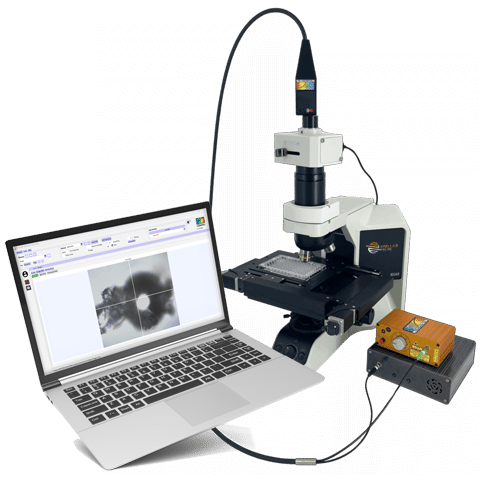
StellarNet’s Raman Particle Analyzer has been developed to meet the evolving demands of microplastics detection. The system integrates automated particle detection with high-resolution Raman spectroscopy, enabling users to identify and characterize particles across a sample with minimal manual intervention.
Rather than relying on isolated point measurements, the analyzer performs systematic mapping of the sample surface, locating particles and acquiring spectra that reveal their chemical identity. This approach allows for comprehensive characterization of heterogeneous samples, where particle populations may include a wide range of polymer types and sizes.
The system is particularly well suited for the analysis of particles in the 10–20 µm range, where traditional techniques often struggle. By combining morphological data with spectral information, users gain a more complete understanding of both the physical and chemical properties of each particle.
Application Focus: Food Quality and Microplastics
One of the most immediate and impactful applications of Raman particle analysis lies in food quality and safety. Microplastics have been detected in a variety of food products, including seafood, salt, and processed goods, raising concerns about contamination pathways and consumer exposure.
In this context, the Raman Particle Analyzer provides a powerful tool for identifying and quantifying microplastic contamination. Its ability to distinguish between polymer types allows manufacturers and researchers to trace contamination sources, differentiate between environmental and process-related particles, and validate mitigation strategies.
Because the technique is non-destructive and requires minimal preparation, it can be integrated into routine analytical workflows without significantly increasing operational complexity.
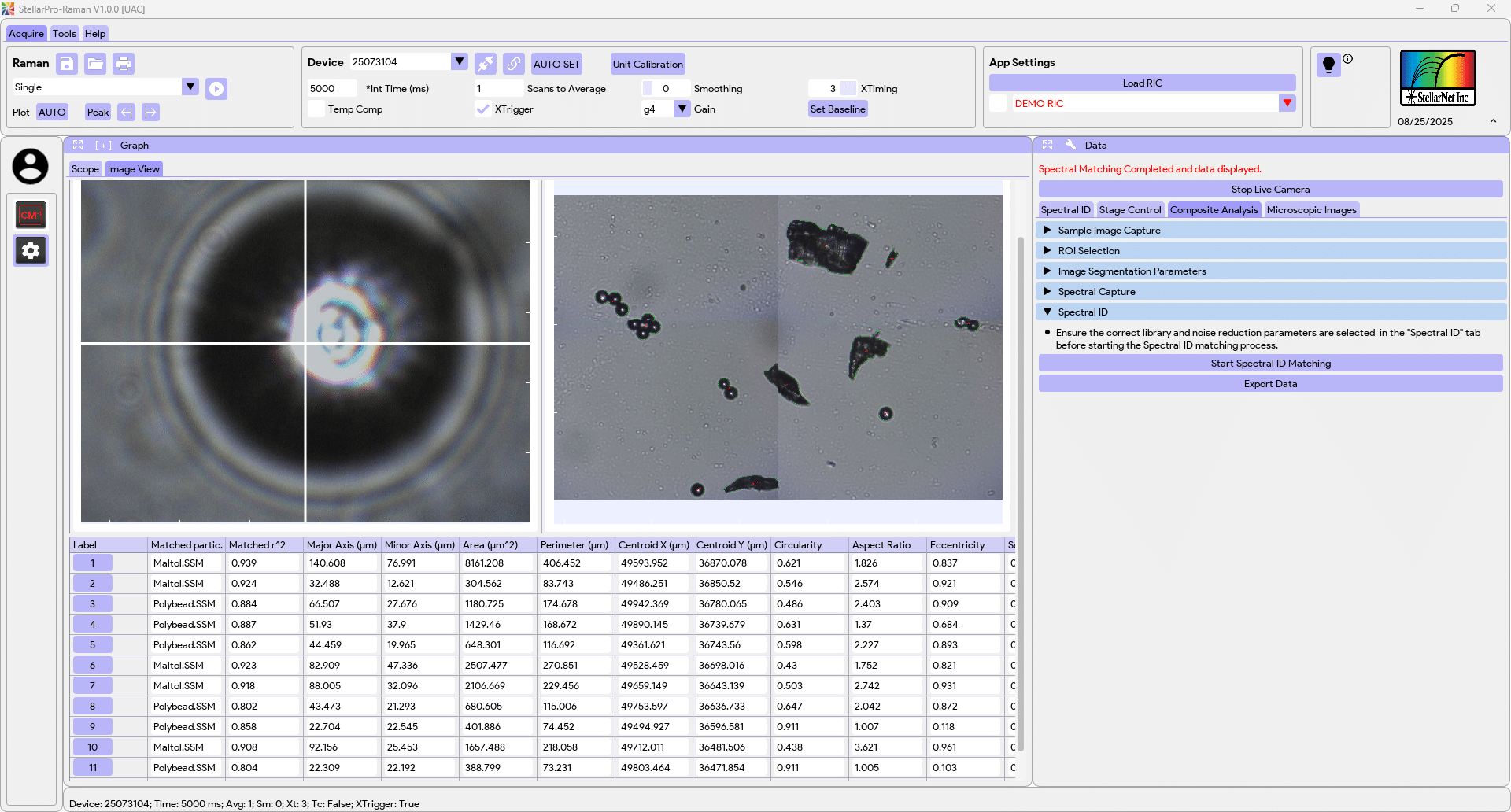
Raman particle analysis of 20um polymer bead
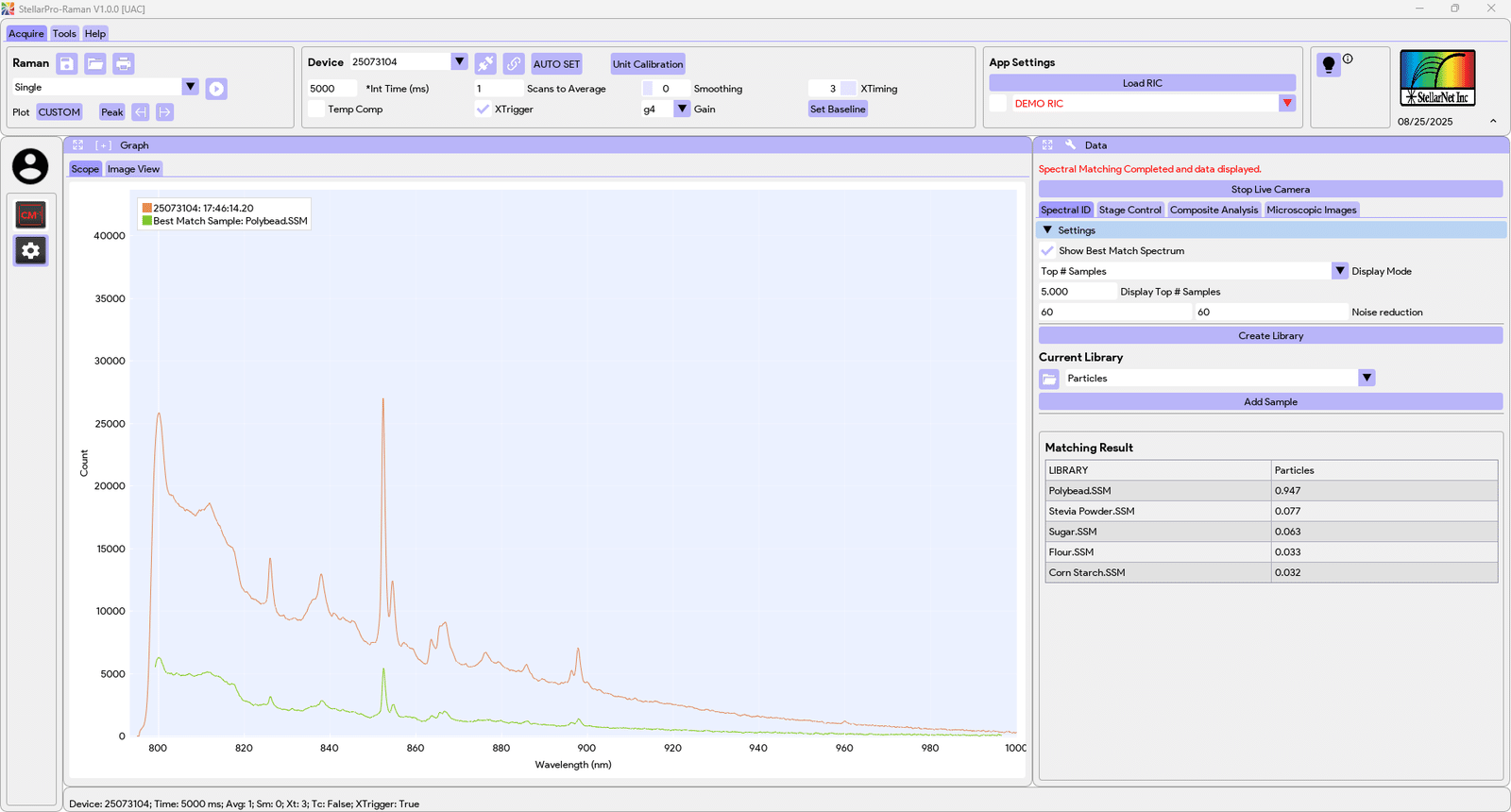
Raman fingerprint spectra of maltol baking sugar with polymer bead adulteration
Calibration and Spectral Validation
Accurate microplastics analysis depends on reliable calibration and validation procedures. Polymer microspheres, such as 10 µm and 20 µm beads, are commonly used as reference materials due to their well-defined size and known spectral characteristics.
These standards provide a consistent basis for verifying system performance, ensuring that both particle detection and spectral identification remain accurate over time. Raman spectra collected from these reference materials exhibit clearly defined peaks corresponding to their molecular structure, allowing users to confirm instrument alignment and sensitivity.
Including representative spectra from these calibration standards in analytical reports also helps establish confidence in measurement results, particularly when analyzing complex or unknown samples.
Conclusion: Supporting a More Sustainable Future
As awareness of microplastics continues to grow, so too does the need for analytical technologies capable of delivering precise and actionable data. Raman particle analysis represents a significant advancement in this field, enabling detailed characterization of microplastics at scales relevant to both environmental and food safety applications.
Through continued innovation, StellarNet, Inc. is committed to providing solutions that empower scientists, manufacturers, and regulators to better understand and address this global challenge.
Engineering Intelligence from Light. Trusted Worldwide.