Established UV-Vis methods provide a rapid approach to identifying and quantifying synthetic color additives in sports drinks, helping manufacturers strengthen formulation and labeling quality control.
A recent recall involving more than 122,000 cases of Gatorade has highlighted the importance of verifying that beverage ingredients match their declared formulations. PepsiCo initiated the voluntary recall on September 25, 2026, involving 28-ounce bottles of Gatorade Lemon Lime, Lemon Lime Zero, Orange and Orange Zero distributed across 37 states. The U.S. Food and Drug Administration classified the recall as Class II on October 2 because the beverages contained undeclared FD&C Yellow No. 5 and/or Yellow No. 6.
Both dyes are permitted for specified food uses in the United States, but their presence must be properly declared on product labels. The recall illustrates a fundamental challenge for beverage manufacturers: ensuring that finished products contain the expected ingredients and that analytical quality control supports accurate labeling.
How Visible Spectroscopy Measures Food Dyes
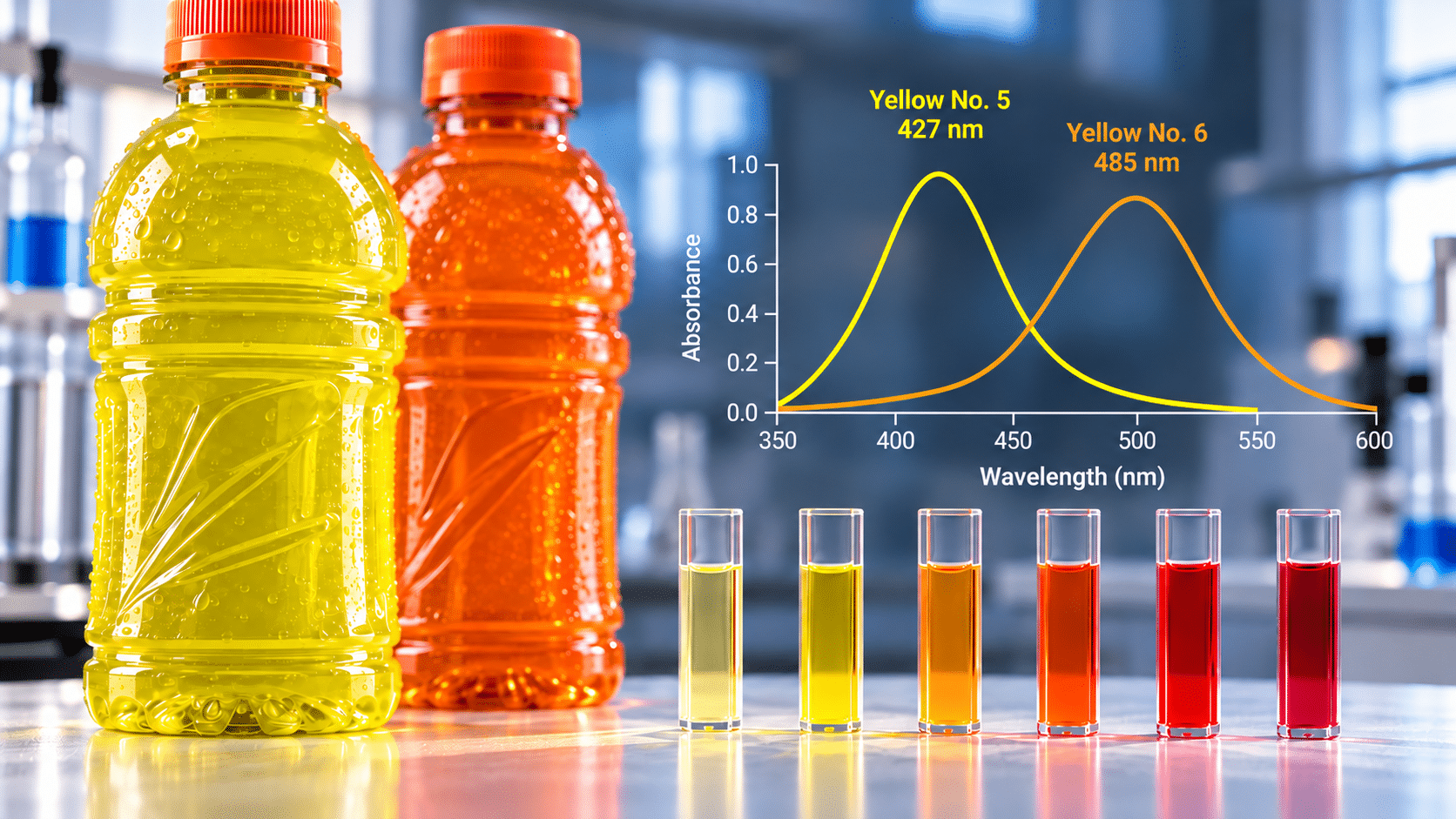
Fortunately, detecting many synthetic food dyes does not require complex chemical reactions or extensive sample preparation. FD&C Yellow No. 5 (tartrazine) and Yellow No. 6 (Sunset Yellow FCF) are water-soluble azo dyes that absorb visible light at characteristic wavelengths.
Yellow No. 5 exhibits strong absorption near 427 nm, while Yellow No. 6 absorbs near 485 nm. When light passes through a beverage sample, these compounds selectively absorb portions of the visible spectrum, producing measurable absorbance features.
The relationship between absorbance and concentration is described by the Beer–Lambert law:
A = εlc
Here, absorbance (A) depends on the molar absorptivity (ε), optical path length (l) and dye concentration (c). By measuring reference solutions of known concentration, manufacturers can establish a calibration curve and use it to determine dye concentrations in beverage samples.
A Practical Method Already Demonstrated with StellarNet Spectroscopy
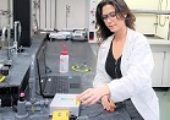
StellarNet’s laboratory experiment, Quantification of Food Dyes in Sports Drinks, documents a complete educational method for measuring FD&C Yellow No. 5, Yellow No. 6 and Red No. 40 using a BLACK-Comet UV-Vis spectrometer, broadband light source, cuvette holder and SpectraWiz software.
The procedure uses prepared dye standards, a water blank and direct absorbance measurements in a 1 cm cuvette. Beverage samples are measured directly and diluted with water when necessary to maintain absorbance within the calibrated linear range. No chemical derivatization or dye extraction is required for this basic single-dye analysis.
The manual includes an example calibration for Yellow No. 6 measured at 485 nm, with a reported coefficient of determination (R²) of 0.99968. This demonstrates the strong linear relationship achievable between dye concentration and absorbance under the illustrated calibration conditions.
From Laboratory Measurement to Beverage Verification
For beverage manufacturers, the value of visible spectroscopy extends beyond measuring the concentration of a declared colorant. Spectral measurements can provide an additional quality-control check by comparing finished beverages with approved formulations and established reference spectra.
A practical screening process can measure a production sample, compare its visible absorbance spectrum against an authenticated reference and identify differences requiring further investigation. Where individual dyes are known and spectral interference is sufficiently controlled, quantitative calibration can also help verify colorant concentrations.
More complex beverages containing multiple dyes or overlapping absorbing ingredients may require multicomponent spectral analysis, chemometrics or chromatographic confirmation. An unexpected absorbance feature alone is not definitive proof of an undeclared ingredient, and methods intended for regulatory decisions require appropriate validation.
Using Light to Verify What’s in the Bottle
The Gatorade recall reinforces the importance of connecting formulation control, analytical measurement and accurate product labeling. Visible spectroscopy offers a rapid, accessible way to examine the optical signatures of food colorants and support routine beverage quality assurance.
StellarNet’s established food-dye experiment demonstrates the underlying measurement principle using readily available UV-Vis instrumentation, without requiring specialized chemical preparation. Although the experiment did not test the recalled Gatorade products, it illustrates a practical analytical approach that manufacturers can adapt and validate for their own formulations.
The color of a beverage is designed to be seen. Spectroscopy makes it possible to measure the chemistry behind that color—helping manufacturers verify that what is in the bottle matches what is on the label.
Learn More About UV-Vis Spectroscopy
Explore additional StellarNet educational resources on absorbance measurements, food-dye analysis and spectroscopy applications.
References
- U.S. Defense Commissary Agency (2026). PepsiCo Inc. recalls Gatorade due to undeclared food dyes. October 8, 2026.
- StellarNet, Inc. Quantification of Food Dyes in Sports Drinks. UV-Visible Spectroscopy, Experiment 1. Laboratory instructional manual.
- U.S. Food and Drug Administration. Color Additives in Foods.
- Sharma, V., McKone, H. T. and Markow, P. G. (2011). A Global Perspective on the History, Use, and Identification of Synthetic Food Dyes. Journal of Chemical Education, 88(1), 24–28.