Spectroscopy Applications
Explore how researchers, manufacturers, and quality-control laboratories use StellarNet spectrometers to solve real-world measurement challenges. Our compact UV-Vis, VIS-NIR, NIR, and Raman spectroscopy systems support applications across food safety, pharmaceuticals, advanced materials, thin films, biomedical research, environmental monitoring, industrial process analysis, radiometry, and space science.
Browse the application areas below to discover customer research, technical articles, spectroscopy methods, and practical solutions for absorbance, transmission, reflectance, fluorescence, Raman, radiometric, and chemometric analysis.
Key Application Areas
Food Safety & Quality
Advanced & quantum materials
Thin Films & Optical Coatings
Pharmaceuticals & Nutraceuticals
Biomedical & Life Sciences
Environmental & Microplastics
Industrial & Process Analysis
Lighting, Displays & Radiometry
Featured Spectroscopy Applications -
Astronomy, Space & Remote Sensing
Astronomy spectroscopy gives researchers a way to study light from objects and environments far beyond the laboratory. StellarNet systems support astronomical spectroscopy for research into stars, planets, meteors, and atmospheric phenomena. Spectral measurements can reveal information that cannot be seen through imaging alone. Compact instruments also open new possibilities for space spectroscopy and CubeSat missions where size and flexibility matter. From meteor and aurora research to remote sensing and educational astronomy, StellarNet provides accessible spectroscopy tools for exploring our planet and the universe beyond it.
Astronomy, Space & Remote Sensing
Wildlife & Ecology Spectroscopy
Spectroscopy provides powerful tools for studying how animals perceive light, display coloration, communicate, and interact with their environments. From ultraviolet vision in birds and insects to underwater light conditions in marine ecosystems, UV-Vis-NIR spectroscopy helps researchers characterize the optical properties of biological structures and natural habitats.
Wildlife & Ecology Spectroscopy
Looking for something else?
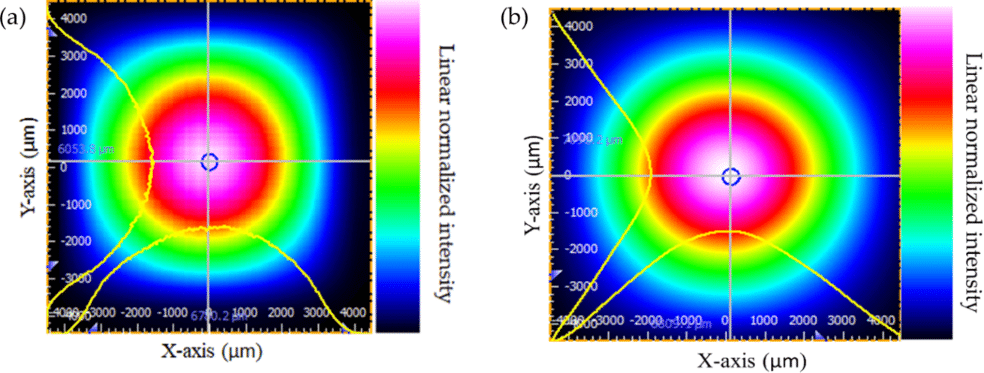
Concentration-dependent photothermal conversion efficiency of gold nanoparticles under near-infrared laser and broadband irradiation
Vikas, Raj Kumar, and Sanjeev Soni Published: 6 February 2023 Abstract The photothermal conversion efficiency of gold different nanoparticles (GNPs) in different concentrations (1.25–20 µg/mL) and...

Evaluation of the Irradiation Treatment Effects on Ancient Parchment Samples
Monia Vadrucci, Cristina Cicero, Claudia Mazzuca, Leonardo Severini, Daniela Uccelletti, Emily Schifano, Fulvio Mercuri, Ugo Zammit, Noemi Orazi, Francesco D’Amico, and Pietro Parisse Published: 30...

Heteroleptic Ir(III)-based near-infrared organic light-emitting diodes with high radiance capacity
Yongjin Park, Gyeong Seok Lee, Woochan Lee, Seunghyup Yoo, Yun-Hi Kim & Kyung-Cheol Choi Published: 25 January 2023 Abstract Near-infrared organic light-emitting diodes (NIR OLEDs) with heavy...
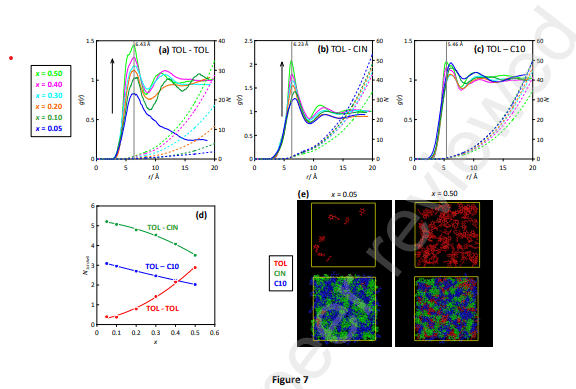
Cineole – Decanoic Acid Hydrophobic Natural Deep Eutectic Solvent for Toluene Absorption
Jose L. Trenzado, Cristina Benito, Mert Atilhan, Santiago Aparicio Published: 24 January 2023 | Department of Physics, University of Las Palmas de Gran Canaria | Department of Chemistry, University...
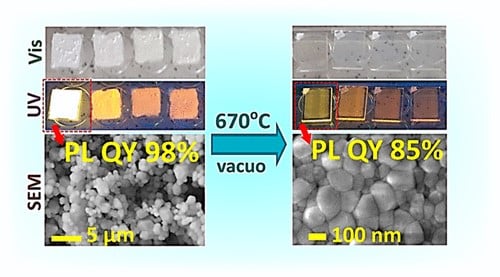
Highly Luminescent Transparent Cs2AgxNa1–xBiyIn1–yCl6 Perovskite Films Produced by Single-Source Vacuum Deposition
Oleksandr Stroyuk, Oleksandra Raievska, Paz Sebastia-Luna, Bas A. H. Huisman, Christian Kupfer, Anastasia Barabash, Jens Hauch, Henk J. Bolink, and Christoph J. Brabec Published: 19 January 2023 |...
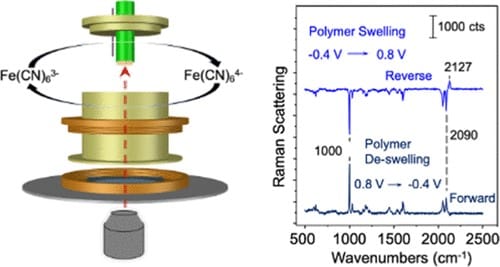
In Situ Confocal Raman Microscopy of Redox Polymer Films on Bulk Electrode Supports
Jiahe Xu, Miharu Koh, Shelley D. Minteer, and Carol Korzeniewski Published: 13 January 2023 | Electrochemical cells, Electrodes, Ions, Polymers, Redox reactions | Published by the American Chemical...