Food Safety & Quality
Featured Articles
Can Spectroscopy Help Detect Food Contamination Earlier?
The 2026 Cyclospora outbreak linked to iceberg lettuce highlights a persistent challenge in food production: contamination can move through the supply chain before conventional testing identifies a problem. Emerging research suggests that NIR, Raman/SERS, chemometrics and machine learning may provide food producers with additional tools for faster screening and earlier investigation.
Predicting Avocado Ripeness with NIR Spectroscopy
Knowing when an avocado is ready for market can be challenging without cutting into the fruit. This application demonstrates how near-infrared spectroscopy and chemometric analysis can predict avocado ripeness quickly and non-destructively, providing a potential tool for monitoring fruit quality and improving consistency throughout the supply chain.
Taking NIR Spectroscopy to the Strawberry Field
What can spectroscopy reveal about strawberries in the field? This application follows a portable NIR spectroscopy system into a strawberry field to demonstrate how rapid, non-destructive measurements can help evaluate fruit quality and collect valuable data outside of the laboratory.
Customer Research & Publications
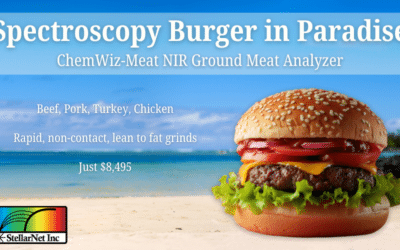
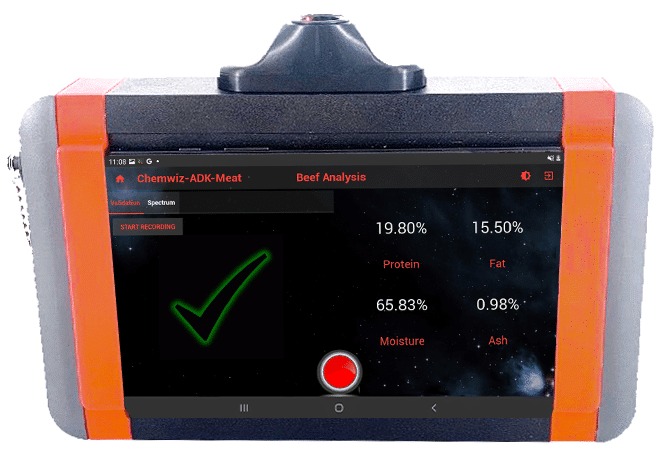
Introducing New ChemWiz-Meat NIR Ground Meat Analyzer
Introducing ChemWiz-Meat: Efficiency and Affordability CombinedChemWiz-Meat is StellarNet’s most affordable meat analyzer, engineered to provide non-contact, rapid, and reliable measurements without...
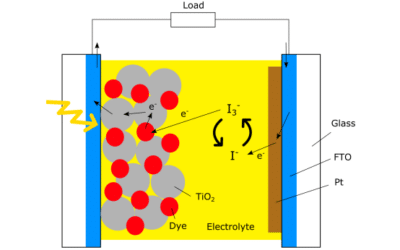
Fabrication of natural dye-sensitized solar cells using dyes from corn, sugarcane and blackberry
Marcelo Alatzatianou Rodrigues April 2024 | Departamento de Pesquisa, União Max de Ensino e Pesquisa, Rua Francisco de Vitória, São Paulo, BrasilFigure 1: Construction diagram and working principle...
June Analyzer of the Month – Strawberry Field Trip Spectroscopy
This month we are highlighting our Fruits and Vegetables NIR Analyzer. There are several components found in fruits that can be measured to determine its quality. These components are different for...
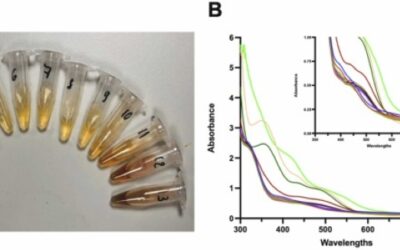
Composite films produced from upcycling of tropical fruit seeds are capable of monitoring shrimp freshness
Tram Anh Ngoc Le, Wei Ning Chen Published: 15 January 2024 | School of Chemistry, Chemical Engineering and Biotechnology, Nanyang Technological University, SingaporeAbstractMany tropical fruit...
Unravelling effects of red/far-red light on nutritional quality and the role and mechanism in regulating lycopene synthesis in postharvest cherry tomatoes
Yanjie Song, Graham Teakle, Robert Lillywhite Published: 21 February 2023 | Warwick Crop Centre, School of Life Science, The University of WarwickAbstractThe main goal of this study was to explore...
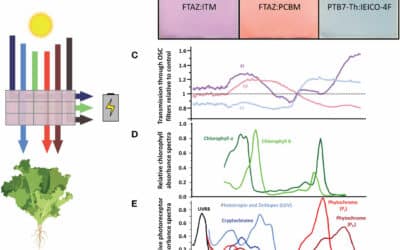
Emergent molecular traits of lettuce and tomato grown under wavelength-selective solar cells
Melodi Charles, Brianne Edwards, Eshwar Ravishankar, John Calero, Reece Henry, Jeromy Rech, Carole Saravitz, Wei You, Harald Ade, Brendan O’Connor, Heike Sederoff Published: 13 February 2023 |...
Spectroscopy Applications
Astronomy, Space & Remote Sensing
Advanced & quantum materials
Thin Films & Optical Coatings
Pharmaceuticals & Nutraceuticals
Biomedical & Life Sciences
Environmental & Microplastics
Industrial & Process Analysis
Lighting, Displays & Radiometry
Food Safety & Quality Spectrometers
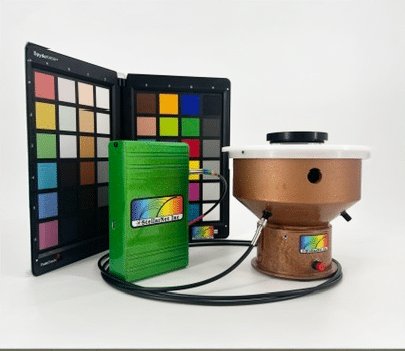
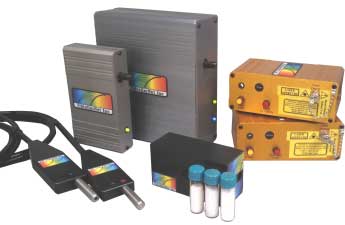
Learn More
Explore Raman, UV-VIS, and NIR spectroscopy through practical guides, application notes, videos, technical resources, and real-world research. Learn how spectroscopy can be used for food quality and safety, ingredient identification, composition analysis, adulteration screening, color measurement, and quality control. These Learning Centers provide practical resources to help researchers and food manufacturers better understand their measurements and apply spectroscopy throughout food research, ingredient verification, and production.
- NIR Learning Center — Discover NIR spectroscopy for food composition analysis, ingredient verification, adulteration screening, and rapid quality control measurements.
- Raman Learning Center — Explore Raman spectroscopy for food and ingredient identification, authenticity testing, adulteration detection, and molecular analysis.
- UV-VIS Learning Center — Learn about UV-VIS spectroscopy for food color measurement, absorbance and transmission analysis, quality evaluation, and food research applications