Research Spotlight : Enabling the Next Generation of Planetary Atmospheric Spectroscopy
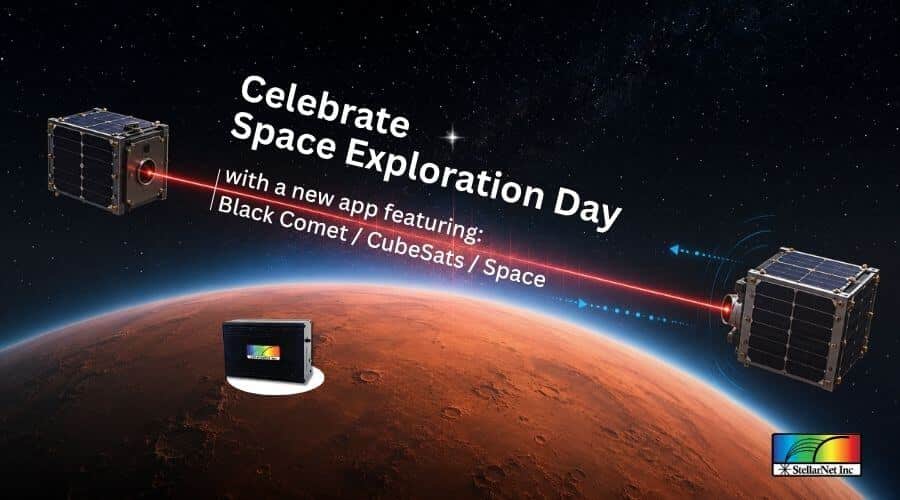
A recent study from researchers at the University of Arkansas presents the development of a Tunable Laser for Small-Satellite Systems (TLSS), a concept designed to measure the composition and isotope ratios of planetary atmospheres using formation-flying CubeSats. Unlike conventional tunable laser spectrometers that house the light source and detector within a single instrument, TLSS separates these components onto two spacecraft. As laser light travels through a planet’s atmosphere, the detector measures wavelength-specific absorption, providing valuable information about atmospheric gases and isotopes.
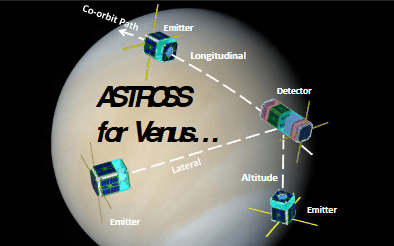
Fig. 1: Arksat 3 system with the TLSS detector andemitter CubeSat units.
The Challenge: Synchronizing Two Spacecraft
Separating the emitter and detector introduces a significant engineering challenge—keeping both spacecraft synchronized during measurements.
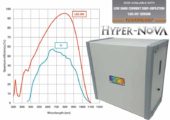
The research team evaluated the StellarNet BLACK-Comet-SR spectrometer as an optical communication receiver. During laboratory testing, the spectrometer monitored the intensity of multiple LED wavelengths over time, allowing software to decode transmitted digital messages.
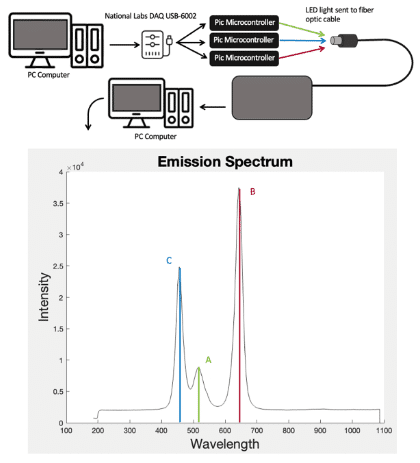
Fig. 2: Diagram of lab setup including emission spectrum of the StellarNet BLK-C-SR
Why It Matters
While spectroscopy is traditionally associated with identifying materials and measuring chemical composition, this research highlights another emerging capability: enabling communication between distributed sensing systems.
As future missions increasingly rely on constellations of small satellites, compact, high-performance spectrometers can contribute not only to scientific measurements but also to the technologies that make those measurements possible.
StellarNet instrumentation is supporting research at the intersection of planetary science, optical communications, and next-generation space exploration.
Check out some of our other space applications below!