Daniil Valme, Anton Rassõlkin, and Dhanushka C. Liyanage
8 April 2025 | Tallinn University of Technology, Estonia
Abstract
Hyperspectral imaging (HSI) has evolved from its origins in space missions to become a promising sensing technology for mobile ground robots, offering unique capabilities in material identification and scene understanding. This review examines the integration and applications of HSI systems in ground-based mobile platforms, with emphasis on outdoor implementations. The analysis covers recent developments in two main application domains: autonomous navigation and inspection tasks. In navigation, the review explores HSI applications in Advanced Driver Assistance Systems (ADAS) and off-road scenarios, examining how spectral information enhances environmental perception and decision making. For inspection applications, the investigation covers HSI deployment in search and rescue operations, mining exploration, and infrastructure monitoring. The review addresses key technical aspects including sensor types, acquisition modes, and platform integration challenges, particularly focusing on environmental factors affecting outdoor HSI deployment. Additionally, it analyzes available datasets and annotation approaches, highlighting their significance for developing robust classification algorithms. While recent advances in sensor design and processing capabilities have expanded HSI applications, challenges remain in real-time processing, environmental robustness, and system cost. The review concludes with a discussion of future research directions and opportunities for advancing HSI technology in mobile robotics applications.
Introduction
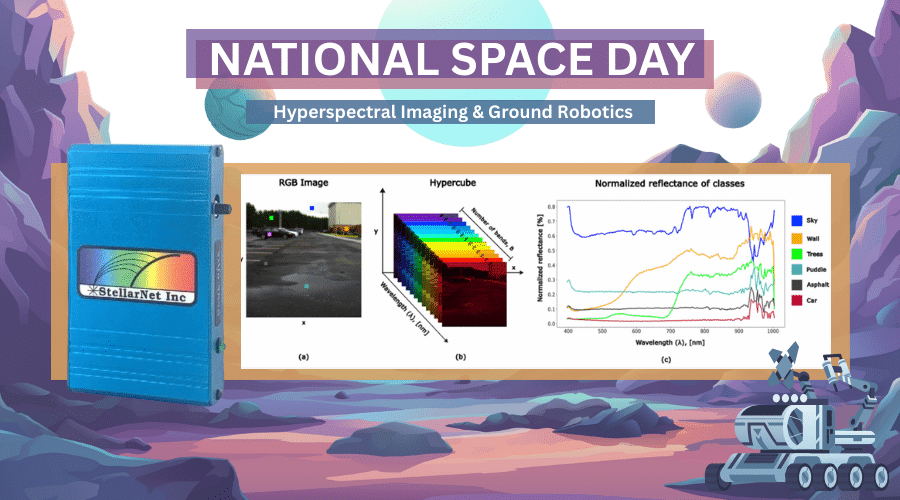
While conventional imaging systems like RGB (red–green–blue) cameras capture data in three broad spectral bands, HSI systems collect information across hundreds of narrow, contiguous bands. This high spectral resolution is crucial for real-world applications where materials exist in complex mixtures, and environmental factors affect measurements. The rich spectral information enables the separation and identification of distinct material components, even when they appear visually similar in conventional imaging. The evolution of HSI technology has been driven by three parallel developments: advances in sensor design, sophisticated data processing algorithms, and increased computational power [2]. The advancement of HSI sensor design, computational power, and data processing algorithms has extended its applications from aerospace to diverse fields, including medicine [3], agriculture [4], waste management [5], environmental monitoring [6], forestry [7], food quality assessment [8], cultural heritage preservation [9], and security [10].While the application of HSI has been extensively discussed in aerial [11,12], spaceborne [13,14], and indoor studies [5], its integration with mobile ground robots—such as autonomous vehicles, quadruped robots, and unmanned ground vehicles (UGVs)—has received comparatively less attention. Existing reviews primary focus on the integration of HSI for precision agriculture purposes [4,15,16]. In mobile robotics and relevant applications, HSI sensors are primarily deployed for two key tasks:
-
- Navigation: assisting autonomous vehicles and UGVs in environment perception, terrain classification, and road condition analysis.
- Inspection and Monitoring: supporting non-destructive material analysis for various purposes.
Mines
The integration of spectral imaging and legged robots or their hybrids is gaining attention, as such platforms can operate in environments where traditional wheeled or tracked platforms cannot operate.
In [67], The Spot (Boston Dynamics, Waltham, MA, USA) versatile robot with the X20P (Cubert GmbH, Ulm, Germany) HSI camera and VLP-16 LiDAR (Velodyne Lidar Inc., San Jose, CA, USA) in the autonomy payload was tested in underground mining environments for mineral exploration (see Figure 13).
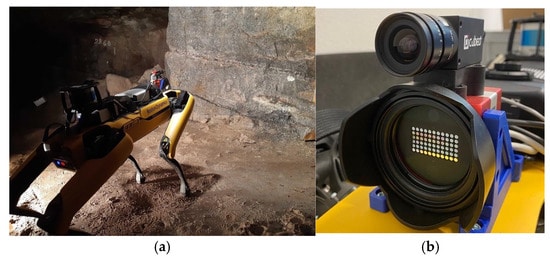
Tests were done in both the lab as well as in Zinnwald/Cinnovec visitor mine in Germany. The features of HSI data were extracted using minimum noise fraction (MNF) and PCA; next, supervised NFIDR and fully constrained least squares (FCLS) were applied providing interpretable results. Also, it was summarized that lightweight HSI cameras might be beneficial for the platforms sensitive to the maximum payload weight.
The VAST sensor array includes a… BLUE-Wave (StellarNet, Inc., Tampa, FL, USA) miniature VNIR spectrometer…