
Betelgeuse is a huge, bright red, pulsating star and is at its highest point above the horizon every Valentine’s Day night between the hours of 8 and 9 p.m (@StellarNet Headquarters, Tampa, FL). It is located in the constellation Orion and located at the warrior’s armpit. Betelgeuse is an extremely large red supergiant and is about as wide as Jupiter’s orbit around the sun. It’s also a variable star, which means that its atmosphere is expanding and contracting, causing its light to pulse on a semi-regular basis, on average about once every six years. Stargazing at this huge, red beating heart in the sky is a great way to spend your Valentine’s Day.
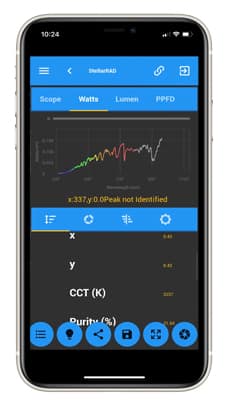
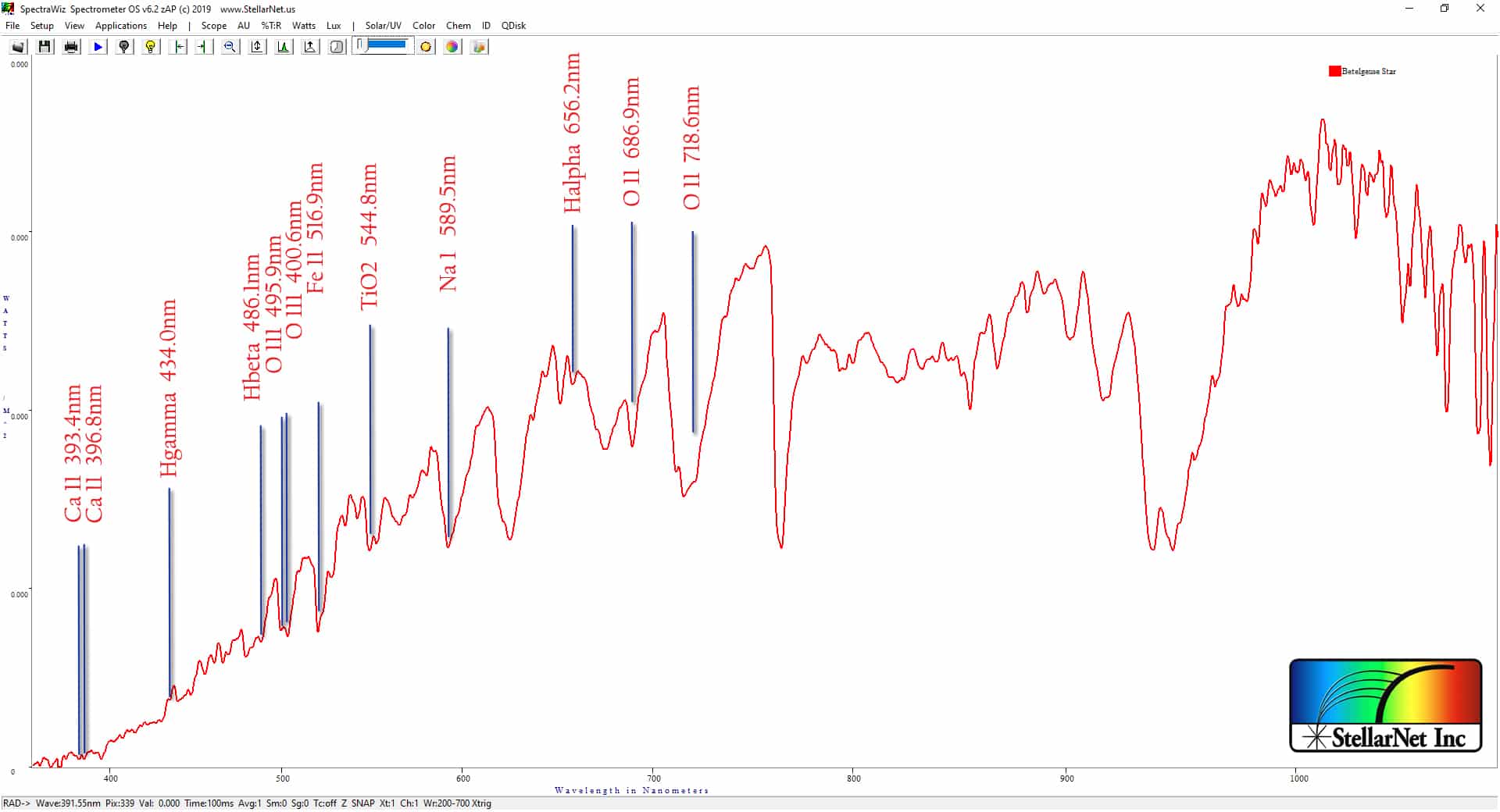
The Spectrum of Betelgeuse reveals much about its composition and temperature. From the spectrum, we can see strong lines of neutral metals and molecular bands of titanium oxide dominate. Betelgeuse’s Color Temperature can be calculated using the StellarRAD App to be ~3350K which classifies it as an M supergiant. From hottest to coldest, these seven spectral classes are designated O, B, A, F, G, K, and M.
Betelgeuse is the 10th brightest star in the night’s sky 🙂