What are Reflectance Probes?
Reflectance probes are fiber bundles designed to deliver the light source to the sample and collect signal that is reflected back. Six or seven fibers in an outer ring are used to illuminate the sample and one fiber in the middle collects the signal. These probes are...What is a Flow Cell?
Flow cells are sample cells designed so that liquid samples can be continuously flowed through the beam path. This is useful for samples that can be damaged by the light source. New sample is continually replenished so that the damage does not interfere with the...What is a Dip Probe?
Dip probes are a probe that allows you to perform liquid absorbance and transmittance measurements without a cuvette. The probe is dipped straight in the liquid sample and the measurement happens at the gap in the tip. A fiber delivers the light source to the tip and...What is Fluorescence?
Molecules have many types of energy levels and all of them can be excited by absorbing photons. Two common energy levels are electronic, where the electrons get excited into higher energy levels, and vibrational, where molecules get excited into different types of...What is Fluorescence Spectroscopy (Fluorimetry)?
Fluorescence spectroscopy uses the process of fluorescence to learn about samples. Because of the nature of fluorescence, a single excitation wavelength can produce a fluorescence spectrum that can be used to identify samples. The Spectral ID application in the...
Introducing our new Applied Spectroscopy Division
New Handheld Raman!
New! ChemWiz-ADK Handheld NIR Spectrophotometer with on board chemometrics and spectral matching!
Read More
Check out our SpectroChemistry Systems for UV-VIS and Fluorescence Applications
Learn More
New Spectrometer Python Application Driver
for Windows, Linux, RasPi, Mac
Check it out!
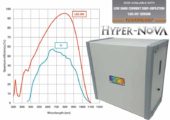
HYPER-Nova Highest Performance Raman Spectrometer
Learn More