What is broadband?
Broadband is an adjective used to describe light sources with a large wavelength range. While there is no clear cut numerical definition, hundreds of nanometers is usually called broadband. Many lamp sources, such as tungsten halogen lamps, are broadband. Lasers can...What is a spectrometer’s System Sensitivity Curve?
The system sensitivity curve shows the total efficiency of the spectrometers. The total efficiency is a combination of the grating, detector, and optics. Below is a system sensitivity curve for a VIS BLUE-Wave spectrometer model: It was generated using a halogen lamp,...What is a spectrometer’s grating efficiency curve?
A grating efficiency curve shows how efficient a grating is at diffracting light at each wavelength. Below is a grating efficiency curve for the VIS BLUE-Wave spectrometer model: Absolute efficiency (%) is plotted versus wavelength. At 500 nm, the efficiency is ~75%....What is a dual blaze spectrometer grating?
A dual blaze grating is a grating with two blaze wavelengths. The SILVER-Nova Super Range spectrometer has a composite grating with a dual blaze at 250 and 1000 nm, giving it a wavelength range of 190-1110 nm. This can be seen in the grating efficiency curve: View...What is a spectrometer’s Blaze Wavelength?
The blaze wavelength is the wavelength at which the grating is most efficient. Take a look at the grating efficiency curve for the UV BLUE-Wave spectrometer model: This grating is most efficient at 300 nm, so the blaze wavelength is 300 nm. This is determined mostly...
Introducing our new Applied Spectroscopy Division
New Handheld Raman!
New! ChemWiz-ADK Handheld NIR Spectrophotometer with on board chemometrics and spectral matching!
Read More
Check out our SpectroChemistry Systems for UV-VIS and Fluorescence Applications
Learn More
New Spectrometer Python Application Driver
for Windows, Linux, RasPi, Mac
Check it out!
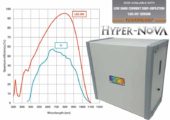
HYPER-Nova Highest Performance Raman Spectrometer
Learn More