What is a Photodiode?
A photodiode is a device that turns photons into current. When a photon strikes a photodiode, it generates an electron. The electron then gets swept away down an electronic circuit. This generates a current which can be measured.What is a Charge-Coupled Device (CCD)?
A charged-coupled device (CCD) is a type of electronic detector that is widely used for detection in the visible region. When an ultraviolet coating is added, CCDs are also useful for the UV region. The CCD is made up of an array of rectangular capacitors, called...What is a Photodiode Array (PDA)?
A photodiode array (PDA) is just many photodiodes stacked together. The individual photodiodes are called pixels or elements. PDAs are particularly useful because they can measure photons in the NIR region, which a CCD cannot. The PDAs used in StellarNet’s NIR...What is a Ultraviolet Coating (for a CCD)?
Also: Fluorophore detector coating Normal CCDs are not efficient in the UV region. However, they can be modified with an ultraviolet coating to increase the efficiency. The coating is made of a fluorescent material that converts the UV photons into lower energy...What is a Detector Efficiency Curve?
A detector efficiency curve shows how efficient a detector is at converting photons into digital signal. Below is a typical efficiency curve for StellarNet detectors: Absolute efficiency (%) is plotted versus wavelength. At ~475 nm, the efficiency is 100%. This means...
Introducing our new Applied Spectroscopy Division
New Handheld Raman!
New! ChemWiz-ADK Handheld NIR Spectrophotometer with on board chemometrics and spectral matching!
Read More
Check out our SpectroChemistry Systems for UV-VIS and Fluorescence Applications
Learn More
New Spectrometer Python Application Driver
for Windows, Linux, RasPi, Mac
Check it out!
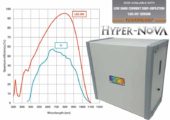
HYPER-Nova Highest Performance Raman Spectrometer
Learn More