Spectroscopy Applications
Explore how researchers, manufacturers, and quality-control laboratories use StellarNet spectrometers to solve real-world measurement challenges. Our compact UV-Vis, VIS-NIR, NIR, and Raman spectroscopy systems support applications across food safety, pharmaceuticals, advanced materials, thin films, biomedical research, environmental monitoring, industrial process analysis, radiometry, and space science.
Browse the application areas below to discover customer research, technical articles, spectroscopy methods, and practical solutions for absorbance, transmission, reflectance, fluorescence, Raman, radiometric, and chemometric analysis.
Key Application Areas
Food Safety & Quality
Advanced & quantum materials
Thin Films & Optical Coatings
Pharmaceuticals & Nutraceuticals
Biomedical & Life Sciences
Environmental & Microplastics
Industrial & Process Analysis
Lighting, Displays & Radiometry
Featured Spectroscopy Application –
Astronomy, Space & Remote Sensing
Astronomy spectroscopy gives researchers a way to study light from objects and environments far beyond the laboratory. StellarNet systems support astronomical spectroscopy for research into stars, planets, meteors, and atmospheric phenomena. Spectral measurements can reveal information that cannot be seen through imaging alone. Compact instruments also open new possibilities for space spectroscopy and CubeSat missions where size and flexibility matter. From meteor and aurora research to remote sensing and educational astronomy, StellarNet provides accessible spectroscopy tools for exploring our planet and the universe beyond it.
Astronomy, Space & Remote Sensing
Looking for something else?
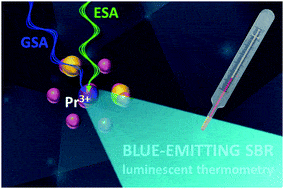
Blue-emitting single band ratiometric luminescent thermometry based on LaF3:Pr3+
Joanna Stefanska; Kamila Maciejewska; Lukasz Marciniak Abstract In accordance with the growing popularity of luminescence thermometry in the single-band-ratiometric approach configuration, we...
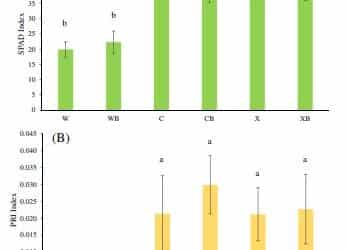
Synergistic effects of biochar and biostimulants on nutrient and toxic element uptake by pepper in contaminated soils
Rafael Antón-Herrero; Liliana Vega-Jara; Carlos García-Delgado, PhD; Begoña Mayans; Raquel Camacho-Arévalo; Eduardo Moreno-Jiménez, PhD; César Plaza, PhD; and Enrique Eymar, PhD Abstract BACKGROUND:...
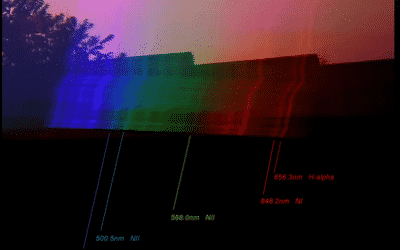
Spectroscopy of Lightning – Colors and Composition
Congratulations Tampa Bay Lightning on Back to Back Stanley Cups! Have you ever heard that lightning can’t strike twice? Tell that to our very own Tampa Bay Lightning who are now back-to-back...
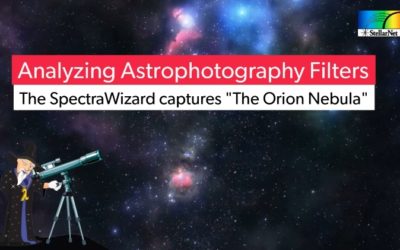
Analyzing Astrophotography Filters- The SpectraWizard captures the Orion Nebula
After analyzing the spectrum of Sirius and Betelgeuse, the SpectraWizard decided to take a shot with astrophotography. His journey takes him to the Great Orion Nebula where he creates a superimposed...
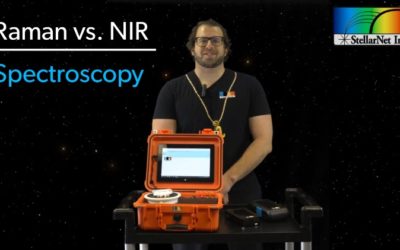
Raman vs NIR Spectroscopy
StellarNet's President, Jason Pierce, explains some of the practical differences of Raman and NIR spectroscopy, which include the inability for NIR to measure aqueous samples, the surface area of...
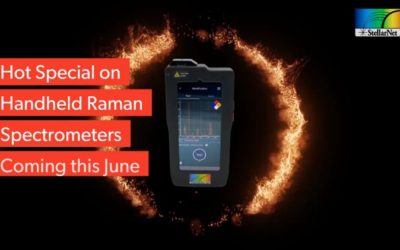
Hot Special on Handheld Raman Spectrometers
StellarNet, Inc. is offering a Hot Special of 20% off all handheld Raman Spectrometers starting in June 2021. This offer is only through our US sales office, please contact your local distributor...