Spectroscopy Applications
Explore how researchers, manufacturers, and quality-control laboratories use StellarNet spectrometers to solve real-world measurement challenges. Our compact UV-Vis, VIS-NIR, NIR, and Raman spectroscopy systems support applications across food safety, pharmaceuticals, advanced materials, thin films, biomedical research, environmental monitoring, industrial process analysis, radiometry, and space science.
Browse the application areas below to discover customer research, technical articles, spectroscopy methods, and practical solutions for absorbance, transmission, reflectance, fluorescence, Raman, radiometric, and chemometric analysis.
Key Application Areas
Food Safety & Quality
Advanced & quantum materials
Thin Films & Optical Coatings
Pharmaceuticals & Nutraceuticals
Biomedical & Life Sciences
Environmental & Microplastics
Industrial & Process Analysis
Lighting, Displays & Radiometry
Featured Spectroscopy Application –
Astronomy, Space & Remote Sensing
Astronomy spectroscopy gives researchers a way to study light from objects and environments far beyond the laboratory. StellarNet systems support astronomical spectroscopy for research into stars, planets, meteors, and atmospheric phenomena. Spectral measurements can reveal information that cannot be seen through imaging alone. Compact instruments also open new possibilities for space spectroscopy and CubeSat missions where size and flexibility matter. From meteor and aurora research to remote sensing and educational astronomy, StellarNet provides accessible spectroscopy tools for exploring our planet and the universe beyond it.
Astronomy, Space & Remote Sensing
Looking for something else?
Study of the photopolymerization process of luminescent labeled photocurable compositions in liquid and gas media
Malgorzata Noworyta, Maciej Pilch, Dawid Kiesiewicz, Renata Klaput, and Joanna Ortyl | Chemical and Process Engineering New Frontiers | July 21, 2026 | 10.24425/cpe.2026.158129 Abstract Although...
Root zone improvements in spinach through commercial biostimulants application vary among cultivars
Md Noor E Azam Khan, Fahmida Fiza, Joseph G. Masabni, and Genhua Niu | Frontiers in Plant Science | July 13, 2026 | 10.3389/fpls.2026.1830913 Abstract Improvements in root-zone conditions can...
Multiscale Multispectral Hyperspectral Data for Estimating Coffee Yield Using Machine Learning Algorithms
George Deroco Martins, Lucas Henrique Vicentini Viana de Carvalho, Filipe Vieira da Silva, Rayssa Santos Barbosa, and Maria Cecilia Lemes Santos | ISPRS Annals of the Photogrammetry Remote Sensing...
Conversion of RGB Camera into Hyperspectral Imager Using a Liquid Crystal Spectral Modulator and Artificial Intelligence
Doron Pasha, Isaac Y. August, and Ibrahim S. Abdulhalim | ACS Photonics | July 7, 2026 | 10.1021/acsphotonics.6c00774 Abstract Hyperspectral imaging extracts spectral information for quantitative...
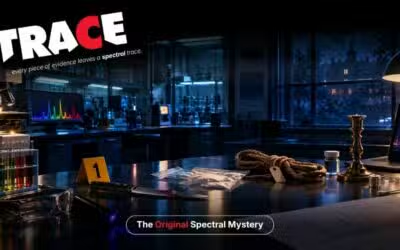
TRACE: A StellarNet Halloween Spectroscopy Mystery
It was a frightful afternoon at StellarNet, and the team decided to play a new board game: TRACE. TRACE is a spectroscopy-inspired whodunit game filled with suspicious substances, questionable...
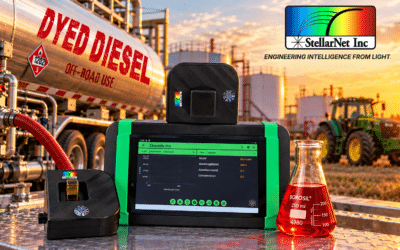
Red Dyed Diesel: How Portable Spectroscopy Measures Fuel Dye Concentration
Red dyed diesel—also known as red diesel, off-road diesel, dyed diesel, or farm diesel—has suddenly become a national topic. On October 5, 2026, President Donald Trump signed an executive order...