What is Spectrometer Noise?
Noise is a collective term for sources of unwanted signal. Some noise sources introduce systematic error, and can be corrected for, such as with a dark spectrum. Other noise sources introduce random error, and can be averaged out over several acquisitions. The...What is Quantum Efficiency?
Spectrometer Quantum efficiency describes how many photons that hit a detector actually generate electrons. It is usually expressed as a percentage of photons. It is also wavelength dependent. StellarNet provides detector efficiency curves that display this...What is Dark Spectrum (in SpectraWiz)?
For clarity, “Dark” will be used to indicate a SpectraWiz dark spectrum and “dark spectrum” will refer to the concept. When you acquire a Dark, the SpectraWiz software saves the spectrum and subtracts it from all subsequent spectra that are acquired. Because of this...What is Dark Spectrum (concept)?
The dark spectrum of a spectrometer is a spectrum taken with no light hitting the detector. It captures the shape of the baseline offset. It can be used to adjust sample spectra for non-uniformities in the detector pixels. The SpectraWiz software is able to do this...What is Spectrometer Dark Current?
Sometimes thermal fluctuations have enough energy to generate electrons in the same way that photons do. These electrons are not part of the signal, but there is no way to distinguish them from the signal in the detector, so they become a source of noise. The dark...
Introducing our new Applied Spectroscopy Division
New Handheld Raman!
New! ChemWiz-ADK Handheld NIR Spectrophotometer with on board chemometrics and spectral matching!
Read More
Check out our SpectroChemistry Systems for UV-VIS and Fluorescence Applications
Learn More
New Spectrometer Python Application Driver
for Windows, Linux, RasPi, Mac
Check it out!
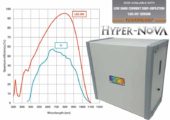
HYPER-Nova Highest Performance Raman Spectrometer
Learn More