
Spectroscopy Applications
Explore how researchers, manufacturers, and quality-control laboratories use StellarNet spectrometers to solve real-world measurement challenges. Our compact UV-Vis, VIS-NIR, NIR, and Raman spectroscopy systems support applications across food safety, pharmaceuticals, advanced materials, thin films, biomedical research, environmental monitoring, industrial process analysis, radiometry, and space science.
Browse the application areas below to discover customer research, technical articles, spectroscopy methods, and practical solutions for absorbance, transmission, reflectance, fluorescence, Raman, radiometric, and chemometric analysis.
Key Application Areas
Food Safety & Quality
Advanced & quantum materials
Thin Films & Optical Coatings
Pharmaceuticals & Nutraceuticals
Biomedical & Life Sciences
Environmental & Microplastics
Industrial & Process Analysis
Lighting, Displays & Radiometry
Featured Spectroscopy Application –
Astronomy, Space & Remote Sensing
Astronomy spectroscopy gives researchers a way to study light from objects and environments far beyond the laboratory. StellarNet systems support astronomical spectroscopy for research into stars, planets, meteors, and atmospheric phenomena. Spectral measurements can reveal information that cannot be seen through imaging alone. Compact instruments also open new possibilities for space spectroscopy and CubeSat missions where size and flexibility matter. From meteor and aurora research to remote sensing and educational astronomy, StellarNet provides accessible spectroscopy tools for exploring our planet and the universe beyond it.
Astronomy, Space & Remote Sensing
Looking for something else?
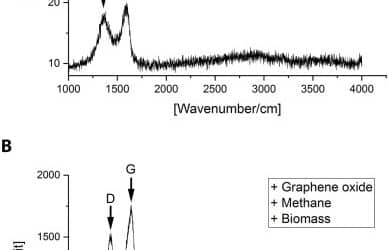
Current production by non-methanotrophic bacteria enriched from an anaerobic methane-oxidizing microbial community
S.Berger; D.R.Shaw; T.Berben; H.T.Ouboter; M.H.in ’t Zandt; J.Frank; J.Reimann; M.S.M.Jetten; C.U.Welte Abstract In recent years, the externalization of electrons as part of respiratory metabolic...
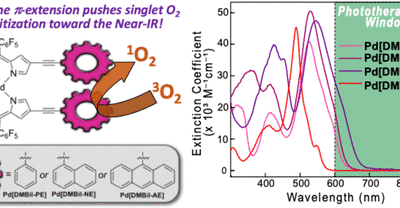
Synthesis, Spectroscopic, and 1O2 Sensitization Characteristics of Extended Pd(II) 10,10-Dimethylbiladiene Complexes Bearing Alkynyl–Aryl Appendages
Anthony T. Rice; Maxwell I. Martin; Molly C. Warndorf; Glenn P. A. Yap; and Joel Rosenthal Abstract Photodynamic therapy (PDT), which involves the photoinduced sensitization of singlet oxygen, is an...
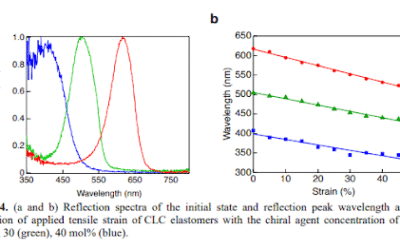
Mechano-Optical Sensors Fabricated with Multilayered Liquid Crystal Elastomers Exhibiting Tunable Deformation Recovery
Kyohei Hisano, Seiya Kimura, Kyosun Ku, Tomoki Shigeyama, Norihisa Akamatsu, Atsushi Shishido, Osamu Tsutsumi Abstract Advances in tuning the mechanoresponsive behavior of liquid crystal elastomers...
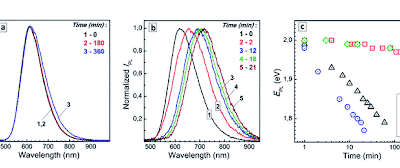
Spontaneous alloying of ultrasmall non-stoichiometric Ag–In–S and Cu–In–S quantum dots in aqueous colloidal solutions
Oleksandr Stroyuk; Oleksandra Raievska; Dmytro Solonenko; Christian Kupfer; , Andres Osvet; Miroslaw Batentschuk; Christoph J. Brabec; and Dietrich R. T. Zahn Abstract The effect of spontaneous...
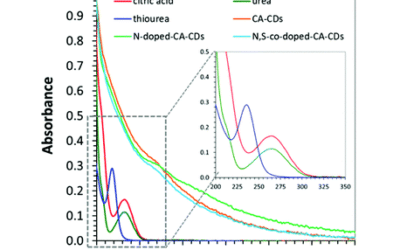
New horizons for carbon dots: quantum nano-photoinitiating catalysts for cationic photopolymerization and three-dimensional (3D) printing under visible light
Wiktoria Tomal; Tomasz Świergosz ;, Maciej Pilch ; Wiktor Kasprzyk ; and Joanna Ortyl Abstract Herein, the application of various citric acid-based carbon dots (CDs) as efficient photosensitizers...
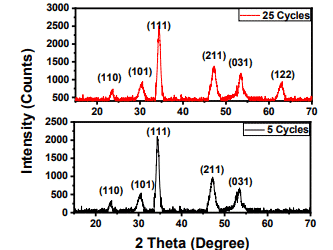
Effect of SILAR Cycles on the Thickness, Structural, Optical Properties of Cobalt Selenide Thin Films
Egwunyenga, N.J.; Onuabuchi, V.C.;, Okoli, N.L.; and Nwankwo, I.E. Abstract Cobalt Selenide thin films were fabricated using Successive Ionic Layer Adsorption and Reaction (SILAR) deposition...