SPECTRAL DIFFERENTIATION BETWEEN COPPER AND IRON COLORANTS IN GEM TOURMALINES
Paul B. Merkel and Christopher M. Breeding
The authors used Vis-NIR spectral measurements combined with LA-ICP-MS data to investigate the usefulness of absorption spectra for differentiating between copper and iron as sources of greenish blue coloration in gem tourmaline. While both Cu2+ and Fe2+ produce absorption bands with maxima near 700 nm, Cu2+ also has a strong band with a maximum near 900–925 nm, where absorption due to Fe2+ is typically at a minimum. In addition, Vis-NIR spectroscopy successfully identified Cu in pink/purple and violet stones that could be candidates for heat treatment. For the blue, green, and violet Cu-bearing tourmalines of pale-to-moderate color intensity in this study, weight percent of CuO could be estimated from the absorbance at 900 nm. This relatively inexpensive identification method may prove to be a valuable screening tool for Cubearing tourmaline.
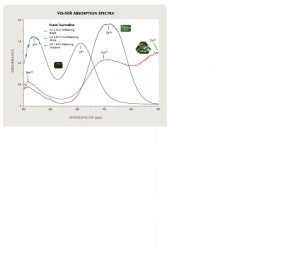
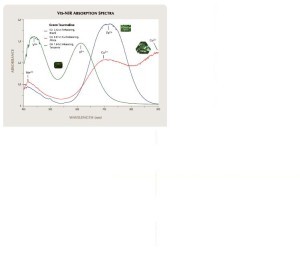
These Vis-NIR absorption spectra (collected with the EPP2000 spectrometer- now called the BLACK-Comet) are from green tourmalines colored primarily by Cu2+ (G3), Fe2+ (G2, G3), or V3+ (G8).
Benchtop vs. StellarNet miniature spectrometers-
For each sample, we determined specific gravity hydrostatically and measured refractive indices using a standard gemological refractometer. Vis-NIR spectra were collected with two different spectrometers. We analyzed most of the larger samples using a Perkin-Elmer Lambda 950 spectrometer equipped with a 150 mm integrating reflectance sphere, in the range 350–1150 nm. The gem was held (~5° from normal) in the jaws of center-mount sampling module PELA-9038, and the beam was directed through the table and reflected back off the pavilion facets. Smaller samples (