
Development of a doped titania immobilised thin film multi tubular photoreactor- October 2012
M Adams, N Skillen, C McCullagh, PKJ Robertson – Applied Catalysis B: Environmental , 2012.
This paper describes a novel doped titania immobilised thin film multi tubular photoreactor which has been developed for use with liquid, vapour or gas phase media. In designing photocatalytic reactors measuring active surface area of photocatalyst within the unit is one of the critical design parameters. This dictate greatly limits the applicability of any semi-conductor photocatalyst in industrial applications, as a large surface area equates to a powder catalyst. This demonstration of a thin film coating, doped with a rare earth element, a novel photoreactor design produces a photocatalytic degradation of a model pollutant (Methyl Orange) which displayed a comparable degradation achieved with P25 TiO2. The use of lanthanide doping is reported here in the titania sol gel as it is thought to increase the electron hole separation therefore widening the potential useful wavelengths within the electromagnetic spectrum. Increasing doping from 0.5% to 1.0% increased photocatalytic degradation by ∼17% under visible irradiation. A linear relationship has been seen between increasing reactor volume and degradation which would not normally be observed in a typical suspended reactor system… Absorbance readings were normalised to 1. 2.4.1. Illumination Sources. The two different illumination lamps used were spectrally analysed using a Stellarnet EPP2000 Spectrometer to determine their exact emissions.
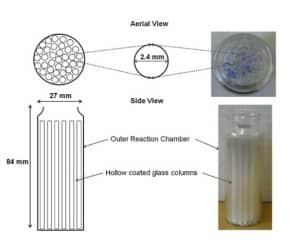
Figure 1. Arrangement of Multi Tubular Photoreactor.
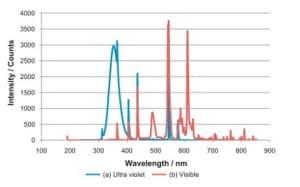
Figure 3. Emission spectrum for UV and Visible Lamps.
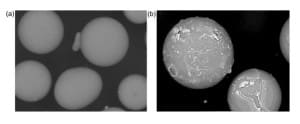
Figure 4. (a) Uncoated silica particles and (b) titania coated silica particles.