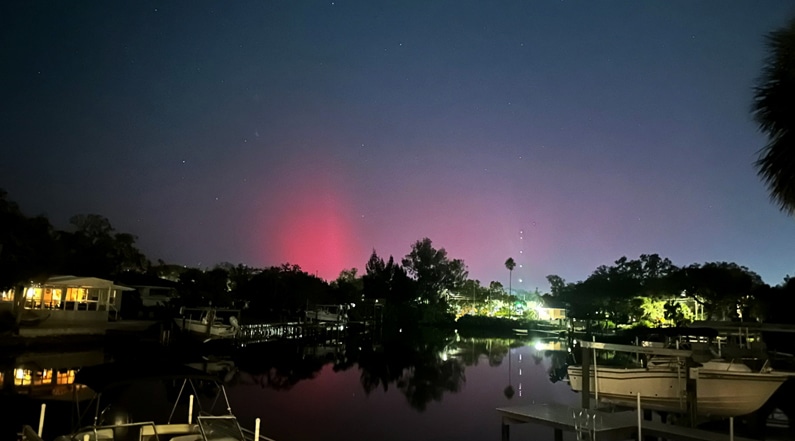
Recent solar storms have transformed skies across the country, pushing dazzling auroras far beyond their usual reach—even into Florida. On November 11th, long-exposure photography captured vibrant northern lights over the Tampa Bay area, a rare sight this far south.
These displays were fueled by powerful solar flares and coronal mass ejections that sent waves of charged particles crashing into Earth’s magnetic field, triggering a level G5 geomagnetic storm—the strongest since the legendary Halloween storms of 2003. As a result, regions that almost never experience auroral activity were treated to an extraordinary glimpse of the northern and southern lights, turning science into a spectacular sky-show.
The Aurora Borealis: How it Works
Solar Wind: The Sun constantly emits a stream of charged particles called the solar wind. Occasionally, the Sun experiences solar flares and coronal mass ejections (CMEs). This releases even larger amounts of charged particles into space.
Earth’s Magnetic Field: Earth has a magnetic field that extends into space, surrounding the planet. This magnetic field deflects most of the solar wind, directing it around the Earth.
Magnetosphere: Earth’s magnetic field creates a protective bubble around the planet called the magnetosphere. When the solar wind interacts with the magnetosphere, it compresses the side facing the Sun and stretches the side facing away, creating a long tail on the night side.
Entry into the Atmosphere: Some of the particles from the solar wind funnel towards the Earth’s poles by the magnetic field lines. As they approach the Earth’s atmosphere near the poles, they collide with gas molecules, mostly oxygen and nitrogen.
Excitation of Atoms: When these particles collide with gas molecules in the atmosphere, they transfer their energy to the atoms and molecules, exciting them to higher energy states.
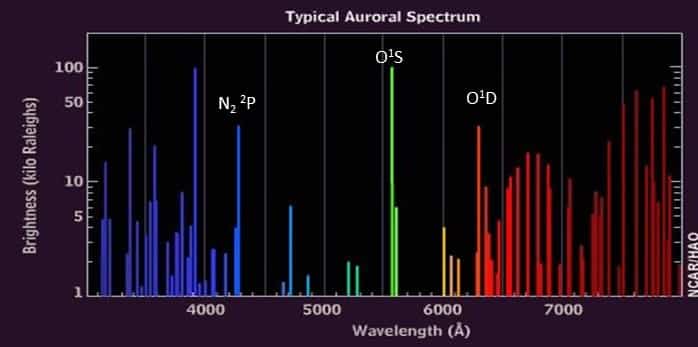
Light Emission: As the atoms and molecules return to their normal energy states, they release the excess energy in the form of light. As seen below, different gases in the atmosphere emit light at different wavelengths, resulting in the characteristic colors of the aurora.
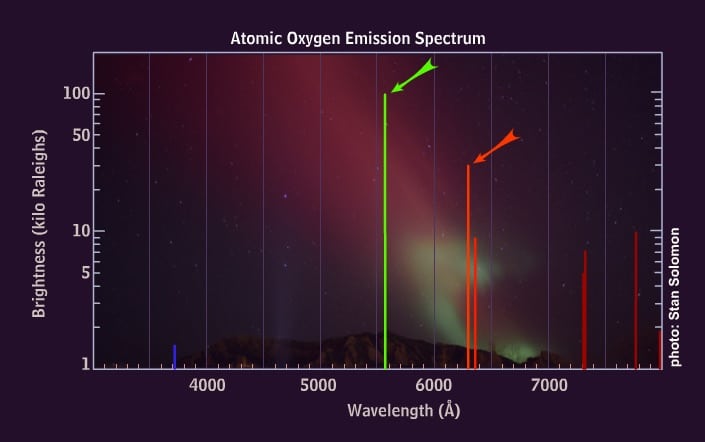
Oxygen
Emits a green or sometimes a rare red light when it’s about 60 miles above the Earth.
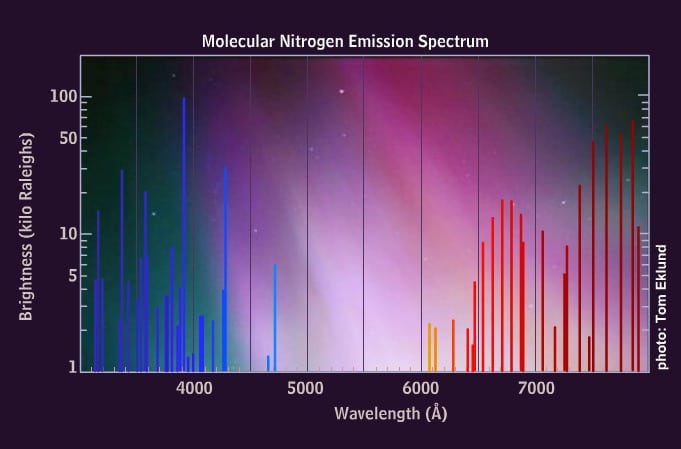
Nitrogen
Produces blue or purplish-red light.
Auroral Oval: The aurora borealis is typically seen in an oval shape around the magnetic poles. This is because the charged particles are guided by Earth’s magnetic field lines towards the poles, where they interact with the atmosphere and produce the light display.
Other Astro-Spectroscopy Articles
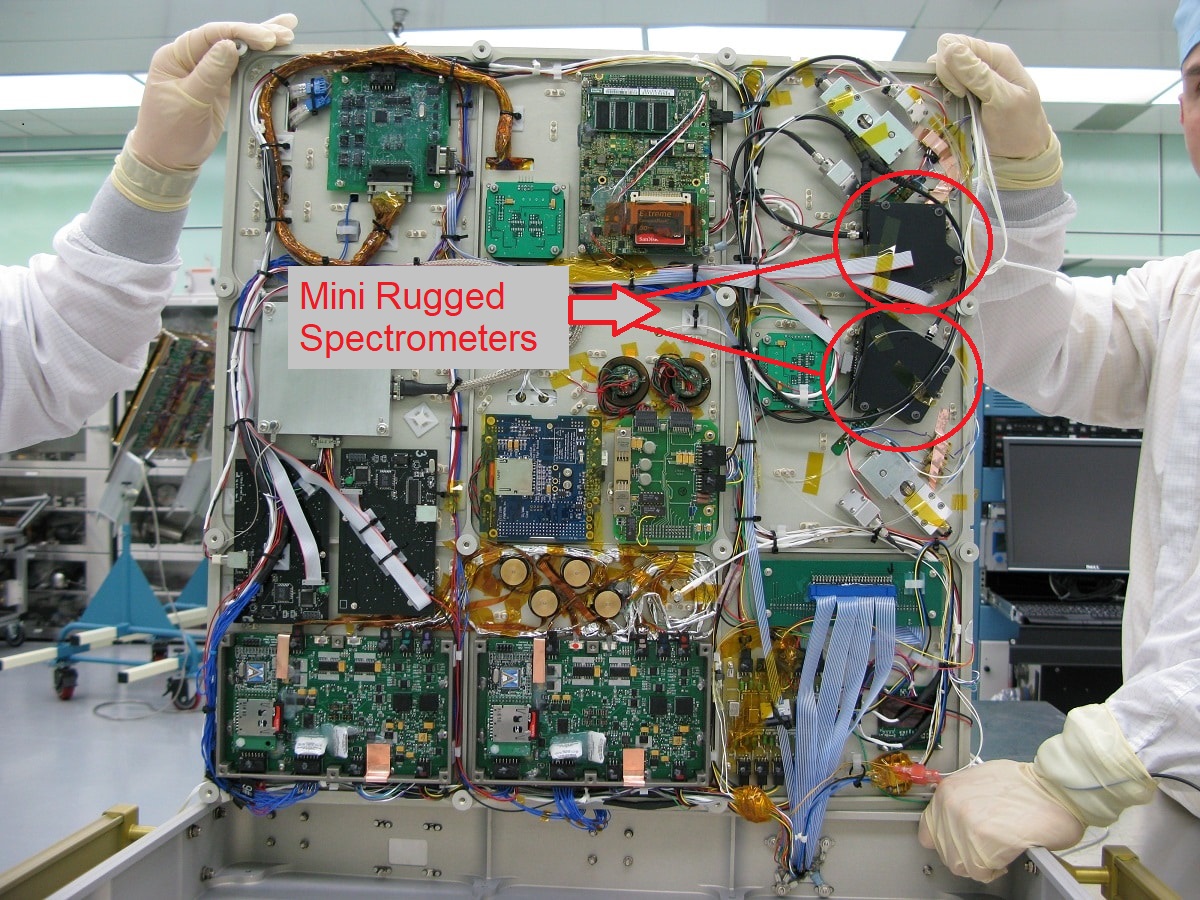
Flashback Friday- Spectrometers in Space! Rugged, Reliable, StellarNet!
Our BLUE-Wave spectrometers were launched into space and mounted on the ISS as part of the MISSE-7 experiment, designed to take real-time spectra to provide insight on how the environment of space affects different optical properties of materials…
The SpectraWizard Goes Stellar- AstroSpectroscopy Basics
Spectroscopy is one of the most valuable tools that an astronomer has for studying the Universe. Spectrometers help us determine the chemical compositions, physical properties, and velocities of astronomical bodies light-years away…
National Space Day Spectroscopy with StellarNet
At StellarNet, we celebrate space day everyday. Our products are space-themed with names such as “BLACK-Comet”, “Quasar”, “DWARF-Star”, and more! Space travel is no stranger to our spectrometers. They’ve even been able to do scientific research on NASA’s International Space Station…