Season’s Greetings from the SpectraWizard and the StellarNet Team!
It’s that magical time of year when lights twinkle, lasers glow, and displays shimmer in every spectral color—and we couldn’t resist diving into the science behind the sparkle.
Whether you’re analyzing the spectral fingerprint of a holiday LED or exploring the radiant output of lasers and displays, StellarNet’s compact, high-performance spectrometers deliver the precision and reliability your measurements deserve.
From VIS to NIR, our instruments capture every wavelength of holiday brilliance—bringing lab-grade spectral power to researchers, engineers, and curious light lovers everywhere.
Let’s unwrap the science of the season, one spectrum at a time. 🎄✨🌈
1. Assessing the color of white holiday lights
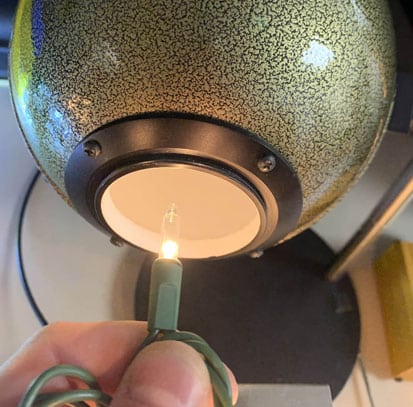
Here at StellarNet we decided to go holiday light shopping and bought a variety of white holiday lights to test using our spectrometers. We purchased traditional incandescent filament bulbs, and two different LED versions, warm and cool white. Below are the results showing the similarities and differences of the light emission from these different lighting technologies.
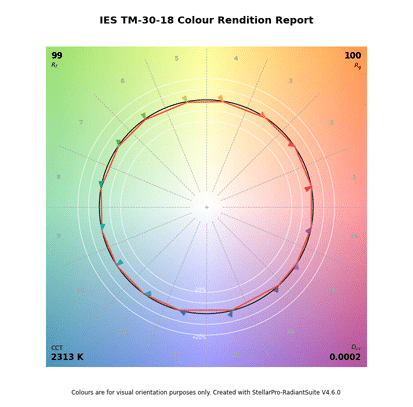
Traditional Incandescent Lights
Twenty years ago, there wasn’t much choice in light technology for the holidays. Filament lights dominated, with their soft white glow, and were pretty uniform in color due to the standardization of the filament chemistry. Wanted a color instead of white? Just put a colored film over the bulb and voila! Color! Incandescent bulbs are still available today and inexpensive to buy. However, these lights are energy hogs, easily trip electrical breakers, and are essentially designed to self-destruct. Running an electrical current through a filament eventually degrades the filament to the point of destruction.
Click here to download the full report generated from RadiantSuite.
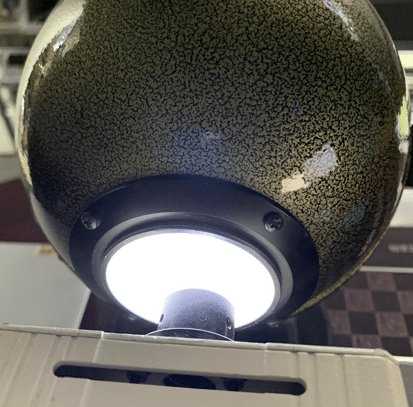
Using our LED Measurement System with a BLUE-Wave spectrometer and IS6 integrating sphere, we are easily able to measure the spectral distribution. StellarNet offers many software platforms that can be used for radiometric measurements including StellarPro and our new RadiantSuite advanced radiometer software.
Cool White LEDs
LED technology has been around for a number of decades, but it’s only been in the past 10 years that it has become the major player in holiday lighting. LEDs are a radical departure from Edison’s incandescent light. They produce more lumens per watt of input power than incandescent bulbs— they’re more efficient at producing light. LEDs are a completely different technology – they rely on the band-gap of semiconductor compounds to emit a single wavelength of light. Making “white” light is not a simple task. One approach is to mix the light from several colored LEDs to create a spectral power distribution that appears white.
Another technique to make white LEDs, used here in our holiday lights, is to use a phosphor together with a short-wavelength blue LED. When the phosphor is illuminated by blue light, it emits yellow light having a fairly broad spectral power distribution. The remaining blue light, when mixed with the yellow light, results in white light. Check out the spectral profile of the cool white LED below to see the blue LED with phosphor coating. New phosphors are constantly being developed to improve their color rendering.
Click here to download the full report generated from RadiantSuite.
Warm White LEDs
Designing LEDs to produce the consumer’s desired effects seems like a fairly difficult task. Using a StellarNet spectroradiometer designed for LED test and measurement you can easily adjust parameters of your LED arrays or development materials and test the emission. In this test we can see the “warm” white is designed to be as similar to incandescent as possible measuring xy chroma = 0.48, 0.42, CCT= ~2541.96, but only a CRI of 62.03.
Click here to download the full report generated from RadiantSuite.
2. Laser projection holiday light systems

Who needs string lights when laser projection systems can create striking holiday displays in minutes? To better understand their performance, we evaluated two consumer laser projectors and measured their optical output.
The first unit was a higher-power projector with three color-mixing lasers. Although the packaging listed each laser at <5 mW, measurements using StellarNet’s Laser Measurement System—calibrated for total power in milliwatts with a diffuser—revealed a significantly higher combined output.
For comparison, we also measured Raman spectroscopy lasers, which typically operate around 500 mW at 785 nm (red). While individual beams in the projector may meet <5 mW ratings, the total emitted power was much higher. These findings highlight the importance of laser safety; users should never look directly into high-power laser projectors.
The second projector was a lower-cost system using two lasers and an LED. It employed a rotating mask to project animated holiday patterns such as snowflakes and snowmen, offering a simpler alternative design.
3. Display Lighting, the Times Square way
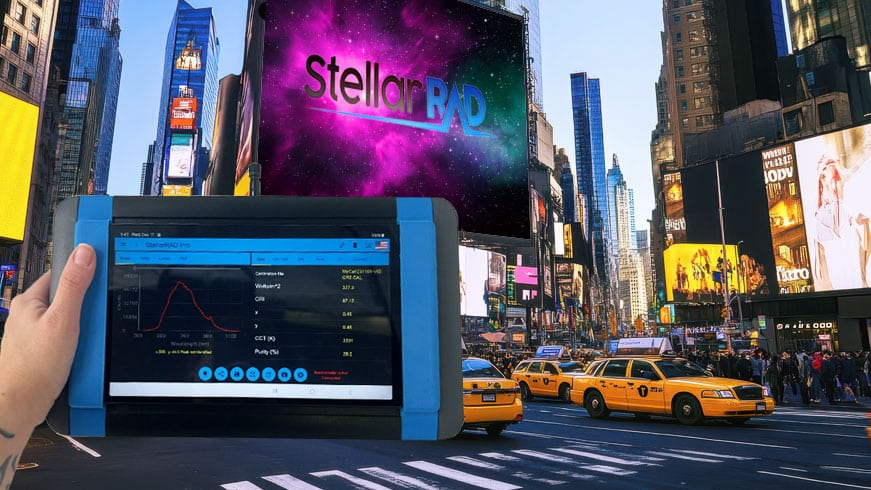
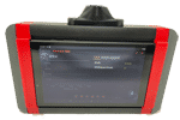
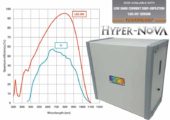
High-brightness LED display lighting—such as outdoor video walls and digital signage—requires accurate spectroradiometer measurements to ensure color accuracy, luminance, and spectral uniformity. StellarNet’s Display Measurement Systems use high-sensitivity UV-VIS spectrometers, including the BLACK-Comet and SILVER-Nova, to measure visible spectral power distribution, chromaticity, radiance, and luminance directly from displays. For low illumination detection for backlit displays or NVIS applications, the HYPER-Nova uses deep detector cooling for reduced noise and reliable, repeatable results supported by NIST-traceable calibrations.
These display solutions integrate compact fiber-optic spectrometers with precision optics and real-time StellarPro software for spectral visualization, CIE chromaticity mapping, and reporting. Take your radiometric measurements even further with RadiantSuite featuring TM-30 support. Unlike colorimeters, StellarNet spectroradiometers capture complete visible spectral data for accurate color and performance analysis. Flexible system configurations support both laboratory and high-brightness outdoor LED display measurements, with modular designs that scale as display technologies evolve.