
Marine organisms exhibit a multitude of biological rhythms synchronized with the interactions of the sun-, earth-, and moon cycles. However, the biological rhythms in bivalves remain poorly studied. This study focuses on the native European flat oyster (Ostrea edulis), an endangered species of coastal ecosystems and a key organism in restoring of biogenic reef habitats. We aim to determine whether a molecular endogenous circadian rhythm exists in O. edulis and to characterize its daily expression. To address these questions, the oysters’ valve behavior, as an output of the circadian clock expression, was recorded under different light conditions and free-running regimes using non-invasive valvometry. This work demonstrates the existence of a circadian clock mechanism that generates a labile behavioral circadian oscillation under free-running conditions. In light: dark conditions, a diel rhythm appears nocturnal, synchronizable to a shift of light phase, and remains unmodified whether the oysters are fed or not. This rhythm anticipates light: dark changes, indicating its endogenous origin. Finally, when exposed to artificial light at night the daily behavior is disrupted. This study characterizes the circadian behavioral rhythm of O. edulis’s as plastic and labile. This plasticity would be advantageous in terms of ecological adaptability but increases sensitivity to anthropogenic pressures such as light pollution.
The native European oyster Ostrea edulis (Linnaeus 1758) is a filter feeder formerly abundant in Europe from the North Sea, along the Atlantic coast and other European coastal waters including the Mediterranean and the Black Sea1. O. edulis is a biogenic reef builder that plays a key ecological role and provides many ecosystem services (e.g. substrate formation and biodiversity enhancement)2. Over the 20th century, stocks of O. edulis have been severely depleted by overfishing and additional anthropogenic stressors, such as invasive diseases and is now one of the most threatened marine habitats in Europe3,4. However, in recent years, conservation and active restoration of European oyster habitats across its former distribution range have become a major focus of ecological restoration efforts5,6 to take advantage of the wide-ranging ecosystem functions and services this species and it reef habitats provide2. Despite these recent efforts, knowledge of the general physiology of O. edulis has primarily centered on reproductive aspects. Notably, chronobiological studies of their behavioral and physiological traits are still lacking, which is crucial for understanding their ability to adapt to and fit within their cyclic and fluctuating environment.
Experimental Setup
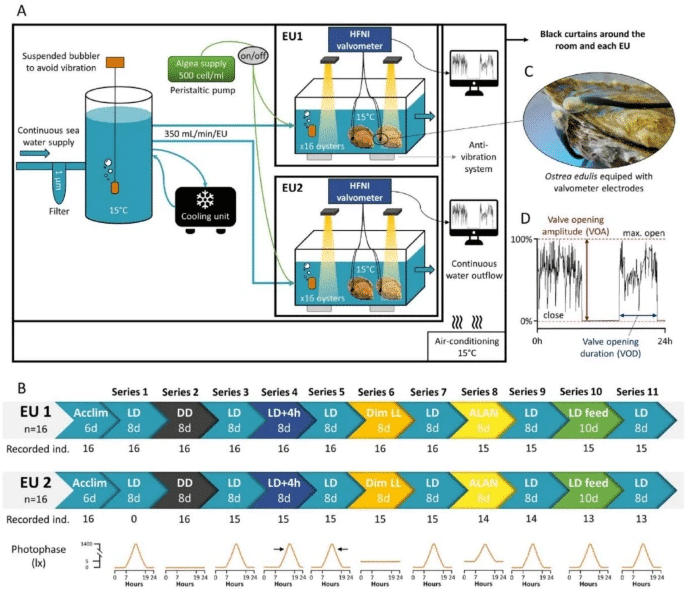
Throughout the entire experiment, the oysters were isolated from external vibrations using an antivibration system and an isolated blind room to minimize any external influences on their valve behavior (Fig. 1A). Experiments were performed in two distinct experimental units (EU1 and EU2) (L × W × H:74.8 × 54.8 × 40.8 cm), containing approximately (~) 150 L of seawater, which was continuously supplied with filtered (< 1 μm) and oxygenated seawater at a flow rate of 350, maintaining a constant composition of 15 ± 0.1 °C, pH = 7.9 ± 0.1, salinity = 33.1 ± 0.1‰, mean ± SE. A 180 L retention tank was situated between the seawater supply and the two EUs to homogenize the seawater and prevent potential environmental cycle cues. The experimental setup and each EUs were surrounded by opaque black curtains to shield the experiment from external light contamination (Fig. 1A).
Experimental setup and protocol. (A) Experimental setup to investigate the circadian rhythm of O. edulis. (B) Experimental protocol. Timeline of the 11 series to which the oysters of both EUs are exposed successively. (C) Zoom of O. edulis equipped with HFNI valvometry electrodes for valve behavior recording. (D) Example of a daily individual valve activity showing the two behavioral parameters chosen in this experiment, i.e. the valve opening amplitude (VOA) and the valve opening duration (VOD). EU: experimental unit. HFNI: high frequency non-invasive.
Illuminances were measured underwater at the oysters’ depth in lux (lx) in each EU using a handheld spectroradiometer (Blue-Wave UVN-100, StellarNet Inc.).