2026 Spectroscopy Application Challenge Winner: Watching the Next Generation of Solar Cells Form in Real Time
University of Osaka & Kyoto University | Lead-Free Perovskite Solar Cells
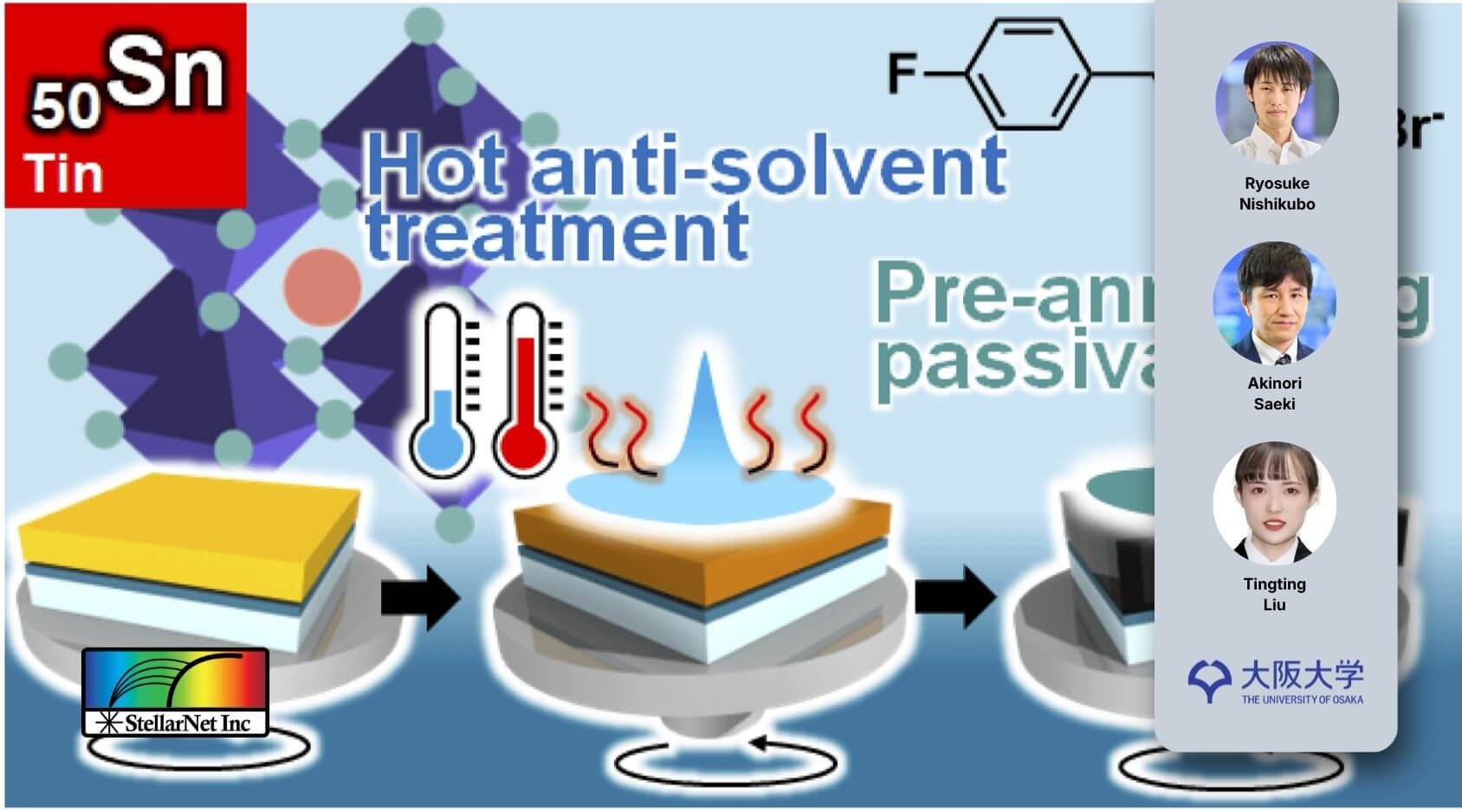
Temperature-controlled anti-solvent engineering enables the fabrication of reproducible and stable tin-based perovskite solar cells by decoupling the kinetic fragility
What if you could watch a solar cell form—and learn how to make it better while it is happening? That idea helped researchers from The University of Osaka and Kyoto University earn First Place in StellarNet’s 6th Annual Spectroscopy Application Challenge for their work developing more reproducible and stable lead-free tin-perovskite solar cells.
Seeing What Happens While It Happens
Here’s the part we especially loved. Rather than only measuring the solar cell after it was finished, the researchers used in-situ UV-Vis absorption and photoluminescence spectroscopy to watch the perovskite film develop during fabrication. A StellarNet BLACK-Comet spectrometer monitored UV-Vis absorption, while a SILVER-Nova spectrometer measured photoluminescence inside a nitrogen-filled glovebox. Together, those measurements helped reveal how processing conditions influenced crystallization and the electronic quality of the developing film. A measurement after fabrication tells you what you made; in-situ spectroscopy can help reveal how you made it.
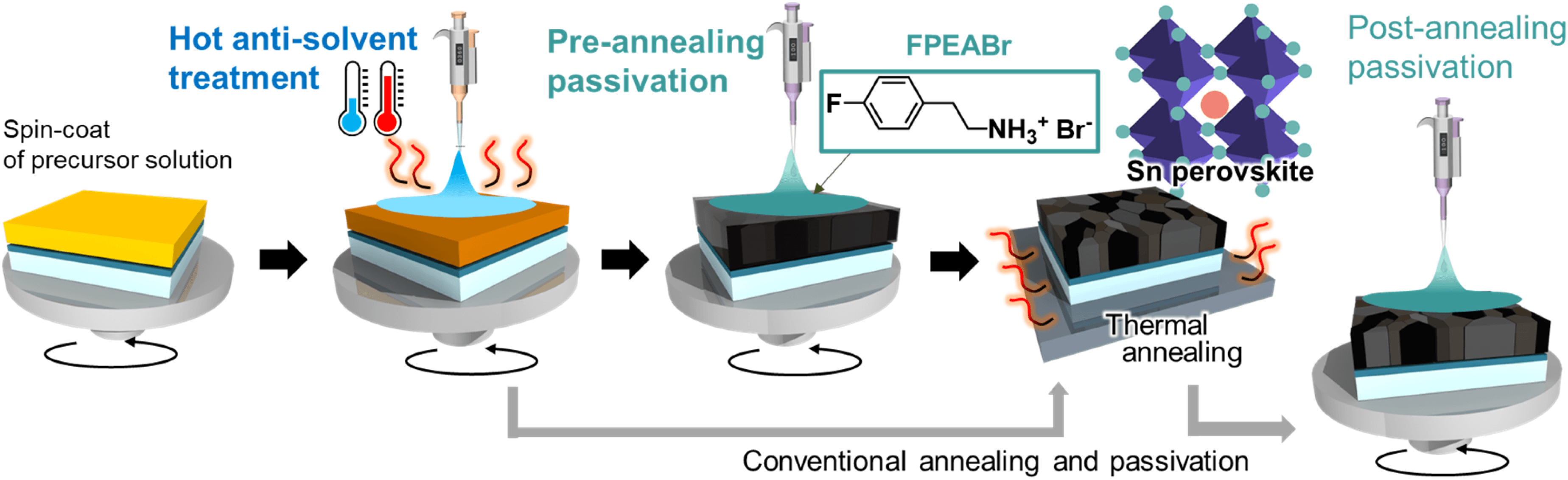
Figure 1: Schematic of hot anti-solvent treatment and pre-annealing passivation to decouple the kinetic fragility and transfer to temperature-controlled nucleation and growth (the black arrows). The process represented by the grey arrows is conventional post-annealing passivation.
Why They Won
This research captures exactly what the Spectroscopy Application Challenge is about: using light not simply to measure something, but to uncover information that helps solve a meaningful scientific and engineering problem. The team connected processing conditions, real-time optical changes, material quality and solar-cell performance while tackling one of the important challenges facing lead-free perovskite photovoltaics: making the fabrication process more controllable and reproducible.
Published Research
Journal of Materials Chemistry A, 2026
Thank you to everyone who applied to the SpectraWizard’s Spectroscopy Application Challenge this year!
Be sure to Like us on Linkedin to get all of our fun and informational spectroscopy updates!