Reducing Fiber Coupling Variability with SMA-Lock Upgrade on StellarNet Miniature Spectrometers
Miniature fiber optic spectrometers are widely used in applications where repeatable optical alignment is essential. Standard SMA-905 fiber connectors, however, can exhibit slight variations in rotation, axial position, or seating depth during repeated connection cycles. These small inconsistencies can significantly impact throughput efficiency and spectral intensity stability.
StellarNet has introduced the SMA-Lock upgrade – developed to improve repeatability by mechanically stabilizing the fiber optic interface during repeated and long-term operation. This improvement is especially valuable in radiometrically calibrated systems, process monitoring, and in-line inspection.
Why Does Fiber Optic Coupling Repeatability Matter?
StellarNet spectrometers are already known to be rugged with no moving optical parts, shock-resistant construction, and stable optical alignment – why is the SMA-Lock needed?
In fiber optic spectrometer systems, consistent optical geometry is essential. Repeated connection cycles can introduce inconsistencies between measurements or between technicians. These variations can become significant if your application requires precision.
Small deviations in fiber optic position can introduce:
- Intensity Fluctuations
- Variable Signal-to-Noise Ratio
- Calibration Instability
- and Increased Measurement Uncertainty
SMA-Lock
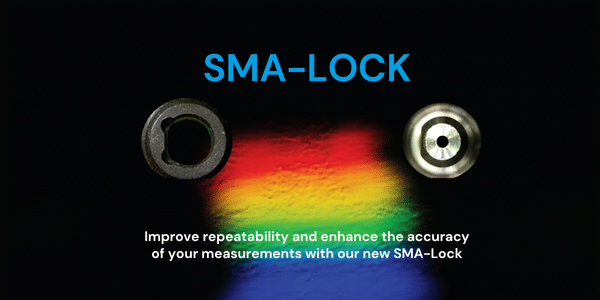
StellarNet’s SMA-Lock features a secure fiber connection in a fixed and repeatable position, minimizing the variability caused by connector movement, repeated reconnection cycles, or operator variability.
The SMA-Lock features controlled connector seating with reduced rotational play. The fiber can only be inserted into the spectrometer in a single position, removing operator variability. The SMA-Lock is paired with a keyed SMA fiber.
StellarNet took two identical systems – one featuring the SMA-Lock and one with a standard SMA-905 connector.
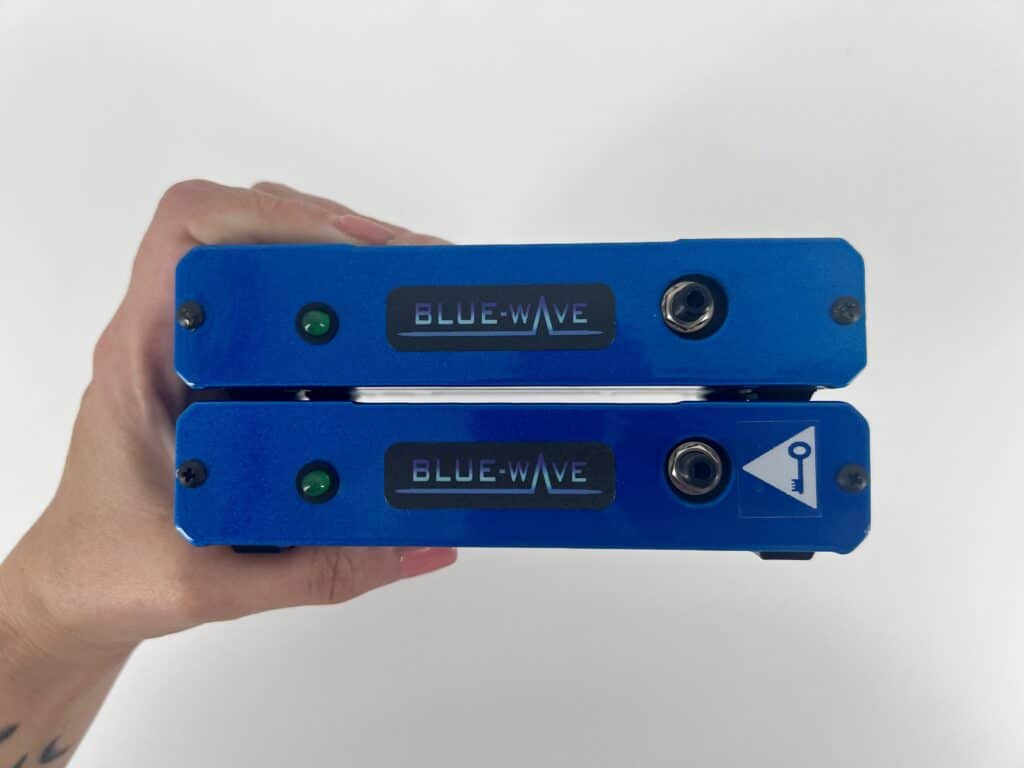
To test the SMA-Lock, we had two technicians each insert the fiber optic cable into the spectrometer’s entrance port 15 times and recorded the data in scope and calibrated radiometer modes.
Configuration A uses the standard SMA connector.
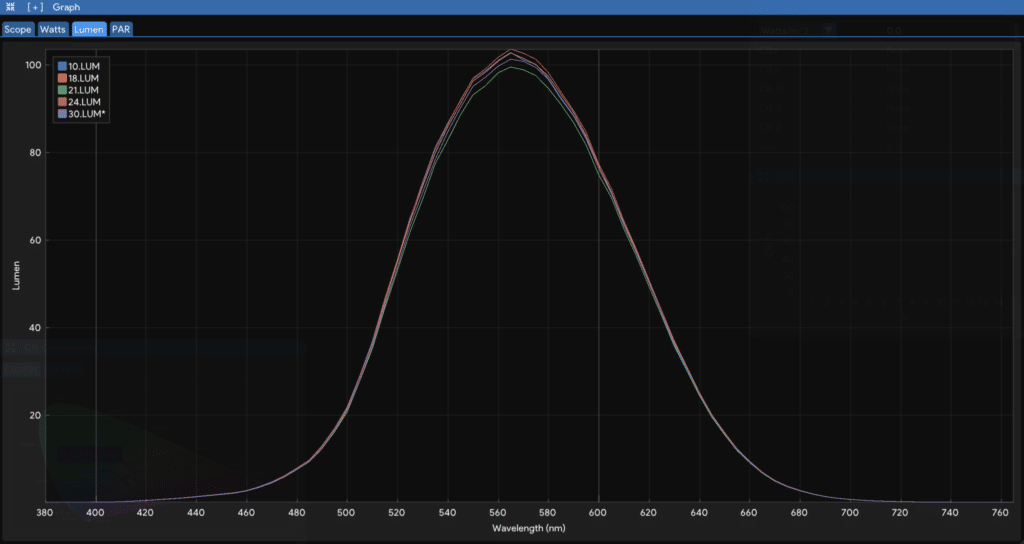
Overlay of five measurements from Configuration A (standard SMA)
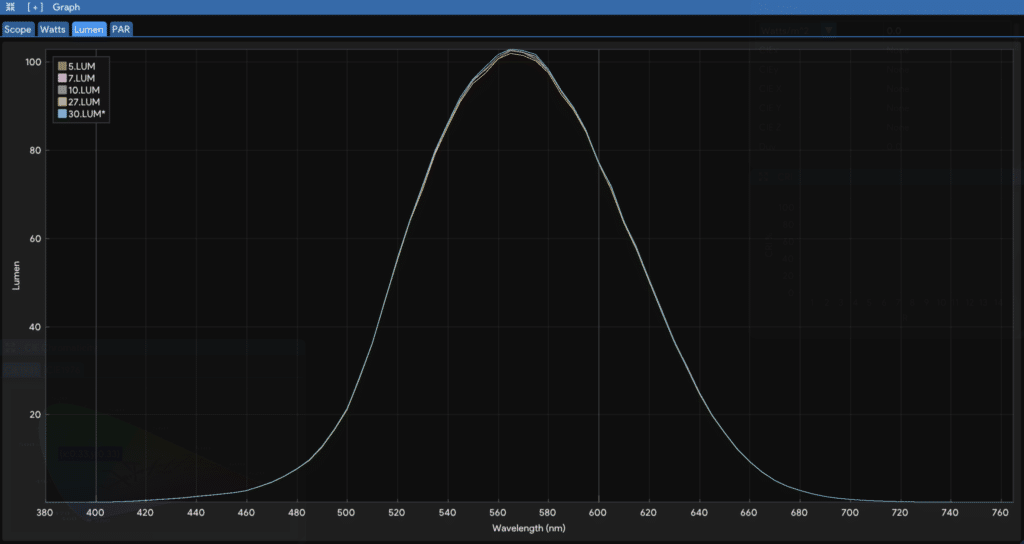
Overlay of five measurements from Configuration B (SMA-Lock)
Impact on Measurements
The SMA-Lock design has a Coefficient of Variability(CV) reduction of 76% – with the CV of the SMA-Lock configuration achieving 0.43%, below the 1% threshold typically required for industrial-grade calibrations in spectroscopy. These values are integrated over the visible (380-780nm range).
The standard deviation for the standard SMA connector was recorded at 199.9, which indicates a broad spread in the data points. This is likely caused by mechanical instability or fiber optic mating variance. The SMA-Lock configuration reduces this to 46.73, which represents a 4.28x improvement.
Median values confirm that the SMA-Lock does not introduce alignment offsets or attenuation of the signal, as there was a ~0.1% difference.
This means the SMA-Lock provides:
- Improved Scan-to-Scan Repeatability
- Reduction in intensity variation
- More stable reference measurements
- Better spectral overlay consistency
- Enhanced Calibration Stability
- Improved Multi-Operator Consistency
- More reproducible measurements across technicians.
Where It Can Be Used
The SMA-Lock can be added as an upgrade to any of our spectrometer systems – BLUE-Wave, BLACK-Comet, SILVER-Nova, Raman systems, DWARF-Star, and high-resolution spectrometers.
Radiometry
Applications such as UV radiometry, solar irradiance monitoring, LED measurement, and laser measurement utilize calibrations to NIST traceable lamps. Mechanical variation that is introduced at the fiber coupling interface may alter the calibration relationship and introduce measurement uncertainty. Adding the SMA-Lock upgrade minimizes these effects supporting improved stability.
Raman Spectroscopy
Raman systems are very sensitive to optical alignment and signal collection efficiency. Slight variations can impact quantitative measurements. The SMA-Lock can be added to any Raman spectrometer to increase the repeatability of your Raman measurements.
Chemometrics
Chemometric techniques rely on statistical analysis of spectral data to develop predictive models for identification, classification and quantitative analysis. Model performance depends heavily on the consistency and repeatability of the spectra obtained. Mechanical variability can introduce non-sample related spectral variation that affects models negatively. The SMA-Lock removes the mechanical variability making your predictive models more robust.
Thin Film Measurements
Thin Film measurements utilize a reference spectrum that is used to normalize the measurement. Any mechanical variation between the reference measurement and scan can alter the results. Potential effects include drift in reflectance calculations and poor repeatability between measurements. The SMA-Lock helps preserve identical optical conditions between reference and sample acquisition.
Upgrade Your System
We can upgrade your current spectrometer system to include the SMA-Lock interface. Upgrade includes replacement of standard SMA-Port and X-axis alignment. New fiber optic cables with keyed SMA interfaces are required.
SMA-Lock + Interchangeable Slits
We can combine two spectrometer upgrades into a package with ultimate flexibility. Ask your application scientist about this option.
The SMA-Lock upgrade extends StellarNet’s rugged miniature spectrometer architecture by improving optical fiber interface stability and optical repeatability. By minimizing coupling variability, users can achieve more consistent spectral performance across laboratory, field, and OEM applications.
Contact StellarNet today to unlock intelligence from light. 🔓