Kobayashi, M. Terazima, and Y. Kimura-The Journal of Physical Chemistry B, 2011
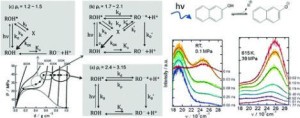
Excited state proton transfer (ESPT) reaction of 5-cyano-2-naphthol (5CN2) has been investigated in sub- and supercritical water by using the time-resolved fluorescence measurement. Under the ambient condition, a very fast decay of the fluorescence from the excited state of the normal 5CN2 (ROH*) and a simultaneous increase of the fluorescence from the excited state of the anion species (ROhttp://pubs.acs.org/entityImage/?code=FF0D&eTag=1d4sc6y*) were observed as reported previously. The very fast ESPT rate was evaluated as 0.12 ps-1. With increasing the temperature at a constant pressure of 39.0 MPa, the proton transfer rate became slow. At 615 K and 39.0 MPa, another fluorescence from a new unknown chemical species appeared, which was assigned to the contact ion pair (CIP) of ROhttp://pubs.acs.org/entityImage/?code=FF0D&eTag=1d4sc6y* and the hydronium ions. With decreasing the pressure at 664 K, the fluorescence from ROhttp://pubs.acs.org/entityImage/?code=FF0D&eTag=1d4sc6y* disappeared, and the fluorescence from ROH* and CIP was observed. At the very low density of SCW, only the fluorescence decay of ROH* was detected. The reaction dynamics were analyzed with the help of the singular value decomposition and the spectral decomposition using model functions. The ESPT rate was correlated with the solvent dielectric constant and/or the hydrogen-bonding ability… through the optical cell flowing pure water or the sample solution was successively measured by a multichannel detector (StellarNet, EPP2000C).