Harsha S. Deshmukh and Gajanan G. Muley
2025 | Department of Physics, Sant Gadge Baba Amravati University
Abstract
The upconversion (UC) phosphors in the series (100-x-y-z)Y2O3+xLa2O3+yYb2O3+zEr2O3 with x=0, 2, 4, 6, 8, and 10; y=3; z=0.1 were prepared by a combustion method to know the effect of La3+ doping on UC emission wavelengths and their intensities. The UC emission has been studied under the 980 nm (power 166 mW) and 932 nm (variable power) diode laser excitation. The phosphors show the green and red band emission pertaining to Er3+ ions. It has been observed that with a lower concentration of La3+ ions (up to 6 mol%), the emission intensity of both bands decreased, with the red band emission remaining dominant. However, as the doping concentration exceeded 6 mol%, the emission intensity of the green band increased significantly, leading to a switch from the red to green band emission at 10 mol% La3+ doping. The variation in the UC emission intensity with the pump power and temperature has been measured. The Er3+ and Yb3+ co-doped UC phosphor with 10 mol% La3+ doping can be used in optical thermometry with the maximum absolute sensitivity of 0.054 3 K1 at 303.15 K. The cubic crystal structure of prepared samples has been confirmed by a powder X-ray diffraction study. Doping of La3+ did not change the crystal structure, but the variation in lattice parameters was witnessed due to the modification of the crystal field by the La3+ ion. The absorbance of samples over the spectral range of 200 nm–1 100 nm has been measured by the diffuse reflectance spectroscopy. All samples exhibited large band gaps. The morphology of particles has been studied by the scanning electron microscopy. Commission International de I’Eclairage (CIE) color coordinates have been determined.
Keywords: Upconversion; optical thermometry; powder X-ray diffraction; combustion synthesis; yttrium oxide
Introduction
The potential applications of upconversion (UC) phosphors in the solar cells, white light generation, color displays, solid-state lasers, optical temperature and pH sensors, photo-dynamic therapy, and security and medical diagnosis [1–8] have attracted wide interest of researchers to search for a new Received: 9 February 2024 / Revised: 27 May 2024 efficient UC phosphor and modify the existing phosphor by adding different kinds of dopants, modifying the synthesis process, and tuning the particle size and other factors. Numerous hosts have been investigated and their utility has been studied with the addition of active trivalent rare earth ions for UC applications [9–18]. The host, Y2O3, is mostly studied as it has the best chemical and physical stability, high refractive index, and low phonon energy [19], which is still investigated for improving the UC emission by adding different dopants [20–24] and modifying the shape, size of particles [25, 26], and synthesis process [27].
Structural and morphological study
SEM images (Fig. 2) of UC phosphors Y2O3:YbEr, Y2O3:6LaYbEr, and Y2O3:10LaYbEr were recorded with 40 000 times of magnification, which shows very fine particulates somewhat of the rod shape with the presented magnification. The sizes estimated are given in Table 2.
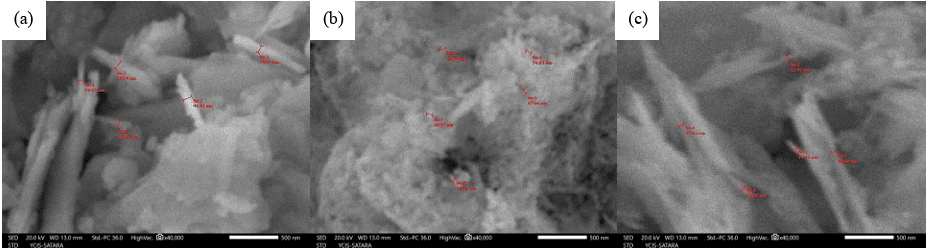
Fig. 2 SEM images of prepared UC phosphors: (a) Y2O3:YbEr, (b) Y2O3:6LaYbEr, and (c) Y2O3:10LaYbEr.
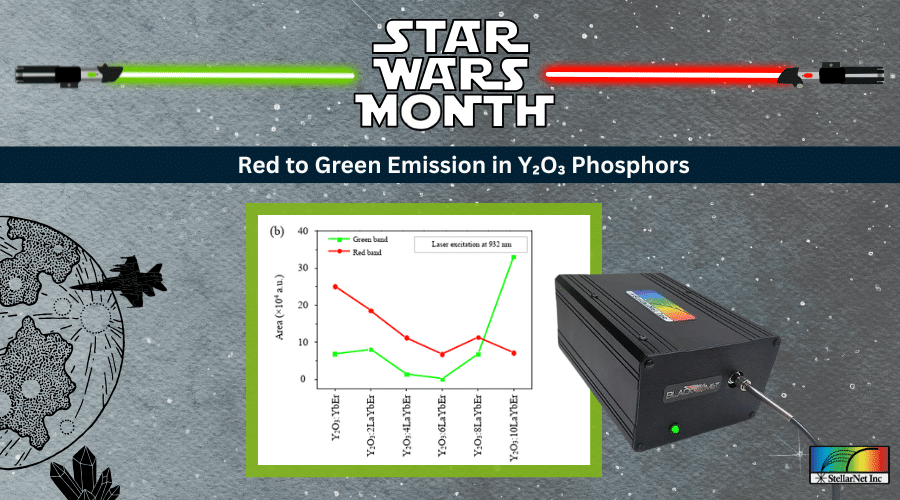
In another UC measurement, a 932 nm laser was used to excite samples with variable power, and the UC signal was recorded with a fiber optic UV-visible spectrophotometer (Black-CSR-50, StellarNet, USA).