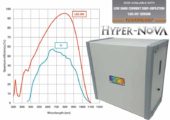
The signal to noise ratio, often abbreviated S/N, is exactly what it sounds like; it’s the ratio of the magnitude of the signal to the magnitude of the noise. Experiments need a large S/N to be able to distinguish features in the signal from the noise. If the S/N is too small, the signal gets lost in the noise and quantities like peak wavelength and peak width become harder to estimate with any certainty.
What is Signal to Noise Ratio?
May 25, 2017 | Glossary of Spectroscopy Terms, Spectroscopy