
Abstract
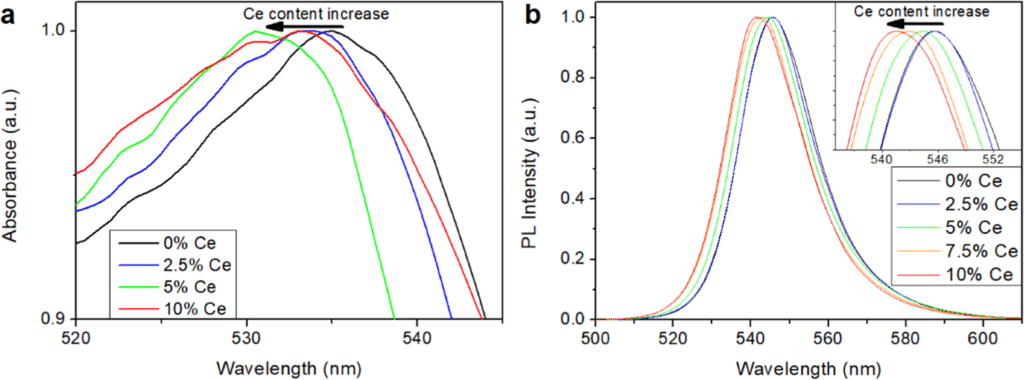
The photoluminescence (PL) and photoluminescence quantum yield (PLQY) of perovskite-based devices are crucial parameters that determine their photovoltaic performance. Doping, especially by ions of rare-earth metals, is an effective strategy for the enhancement of the optoelectronic properties of perovskites. Here, we explore the effect of cerium on the optical performance of CH(NH2)2PbBr3(FAPbBr3) thin films prepared by a simple one-step spin coating. Doped films with optimal Ce concentration showed nearly 20-fold enhancement of PLQY. Absorption and emission spectroscopy revealed that such a PL increment is accompanied by just a slight blue shift, overall maintaining the emission color and its purity. Additionally, we observed that Ce doping significantly affected the perovskite crystallographic texture. We found that maintaining the initial grain orientation is crucial for achieving a high PL efficiency. By combining structural and optical characterization methods, we established the Ce concentration limits for an increased optical performance.
StellarNet System:
Measurements of optical absorbance were taken … a fiber-coupled StellarNet BLUE-Wave miniature spectrometer