
Q Bu, L Zhu, MD Dennis, L Yu, SX Lu… – Journal of Biological, 2011
The phytochrome family of sensory photoreceptors interacts with Phytochrome Interacting Factors (PIFs), repressors of photomorphogenesis, in response to environmental light signals and induces rapid phosphorylation and degradation of PIFs to promote photomorphogenesis. However, the kinase that phosphorylates PIFs is still unknown. Here we show that CK2 directly phosphorylates PIF1 at multiple sites. α1 and α2 subunits individually phosphorylated PIF1 weakly in vitro. However, each of four β subunits strongly stimulated phosphorylation of PIF1 by α1 or α2. Mapping of the phosphorylation sites identified 7 Ser/Thr residues scattered throughout PIF1. Ser/Thr to Ala scanning mutations at all 7 sites eliminated CK2-mediated phosphorylation of PIF1 in vitro. Moreover, the rate of degradation of the Ser/Thr to Ala mutant PIF1 was significantly reduced compared to wild type PIF1 in transgenic plants. In addition, hypocotyls lengths of the mutant PIF1 transgenic plants were much longer than the wild type PIF1 transgenic plants under light, suggesting that the mutant PIF1 is suppressing photomorphogenesis. Taken together, these data suggest that CK2-mediated phosphorylation enhances the light-induced degradation of PIF1 to promote photomorphogenesis. Plant Growth Conditions and Phenotypic Analyses- Plants were grown in Metro-Mix 200 soil (Sun Gro Horticulture, Bellevue, WA) under constant light at 24 °C ± 0.5°C. Monochromatic R and FR light sources and the spectroradiometer (Model BLUE-Wave, StellarNet Inc., Tampa ).
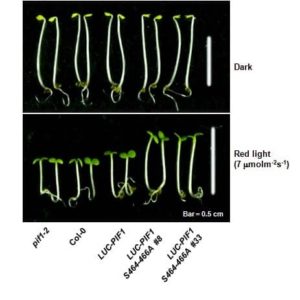
Supplementary Figure: LUC-PIF1(S464-466A) mutant promotes hypocotyl elongation under red light. Photographs showing hypocotyl lengths of various genotypes including two independent alleles of LUC-PIF1(S464-466A) transgenic plants. Seedlings were grown for four days in the dark or one day in the dark followed by three days under red light (7 ìmolm-2s-1). Bar= 5 mm.