On July 22nd, World Brain Day is observed globally. Established by the World Federation of Neurology, the day is meant to raise awareness about brain health and neurological disorders.
The brain is a remarkably complex system, controlling everything from memory and movement to vision and sleep. As researchers continue to uncover how the brain functions—and what happens when neurological disorders occur—spectroscopy has become an increasingly valuable, non-invasive tool for studying the brain in new ways.
To recognize World Brain Day, we’re highlighting three research applications that demonstrate how StellarNet spectrometers are helping advance neuroscience. From improving the quality of life for individuals with traumatic brain injuries to analyzing brain tumors and studying how light influences our circadian rhythms, these application spotlights showcase the diverse role spectroscopy plays in brain research.
Spotlight 1: Measuring Light Sensitivity After Traumatic Brain Injury
In the paper, “Light Filtering Lenses and Visual Photosensitivity in Individuals With Traumatic Brain Injury“, researchers at the Bascom Palmer Eye Institute at the University of Miami Miller School of Medicine set out to evaluate light sensitivity in individuals with TBIs (Traumatic Brain Injury). This is important because photophobia is a common symptom following a TBI which affects daily activities like working on a computer, reading, and being our in the sunlight.
The researchers utilized StellarNet’s spectrometers to measure the spectral characterization of different lenses that were used to test if filtering the light had any improvement on the tolerance to light.
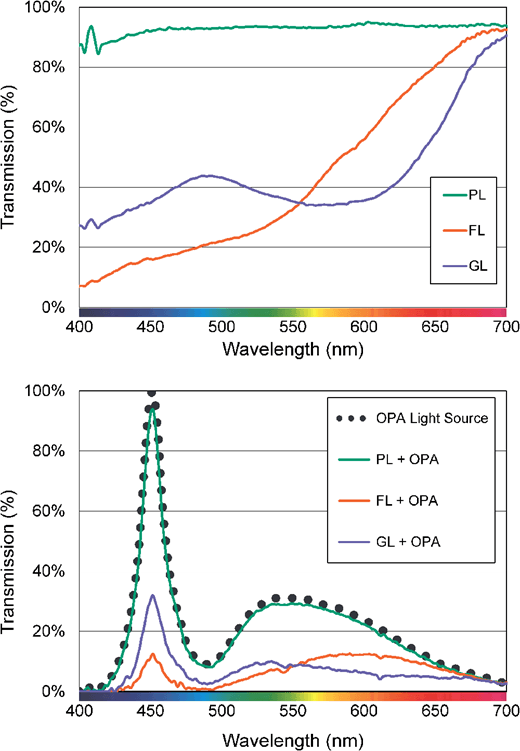
Figure 1: Transmission spectra of the light filtering lenses (PL, FL, and GL) alone (top), and combined with the OPA (bottom), across the visible spectrum (400 to 700 nm).
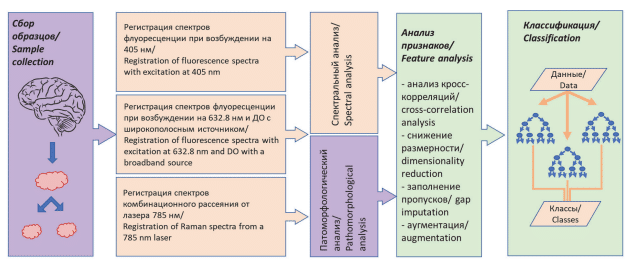
Figure 2. Scheme of sample and data analysis when constructing a model for classifying intracranial tumors based on optical spectroscopy data
Spotlight 2: Using Raman Spectroscopy to Analyze Brain Tumors
In our second application spotlight, we have a group of researchers from Moscow, Russia used StellarNet’s Raman-HR-TEC-785 to collect molecular fingerprints from different brain tumor samples. Brain tumors can be very biologically complex, and accurately identifying tumor characteristics is crucial for diagnosis and treatment planning.
Combining the molecular signatures collected by Raman spectroscopy with other optical measurements, the team looked for correlations between spectral features and tumor composition. The long-term plan is the creation of an optical-spectral decision support system that utilizes machine learning and artificial intelligence to help provide data-driven diagnoses.
Spotlight 3: Understanding How Light Affects the Brain’s Circadian Clock
Lastly, researchers in Spain utilized spectroscopy to compare how differently red and blue light suppresses melatonin – a hormone that is controlled by the brain’s circadian clock. The researchers used a BLACK-Comet spectroradiometer system to characterize the LEDs used during the human exposure part of their experiment. Knowing the exact wavelength and intensity that is reaching the eye is important because the response does not rely simply on the intensity.
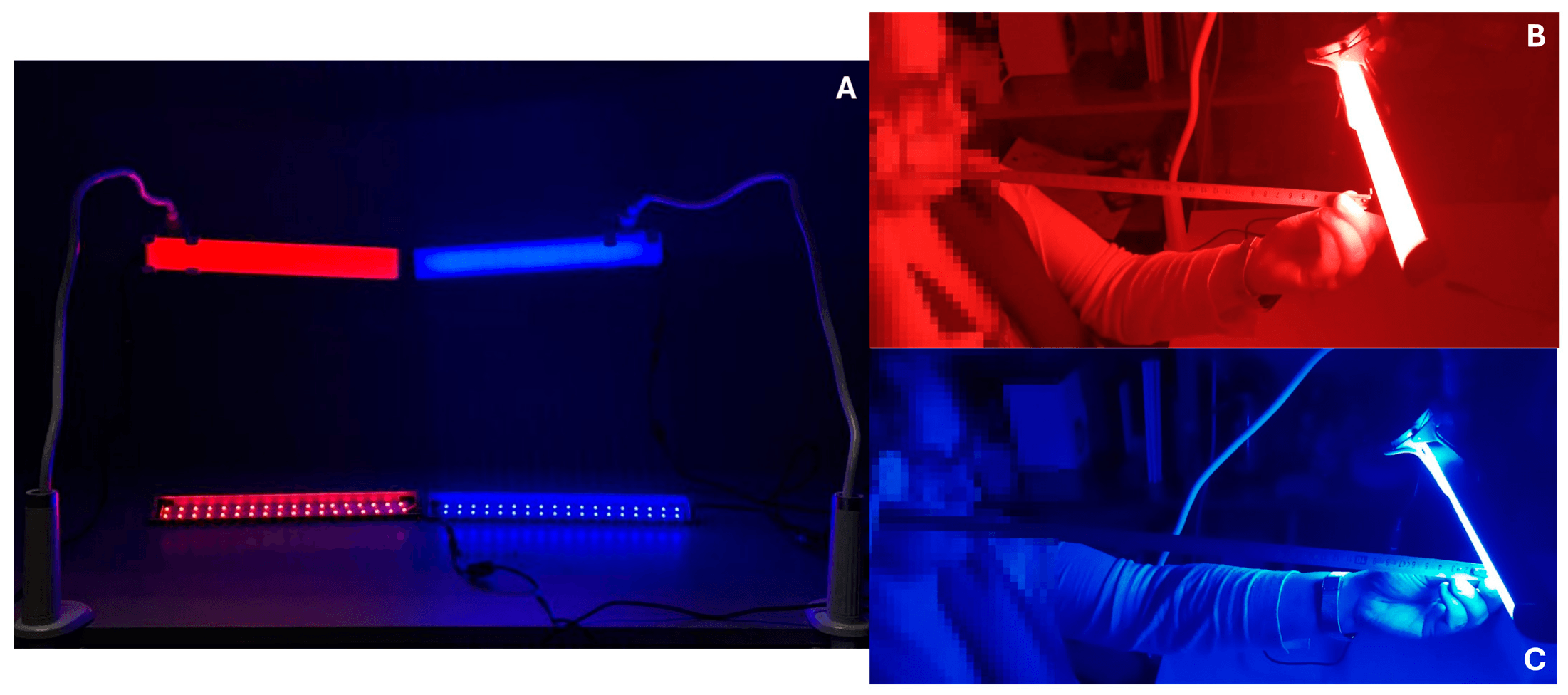
Figure 3. (A) Luminaires used in the experiments: at the top, the custom-built luminaires, and at the bottom, the luminaires without the diffuser, showing the LEDs. (B) Luminaire with red LEDs, calibrating the distance for the experiment. (C) Luminaire with blue LEDs, adjusted using a meter to ensure the correct distance.
Although these three studies focus on different areas of neuroscience, they all utilize spectroscopy to better understand the brain. Whether characterizing light-filtering lenses for individuals with traumatic brain injuries, collecting molecular fingerprints from brain tumors, or measuring the precise light exposure that influences melatonin production, each application highlights a unique way optical measurements contribute to neuroscience research.
As neuroscience continues to advance, optical technologies will play an increasingly important role in understanding the relationship between light and the brain. By transforming optical signals into measurable data, spectroscopy provides researchers with new tools to explore neurological health, improve diagnostics, and develop technologies that support better quality of life.