What is Light Intensity, Absolute Intensity, and Irradiance?
Light intensity is commonly used to describe the amount of optical power falling on a given area. In spectroscopy and radiometry, the more precise term for this quantity is irradiance.
Irradiance is defined as the optical power received per unit area and is typically expressed in units such as watts per square meter (W/m²) or watts per square centimeter (W/cm²). It is commonly used to characterize light sources, including LEDs, lasers, solar radiation, and lamps.
Although the International System of Units (SI) distinguishes between intensity and irradiance, the terms light intensity, absolute intensity, and irradiance are often used interchangeably in practical spectroscopy applications to describe the amount of light reaching a surface.
For example, a solar panel manufacturer may measure irradiance to determine how much sunlight is available for energy generation, while an LED engineer may measure irradiance to evaluate the output of a lighting system.
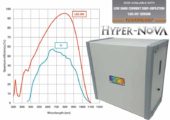
When the term spectral is added, the quantity is measured at each wavelength. For example, spectral irradiance describes how the irradiance is distributed across the spectrum and is commonly reported in units such as W/m²/nm.
Accurate irradiance measurements are essential in applications including solar energy research, UV exposure monitoring, horticultural lighting, LED characterization, and spectroradiometry.