GW Beresford, G Selby, JC Moore – Pedobiologia, 2012
This study assessed the effects of UV-B irradiation on the physiology, life history, DNA, and behavior of the blind non-pigmented soil-dwelling collembolan Folsomia candida (Willem). In three sets of controlled laboratory studies, adult F. candida were reared in darkness and exposed to light with no UV-B (filtered), low UV-B or high UV-B (weighted irradiance energy of 3.12 mW/m2 and 22.1 mW/m2, respectively). Study I investigated UV-B impacts on mortality, egg viability, and egg development time of F. candida under continual exposure. Study II assessed the movement patterns, mortality, egg production and fecundity of adult F. candida in response to UV-B exposure within choice environments. Study III determined the degree of UV-B induced DNA damage (thymine dimer formation) on F. candida and subsequent DNA repair. Continuous irradiation resulted in increased mortality, under high and low UV-B conditions compared to controls. Consistent with other studies on the impact of light on collembola, we found that F. candida avoided light when given the option. Though preferring darkness, animals were more likely to venture into lighted regions with no UV-B (filtered) and experienced higher mortality rates than in regions with high or low UV-B. Eggs were laid preferentially in the dark, with fewer total eggs observed in the habitat with the highest UV-B. We further demonstrated that UV-B induced the formation of thymine dimers in a dose dependent manner. DNA repair was not evident in animals returned to the dark after a brief intense UV-B irradiation. These findings indicate that UV-B exposure and exposure to longer wavelengths of light has both lethal and sub-lethal effects on F. candida that can adversely affect its survival. … UV-B emitting bulbs. The spectra of the 2.0 and 10.0 bulbs were 6 measured using a Stellarnet model EPP2000 spectrometer (Tampa, FL) equipped with 7 a fiber-coupled, quartz diffuser fore optic. The weighted irradiance energy
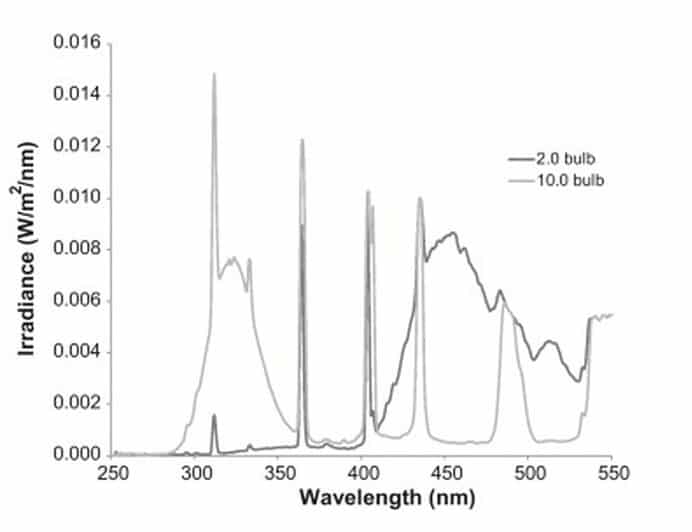
Fig. 1. Wavelength characteristics of the Exo Terra Repti Glo® fluorescent light bulbs (Terra, Mansfield, MA) designated 2.0 (low UV-B) and 10.0 (high UV-B) 26-watt fluorescent UV-B emitting bulbs. The spectra of the 2.0 and 10.0 bulbs were measured using a Stellarnet model EPP2000 spectrometer (Tampa, FL) equipped with a fiber-coupled, quartz diffuser fore optic. The weighted irradiance energy or intensity of radiation of the 2.0 or ‘low UV-B’ bulbs and 10.0 or ‘high UV-B’ bulbs was 3.12 mW/m2 and 22.1 mW/m2, respectively, estimated using the erythemal action spectrum of McKinlay and Diffey (1987) used to measure the carcinogenic effectiveness on human skin. The erythemal action spectrum is useful in comparing the relative effectiveness of different wavelengths producing a biological response. The lamps used here differ in their spectra at longer wavelengths. The higher energy UV-B portion, which carries the greatest weighting, is assumed to be most effective at eliciting a reaction.