Quantum photonics is moving from physics labs into real-world systems: quantum-secure communication, ultra-precise sensing, and new classes of quantum light sources that will underpin tomorrow’s information infrastructure. At the heart of all of these platforms is a deceptively simple question: what light is your quantum device really producing? That’s where StellarNet’s compact fibre-optic spectrometers — and the new StellarElite high-performance line — are becoming essential tools for quantum photonics R&D and production testing.
How Spectrometers are used in Quantum Photonics
Quantum photonics devices hinge on extremely precise optical characterization:
Single-photon & entangled-photon sources
- You need to know the exact central wavelength, bandwidth, and spectral purity of photons generated by SPDC sources, quantum dots, defect centers, or micro-resonators.
- For example, companies such as Sparrow Quantum (https://sparrowquantum.com) are developing on-demand single-photon sources based on photonic quantum chip technology.
- Also, Nu Quantum (https://nu-quantum.com) in the UK specialises in single-photon devices (sources and detectors).
Integrated photonic circuits
- Ring resonators, Bragg gratings, and waveguides must be characterised for resonance positions, free spectral range, and insertion loss to ensure high-fidelity quantum gates and routing.
- For example, organizations such as Xanadu Quantum Technologies (https://xanadu.ai) are building photonic quantum processors using programmable nanophotonic chips.
Quantum light sources & quantum‐dot materials
- Photoluminescence (PL) and absorption spectra can reveal how efficiently new quantum‐dot and 2D materials convert pump light into usable quantum emission.
- Example: QD Laser (https://www.qdlaser.com) produces semiconductor quantum‐dot lasers for silicon photonics/sensing, which may feed into quantum photonics stacks.
Quantum cascade & mid-IR structures
- Superlattice engineering for quantum cascade lasers (QCLs) relies on precise PL and emission spectroscopy to tune transition energies and linewidths.
- For instance, LongWave Photonics LLC (https://www.longwavephotonics.com) offers terahertz QCL systems for imaging, spectroscopy, and heterodyne receivers.
In all of these areas, StellarNet’s high-resolution, fiber-coupled spectrometers allow quantum photonics teams to iterate quickly, monitor devices in situ, and embed spectral feedback into automated experiments.
StellarNet Spectrometers for Quantum Labs
StellarNet’s miniature spectrometers are rugged, fiber-optic instruments that cover UV, VIS, and NIR ranges from roughly 190–2500 nm in modular, lab-friendly packages. SMA-905 fiber inputs plug directly into free-space optics, cryostats, and integrated photonic chips.
For quantum photonics work, three product families are especially relevant:
1. The StellarElite High-Performance Line
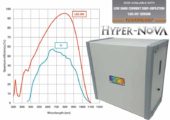
The HYPER-Nova and Quasar UltraCool are part of StellarNet’s new elite spectrometer family designed for extremely low-light and high‐precision work:
- Deep-cooled CCD (down to about –60 °C)
- Low Dark Current (LDC) detector design
- Peak quantum efficiencies up to ~95%
- Configurations for UV-VIS, 532 nm, and 785 nm Raman, and custom low-light applications This combination of deep cooling and high QE makes HYPER-Nova ideal for weak PL from quantum dots, faint Raman signals from 2D materials, and long-integration measurements on integrated quantum devices.
- High-throughput “Quasar” optics for ~10× optical gain
- Low Dark Current detector architecture
- Deep cooling (TEC-based) for very low noise Quasar UltraCool is a strong fit in applications where you average many single-photon events into a clean spectral envelope, or need long exposures without thermal noise creeping in.
Together, these elite instruments provide quantum photonics users with research-grade performance at a modular-spectrometer price point, with the form factor and durability StellarNet is known for.
2. HR-X & HR High-Resolution Series
When you’re measuring narrow cavity resonances, telecom-band waveguides, or laser wavelengths, resolution is king.
StellarNet’s HR-X Hi-Res Series provides:
- Spectral resolution down to ~0.05 nm
- Models spanning UV, VIS, and NIR (≈200-1100 nm)
- Extended optical path for 2×–4× higher resolving power vs standard HR/BLUE-Wave enclosures
These instruments are excellent for:
- Waveguide & ring resonator characterization
- Bragg grating monitoring in quantum photonic circuits
- Tunable laser wavelength tracking and stabilization loops
3. DWARF-Star & SILVER-Nova Workhorses
On the NIR and broadband sides, quantum photonics groups frequently leverage:
- DWARF-Star NIR spectrometers (≈900–1700 nm, InGaAs): great for telecom-band quantum devices, single-photon detector characterization, and QCL-related PL in the short-wave infrared
- SILVER-Nova TEC-cooled UV-VIS-NIR spectrometers (≈190–1110 nm) with optional two-stage TEC upgrades can be used in many quantum‐materials studies for PL and absorption
All of these can be driven via StellarNet’s Python SDK, making it straightforward to integrate into quantum-optics control stacks and automated experiments.
How Quantum Labs Can Use StellarNet Day-to-Day
Putting this into practical terms, a typical quantum-photonics lab might use StellarNet spectrometers like this:
Characterizing SPDC & single-photon sources
- HR-X or HR series spectrometer on the signal/idler outputs to measure central wavelength, bandwidth, and phase-matching curves.
- HYPER-Nova models for long-integration PL of faint sources at cryogenic temperatures.
Tuning integrated quantum photonic chips
- HR-X Hi‐Res spectrometer to map ring-resonator spectra with ~0.05 nm resolution.
- DWARF-Star NIR or telecom-band HR-X for Bragg gratings and waveguides around 1.5 µm.
Developing quantum-compatible materials
- SILVER-Nova or HYPER-Nova UV‐VIS for absorption and PL scans of quantum dots, 2D materials, and color centres.
- Quasar UltraCool to monitor extremely weak emission while sweeping temperature, pump power, or cavity tuning.
Laser & detector calibration
- HR-X / HR spectrometers with laser-measurement accessories to track laser drift, verify line positions, and calibrate single-photon detector response curves.
All of this can be orchestrated through Python or LabVIEW control for automated scans, closed‐loop optimization, or “self-tuning” of quantum devices.
Ready to Bring Quantum Photonics into Your Lab?
If you’re:
- Engineering quantum cascade structures
- Designing integrated quantum photonic circuits
- Developing next-generation quantum-dot emitters
- Or building your own computational / quantum-enhanced spectrometer
StellarNet’s spectrometers — especially the new StellarElite high-performance line — provide the spectral insight needed to move from idea to device.