Sung-Doo Baek, Yu-Ting Yang, Pengfei Wu, Hanjun Yang, Mohammad Ali, Hui Taou Kok, Xiyu Luo, Wenhao Shao, Hyuntae Choi, Jeong Hui Kim, L. Jay Guo, Libai Huang, Barry P. Rand, and Letian Dou | Nature Volume 658, pages 629–635 | October 15, 2026 (published online October 14) | 10.1038/s41586-026-11120-3
Abstract
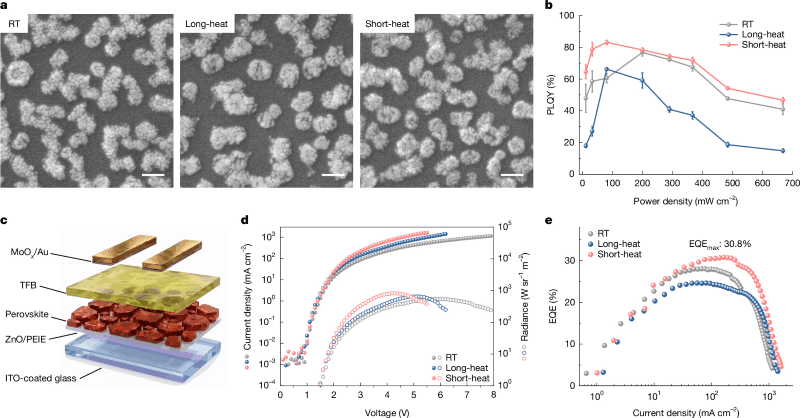
This study traced hidden solution-phase reactions involving 5-aminovaleric-acid-derived additives and used that chemistry to improve near-infrared perovskite light-emitting diodes. Purifying the beneficial 5IMAP reaction product produced films with a reported mean peak photoluminescence quantum yield of 97.2 percent and devices with a champion external quantum efficiency of 37.1 percent and a mean peak efficiency of 32.8 percent. The results show how resolving additive conversion pathways can replace empirical formulation with more reproducible molecular engineering.
How it was used:The spectrometer recorded the device emission spectrum in a custom goniometer-based electroluminescence characterization setup. The accessible methods information identifies the StellarNet brand but does not name the spectrometer model or accompanying optics and software.