NIR Spectroscopy for Plastic Identification and Recycling
America Recycles Day is a reminder that successful recycling starts with knowing what materials we have. Many plastics may look identical, but differences in their chemical composition determines how they should be sorted and processed. Being able to quickly distinguish between polymer types can help reduce contamination and improve the consistency of recycled materials.
Near-infrared (NIR) spectroscopy provides a rapid non-destructive way to identify many common plastics. When NIR light interacts with a plastic sample, its molecular structure produces a characteristic spectral fingerprint. These fingerprints can be used to differentiate materials such as PET, HDPE, PVC, and PP. This turns a visual sorting challenge into an objective measurement.
What can NIR see that we can’t?
NIR light sits just beyond the red end of the visible spectrum. When it shines on a piece of plastic, bonds in the material absorb some wavelengths more strongly than others. The spectrometer measures how much light returns at each wavelength. The resulting pattern is like a fingerprint: two pieces of plastic can look alike in visible light and still produce different NIR spectra.
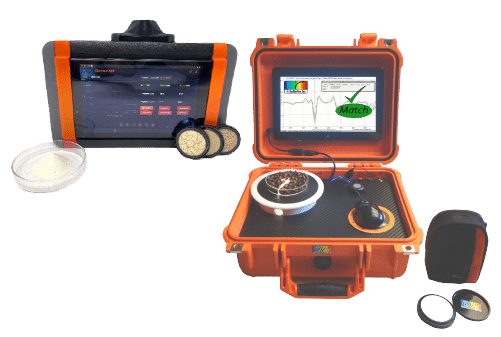
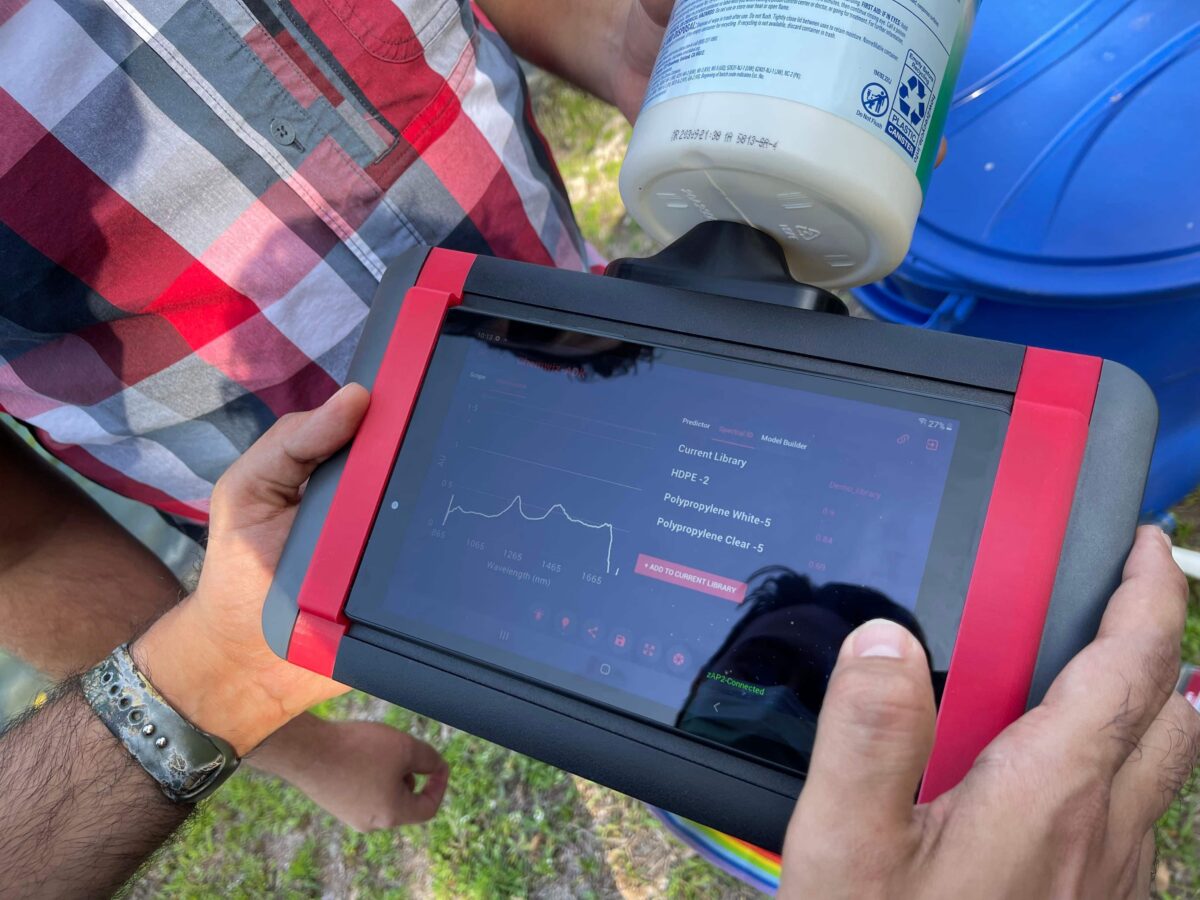
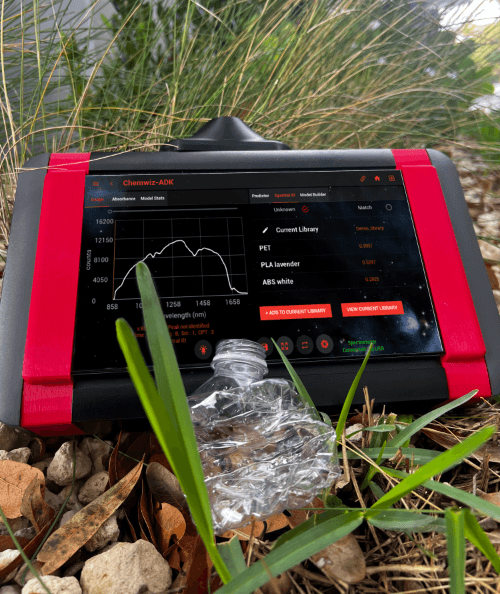
The ChemWiz-ADK-PP combines portable spectroscopy with easy-to-use spectral matching tools. Users can compare unknown materials against an existing plastic library, save validated samples, and develop custom libraries tailored to their own materials. From incoming inspection to sorting and recycling, the ChemWiz-ADK can help bring fast plastic identification to your process.
How does the analyzer find a match?
The analyzer scans the unknown plastic and compares its spectrum with a library of spectra from known materials. It looks at the pattern across many wavelengths, not just one peak. That’s how it can help tell common plastics such as PET, HDPE, PVC, and polypropylene (PP) apart without cutting or damaging the sample.
The reference library matters. A match is most useful when the library represents the kinds of materials you actually see. If a scan doesn’t produce a clear match, treat it as a reason to check again rather than forcing the sample into a category. And identifying the resin is only one step: whether an item can be recycled still depends on what the facility accepts.
Explore the ChemWiz-ADK Plastics and Polymer Analyzer