9 December 2024 | 1) Department of Environmental & Biological Chemistry, Chungbuk National University, Cheongju, Chungbuk 28644, Republic of Korea 2) Division of Soil and Fertilizer, National Institute of Agricultural Sciences, RDA, Wanju, 55365, Republic of Korea 3) Department of High-tech Cultivation, Smart Horticultural Research Division, Chungcheongbuk-do Agricultural Research and Extension Services, Chungbuk 28130, Republic of Korea
Limited light intensity and low temperature in winter lead to various challenges such as reduction in growth, yield and quality of cultivated roses, which can be complemented by artificial supplementary lights. This study aims to evaluate the effect of different supplementary lights, including metal-halide (MH), metal-halide+high-pressure sodium lamp (MH + HPS) and high-pressure sodium lamp (HPS) on the growth characteristics of cultivated roses in winter. Compared to individual light, the results demonstrated that combined supplementary lights (MH + HPS) increased stem diameter, number of leaves and flower diameter of cultivated roses. The height, leaf length, leaf width, number of petals, chlorophyll content and chlorophyll fluorescence (Fv/Fm) of roses grown in different supplementary lights were not significantly affected. In all the three treatment areas, photosynthetic photon flux density (PPFD) and temperature at night were higher in the MH + HPS area, followed by the HPS and MH areas. The plant-induced electrical signal (PIES) of roses cultivated under MH + HPS light indicated higher water and nutrient uptake than other treatments, which was positively associated with rose growth, but the difference was insignificant. Principal component analysis (PCA) revealed that the growth parameters of roses were mainly associated with MH + HPS supplementary light. Therefore, combined supplementary light was beneficial to improve the growth and quality of cultivated roses.
Keywords: high-pressure sodium lamp, metal-halide lamp, plant-induced electrical signal, roses, supplementary light
Introduction
Atmospheric factors, including light, temperature, humidity, rain and CO2, are often unpredictable, adversely affecting commercial ornamental and vegetable crop production (Gómez et al., 2019). Growers can enhance year-round plant productivity in controlled environments by optimising these conditions with the use of resources such as nutrients and water. Among these conditions, light is the foremost energy source for biological processes, as it plays a crucial role in photosynthesis, plant growth and development.
It is essential in triggering various signals for plant morphogenesis and physiological processes (Chen et al., 2004). Rose is a perennial flowering plant from the Rosaceae family and is characterised by its woody stem.
Cut roses with red colour are the most preferred flowers worldwide, and their demand is constantly rising (Kim, 2018). Roses are in high demand not only as ornamental flowering plants but also for their medicinal value (Choi et al., 2015). For the quality and high production of roses, environmental factors such as temperature, light intensity and humidity should be considered.
The ideal temperature for growing roses is between 20°C and 30°C during the daytime and 18°C and 20°C at night-time (Ushio et al., 2008). However, in temperate zones, during the summer the highest temperature reaches 35°C and it drops below −5°C in winter (Kim et al., 2022).
Supplementary Figure 1
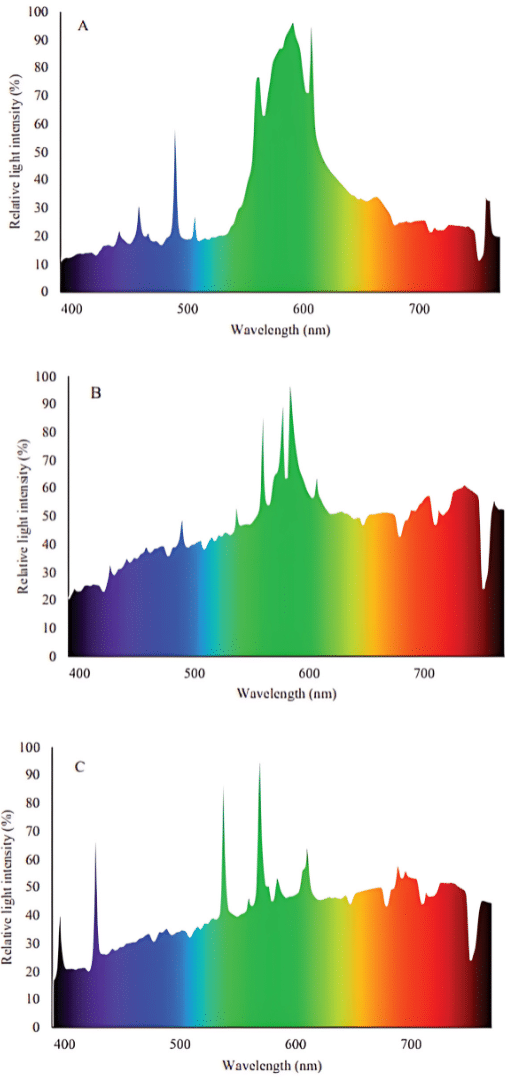
Light spectra for roses cultivated under different supplementary lights in greenhouse: (A) HPS spectra; (B) MH + HPS spectra and (C) MH spectra. HPS, high-pressure sodium; MH, metal-halide; MH + HPS: metal-halide + high-pressure sodium lamps.
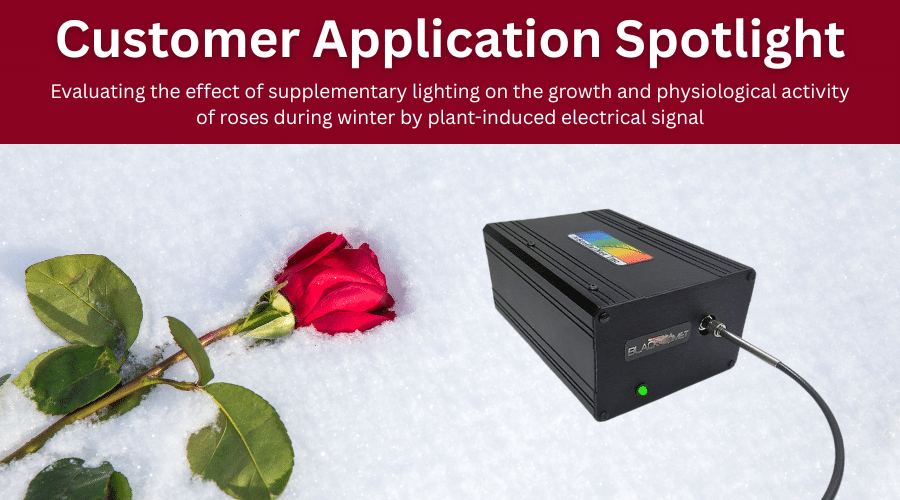
Daily light integral (DLI) without supplementary lighting was 1.8 mol ∙ m−2 · day−1. The DLI for MH, MH + HPS and HPS treatments were 2.31, 2.84, and 2.62 mol · m−2 · day−1, respectively. Light spectrum of MH and HPS was measured using BLACKComet UV-VIS spectrometer (StellarNet Inc., Tampa, FL, USA). Photon flux density (PFD) was measured between 400 nm and 780 nm and percentages of blue, green, red and far-red lights were calculated based on the light spectrum measured in the ranges of 400–500, 500–600, 600–700 and 700–780 nm, respectively, relative to the total PFD. The measured spectrum by wavelength is presented in Supplementary Figure 1.