H Terraschke, LR Arana, P Lindenberg, W Bensch – Analyst, 2016
Here, we introduce the principle of the novel in-situ luminescence analysis of coordination sensors (ILACS) approach for monitoring the formation of solid materials, recording information from the formed solid compounds as well as from the surrounding solutions. This technique utilizes as main tool the sensitivity of luminescence properties of lanthanide (Ln) ions on the coordination environment, being incorporated as local sensors by the investigated material during synthesis. The luminescence spectra and their environment-dependent development are monitored in-situ from the early stages of the reaction until the final product formation under real conditions with high time resolution. The ILACS principle is demonstrated here for monitoring the formation of [Eu(phen)2(NO3)3] (phen = 1,10-phenanthroline) and further metal-ligand exchange processes during its conversion to [Sn(phen)Cl4]. These reactions were followed, for instance, analyzing the antenna effect, shift of the 5D0→7F4 Eu3+ transition and quenching effects. In addition, these results have been validated by comparison with other in-situtechniques. The results demonstrate that ILACS is a new powerful, fast, broadly available in-situcharacterization method, which is applicable for liquids, amorphous samples, very small crystallites besides for large crystals.
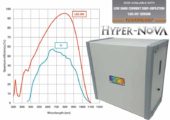
… The luminescence setup comprises a portable EPP2000 (StellarNet Inc., United States) spectrometer, equipped Page 2 of 6 Analyst … A slight red shift for long wavelengths was detected by the applied portable StellarNet spectrometer.