Comparison of Single-Fiber Cable vs. Linear Fiber Bundle
Fiber optic cables are a critical component of spectroscopy systems – directly influencing signal strength, measurement repeatability, and overall system performance.
Regardless of the measurement technique – reflectance, transmission, fluorescence, Raman spectroscopy, or overall process monitoring- the optical fiber determines how efficiently light travels to the spectrometer.
There are many common fiber configurations, but two popular ones are
- Single-Core Optical Fibers
- Linear Fiber Bundles
Fiber bundles are at times assumed to collect more light because they contain multiple fibers, but actual optical performance depends on several factors that often favor a single large-core fiber.
The Two Fiber Designs
Single Core Fiber
A single-core optical fiber contains one continuous optical core surrounded by cladding and protective jacketing.
For spectroscopy, larger core diameters increase the amount of light entering the spectrometer while keeping a simple optical path.
Linear Fiber Bundle
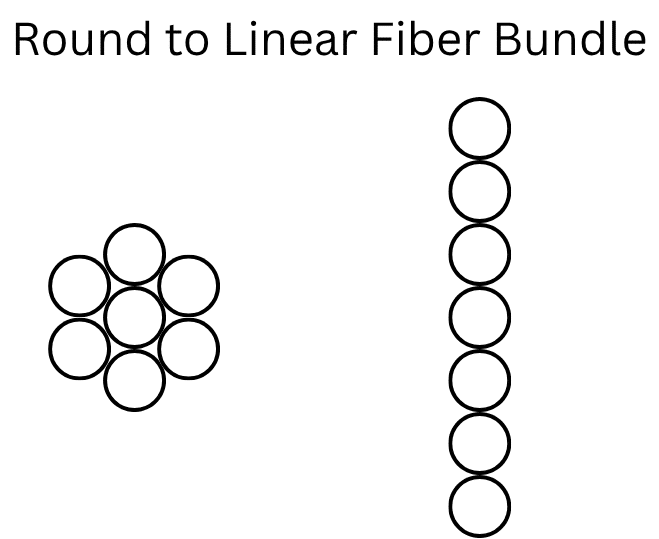
A linear fiber bundle combines multiple individual fibers into a single connector. Most bundles have one end that is in a hexagonal shape packed closely together, with the other end having the fibers stacked on top of one another linearly.
Why Throughput Differs
Looking at the active collection area of the single fiber vs linear bundle, we can see that the single fiber generally delivers higher throughput.
For this test, we used an F600-UVSR fiber and compared it with a competitor’s 7×105 μm round-to-linear fiber bundle.
Active Collection Area
600μm Single Fiber : ~282,700 μm2
Linear Bundle: ~60,600 μm2
Even before considering any additional losses, the 600 μm fiber has over four times the active collection area of the bundle.
Packing Efficiency
Fiber bundles have unavoidable dead space consisting of cladding, buffer coating, adhesive, and air gaps. These regions do not transmit light. A single fiber uses nearly the full diameter.
Spectrometer Entrance Matching
Linear bundles are designed to illuminate the entrance slit of a spectrometer. If the linear bundle is not properly aligned, there may be differences from the expected spectral output. Additionally, if the full linear arrangement isn’t fully utilized, portions of the collected light might not enter the spectrometer efficiently. StellarNet spectrometers have an entrance slit that is 1000 μm high with different width options.
Experimental Comparison
Testing was performed using identical measurement conditions while changing only the fiber configuration
| Configuration | Description |
| Single Fiber | 600 μm for UVSR Fiber |
| Linear Bundle | 7 x 105 μm core fibers |
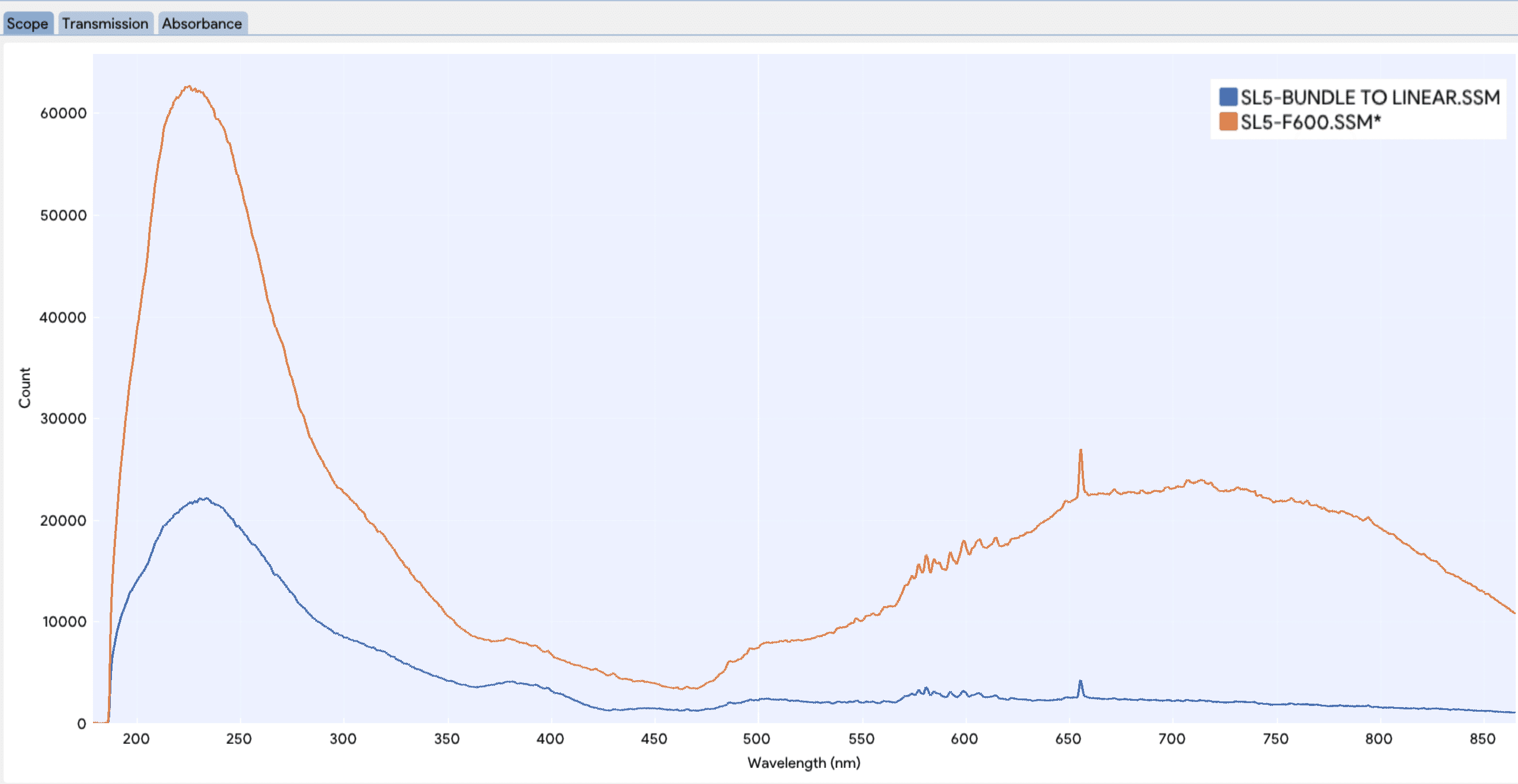
The spectrometer used was a BLACK-Comet BLK-C with a 50 μm slit and an SL5 deuterium-halogen lamp.
After allowing the lamp to warm up for 10 minutes, the fiber was directly connected to the spectrometer and light source.
Measured results showed:
- Higher signal intensity using 600μm fiber
- Shorter required integration times
- Better overall optical throughput
The observed performance closely matched theoretical expectations based on the active core area and optical efficiency.
Conclusion
The correct fiber selection plays a significant role in overall system performance. Linear fiber bundles can provide unique advantages for unique applications; they do not inherently collect more light than a large-core single optical fiber.
In StellarNet’s testing, a 600μm single-core fiber produced substantially higher optical throughput than a linear bundle composed of seven 105μm fibers.
Why Engineers Choose StellarNet
For more than three decades, StellarNet has helped researchers, engineers, and manufacturers transform light into actionable engineering intelligence. Our modular spectroscopy systems combine high-performance optical measurement, flexible system configurations, rapid customization, and US-based engineering support to help solve complex measurement challenges across the global photonics industry.
Check out our spectrometer systems!
UV-VIS Spectrometers
NIR Spectrometers
Raman Spectrometers
Spectroscopy Learning Center