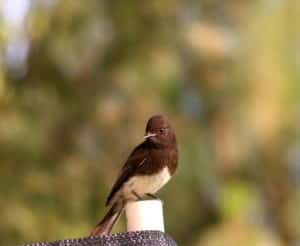
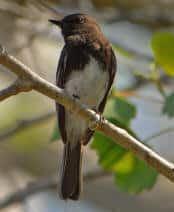
 Black Phoebes rely on chromatic contrast to search for food. For a bird to survive, it must be able to successfully find and eat food items. Many factors can affect the ability of the bird to find food such as the habitat it lives in, the abundance of food, or how its visual system interprets images. Birds are generally considered to have very good color vision. In this study we explored how the Black Phoebe’s (a small bird that is a sit-and-wait predator) vision, the reflectance of prey items and the background, and irradiance interacted to change how the bird looked for food items. We found that birds decreased their search effort for prey items when chromatic contrast was high, but search effort was not affected by brightness. We were also interested in how the amount of tree cover, grass cover and the abundance of food items change how birds searched because Black Phoebes live in urban parks with high levels of tree and grass cover. We found that increased tree and grass cover decreased search effort, but the abundance of food items in the environment did not change how the bird searched. We suggest that sit-and-wait predators may attack prey items only when they are sure they will catch them: prey items that are harder to see require more search effort to ensure that the bird can catch them.
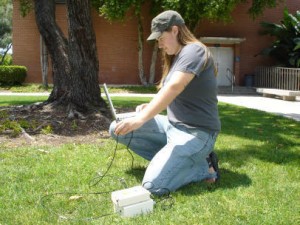
Application Information Provided by:
Dr. Esteban Fernández-Juricic
Assistant Professor
Department of Biological Sciences
California State University Long Beach
Website: http://www.csulb.edu/~efernand/
Behavior & Conservation Lab: http://www.csulb.edu/web/labs/bcl/
Bird’s Eye View (bird vision explained): http://www.csulb.edu/web/labs/bcl/birdseyeview/