StellarNet’s Vice President discusses how engineering collaboration, flexible instrumentation, and modern software platforms help customers solve complex spectroscopy applications.
As spectroscopy expands into advanced manufacturing, materials research, and automated analytical systems, many users find limitations in instrumentation once measurements move into a real operating environment. Integration challenges, data interpretation, and system stability often require solutions that are designed around practical engineering realities.
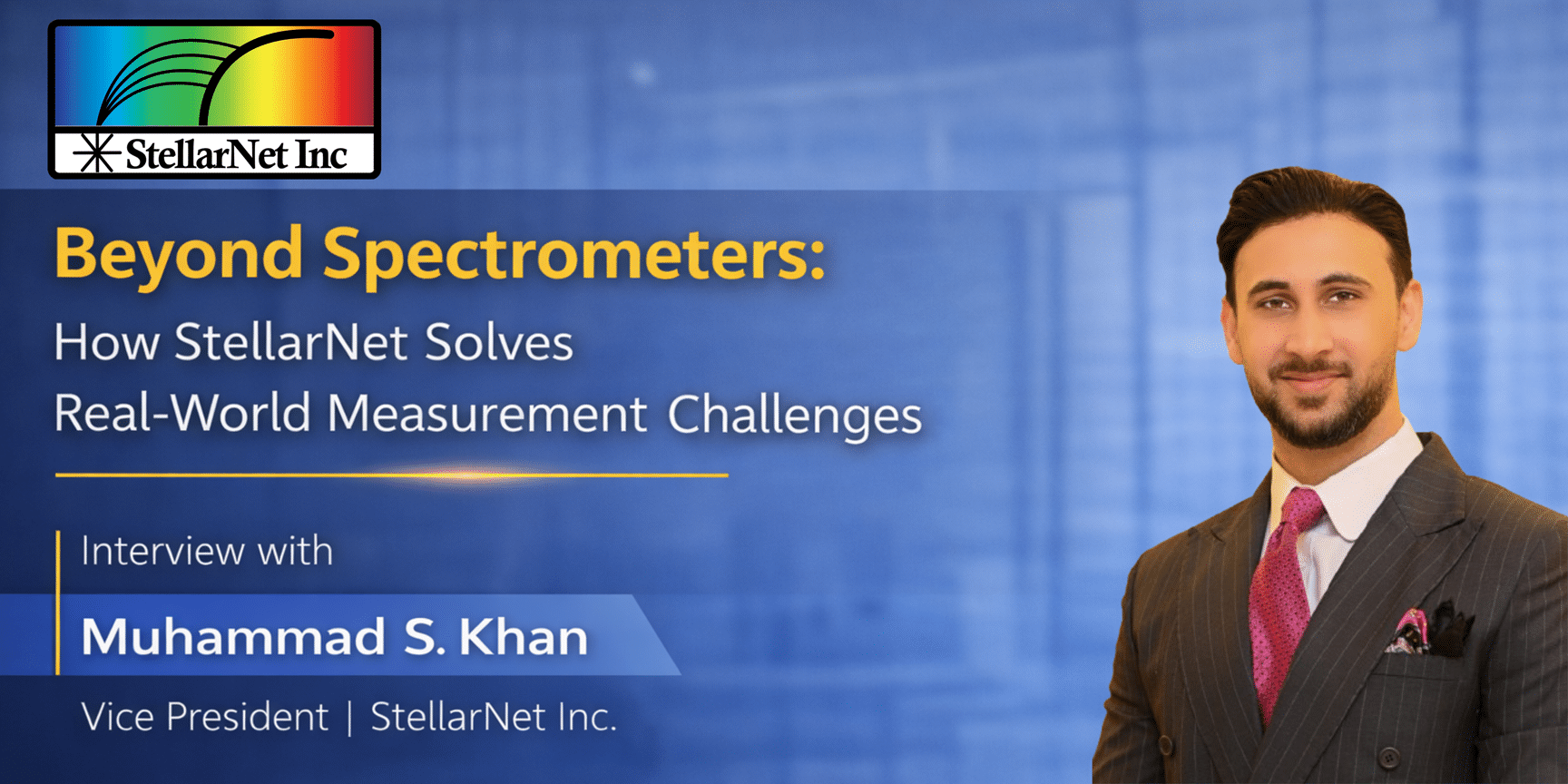
We spoke with Muhammad S. Khan, Vice President of StellarNet Inc., about how the company is evolving as an application solution partner for modern spectroscopy and optical measurement systems.
Q: Congratulations on your new role! What defines StellarNet’s culture and direction today?
StellarNet was founded by engineers and continues to be led by engineers, and that culture strongly influences how we work with customers. Instead of focusing only on selling instruments, our goal is to be an application solution partner. We begin by understanding the measurement problem and the engineering challenges behind it. Going forward, we want to continue strengthening StellarNet as a solution-oriented engineering partner – supporting customers from concept through deployment.
Q: In a competitive spectroscopy market, how does StellarNet stand apart?
Flexibility.
Many spectroscopy systems are designed around fixed configurations for standard lab use. However, customers increasingly need spectroscopy integrated into equipment, production workflows, or specialized research setups. Instead of adapting the customer’s process around an instrument, we try to evaluate which measurement approach would work best for the environment. Sometimes this means a reliable catalog system, and in other cases, we need optimized optics, illumination, or workflow integration.
Q: StellarNet has expanded its technology portfolio recently. What developments are you most excited about?
We are continuing to expand both performance and accessibility across our product platforms. Our StellarElite™ family delivers high-performance spectroscopy in a compact, cost-effective platform that customers can deploy immediately. Beyond spectrometers, we provide complete optical measurement solutions, including high-performance light sources and integrated systems such as Raman-based particle identification platforms and advanced illumination technologies like our SE-LED UV light sources. Many applications require illumination, detection, optics, and software working together, and our expanding universe supports that need.
Q: Software integration has become critical in modern instrumentation. How is StellarNet addressing this?
Many long-time users know SpectraWiz, which served as a powerful and versatile platform – often described as a “Swiss Army Knife” of spectroscopy tools for years. Our next-generation software platform, StellarPro, was developed on that foundation. StellarPro is designed for modern application workflows supporting mapping, radiometric analysis, Raman measurements, thin film characterization, and automated measurement processes. We also provide SDKs that allow researchers and OEM developers to integrate spectroscopy directly into their own systems. In many applications, the software ultimately determines how effective the instrument is at solving the problem.
Q: Artificial Intelligence is influencing many analytical technologies. How do you see AI shaping spectroscopy, and where are StellarNet’s solutions making an impact?
AI is helping transform spectroscopy from a simple data collection into predictive analysis. We are applying AI and chemometric modeling in areas like chemical concentration analysis, material identification with particle analysis via Raman, thin film and coating characterization, and process monitoring. When combined with reliable optical measurements, these tools allow customers to extract meaningful insights from spectral data more quickly.
Q: Which emerging industries and technologies are shaping the future of spectroscopy, and how is StellarNet preparing for them?
We see strong momentum in areas such as semiconductor materials, thin film processing, environmental monitoring, biomedical research, LED and display characterization, and chemical process analysis.
Our engineering team is continuously developing new technologies, including a thin-film analysis and mapping system for larger samples, an updated StellarPro-TFC platform, and new additions to the StellarElite line. This means additional advanced light sources and spectrometers like the SWIR Quasar for real-time gas monitoring and the Quasar Ultra-Comet for ultra-high UV sensitivity measurements. We are also expanding Raman chemometrics tools to combine spectroscopy with advanced data modeling to extract deeper insights from spectral data.
Q: What message would you like customers to take away from this interview?
Whether customers need a proven catalog system or support for a new measurement challenge, our objective is the same — helping them move confidently from evaluation to deployment. At StellarNet, we strive to be more than an equipment supplier.
We aim to be an application solution partner, combining reliable instrumentation with engineering collaboration so customers can focus on solving their application rather than struggling with measurement systems.
⭐ Leadership Perspective
“Our goal is simple — combine reliable instrumentation with engineering collaboration so customers can focus on solving their application, not fighting their measurement system.”
— Muhammad S. Khan, Vice President, StellarNet, Inc.
Let’s Discuss Your Application. If your team is evaluating spectroscopy solutions or developing a new measurement method, StellarNet’s engineering and applications specialists are ready to help.
🌐 www.stellarnet.us