Abstract
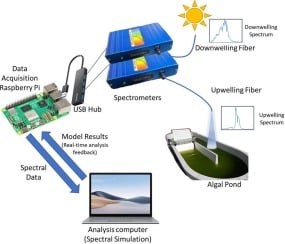
Autonomous, high-frequency monitoring of outdoor algal ponds is needed to quantify biomass productivity and detect culture decline in environments prone to contamination, grazers, and variable operating conditions. We report successes and lessons learned in translating a laboratory spectroradiometric monitoring approach to a multi-year autonomous field deployment at the Arizona Center for Algae Technology and Innovation (AzCATI). The system measures spectrally resolved pond reflectance by ratioing upwelling radiance from each raceway to simultaneous downwelling sky irradiance using fiber-coupled spectrometers. A physics-based reflectance model (ASHARP) is fit to each spectrum pair to estimate optical parameters, including a biomass-proxy coefficient (Ca) which enables near-real-time tracking of biomass accumulation and culture state at 2–5 min intervals. From May 2022 through September 2025 the platform operated continuously while scaling from two to six raceway ponds. Several strains of algae were monitored successfully, including the high productivity Tetraselmis striata and Picochlorum celeri. Transitioning data acquisition from a Windows laptop to a Raspberry Pi improved uptime from 57% (2022) to ~89% (2024–2025) and enabled routine real-time analysis. Further, we converted relative biomass estimates to absolute ash-free dry weight (AFDW) using experimentally-derived calibrations, providing field-relevant biomass predictions with conservative confidence bounds. These results demonstrate the feasibility of long-term, autonomous optical monitoring for well-mixed open-raceway algal cultivation and provide practical guidance for reliable field operation and scaling.
StellarNet Systems:
A single downwelling fiber equipped with a cosine corrector was connected to a spectrometer (StellarNet Blue Wave, BW-VIS, with a 50-um slit) which measured the wavelength-resolved spectrum (335–1169 nm, ±2 nm due to instrument manufacturing differences) of light from the sky. Each pond was equipped with an upwelling fiber which was positioned approximately 4–5 in. from the pond surface at about a 30 deg. angle to collect the spectrum of light reflected from the surface of the individual algal raceways. Each fiber was connected to an upwelling spectrometer (StellarNet Blue Wave, BWVIS, each with a 50 μm slit) which measured the wavelength-resolved spectrum (335–1169 nm, ±2 nm due to instrument manufacturing differences) of light from each of the ponds