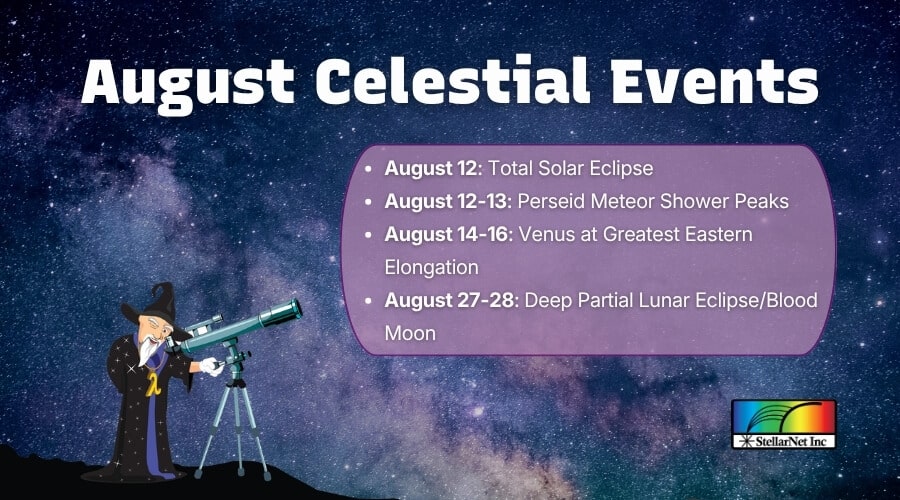
August is an exciting month for skywatchers, with several spectacular celestial events lighting up the sky. On August 12th, a total solar eclipse will cross parts of Greenland, Iceland, and Spain, while the Perseid meteor shower reaches its peak that same night under exceptionally dark, moonless skies. Later in the month, Venus reaches its greatest eastern elongation, offering an excellent opportunity to observe the bright planet, followed by a deep partial lunar eclipse on August 27–28. These events aren’t just beautiful to observe—they also provide scientists with opportunities to study the light and spectra of celestial objects, revealing information about their composition, temperature, and physical properties.
☀️ August 12: Total Solar Eclipse
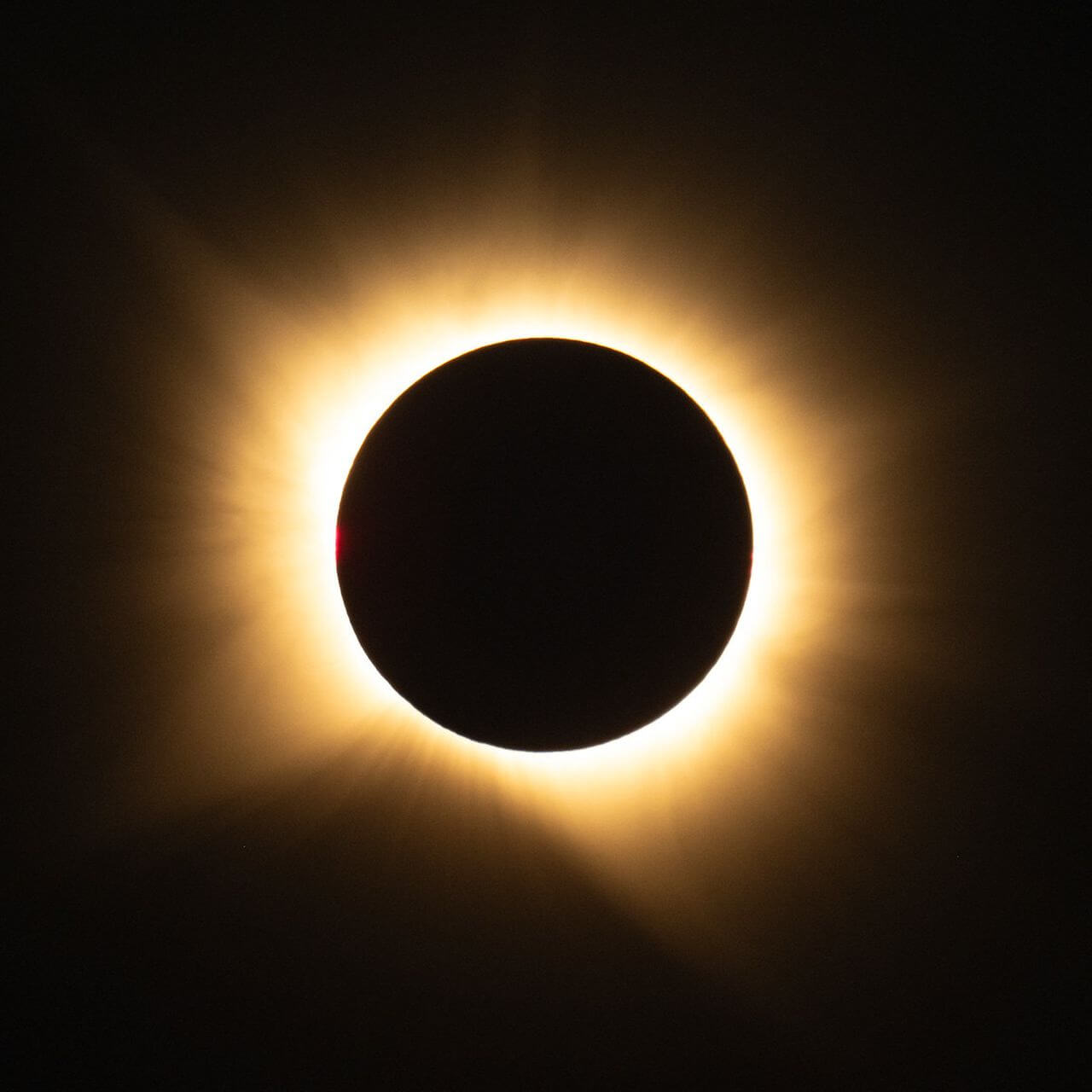
A total solar eclipse is one of the most spectacular celestial events to observe, as the Moon passes directly between Earth and the Sun, temporarily blocking the Sun’s bright disk. Beyond the visual spectacle, eclipses provide scientists with a unique opportunity to study the Sun’s outer atmosphere, including its corona. Spectroscopy can be used to analyze the wavelengths of light emitted by the Sun and identify the elements and physical processes occurring in its atmosphere. StellarNet’s Solar-RAD systems provide a powerful way to measure and analyze solar spectral irradiance.
☄️ August 12–13: Perseid Meteor Shower Peaks
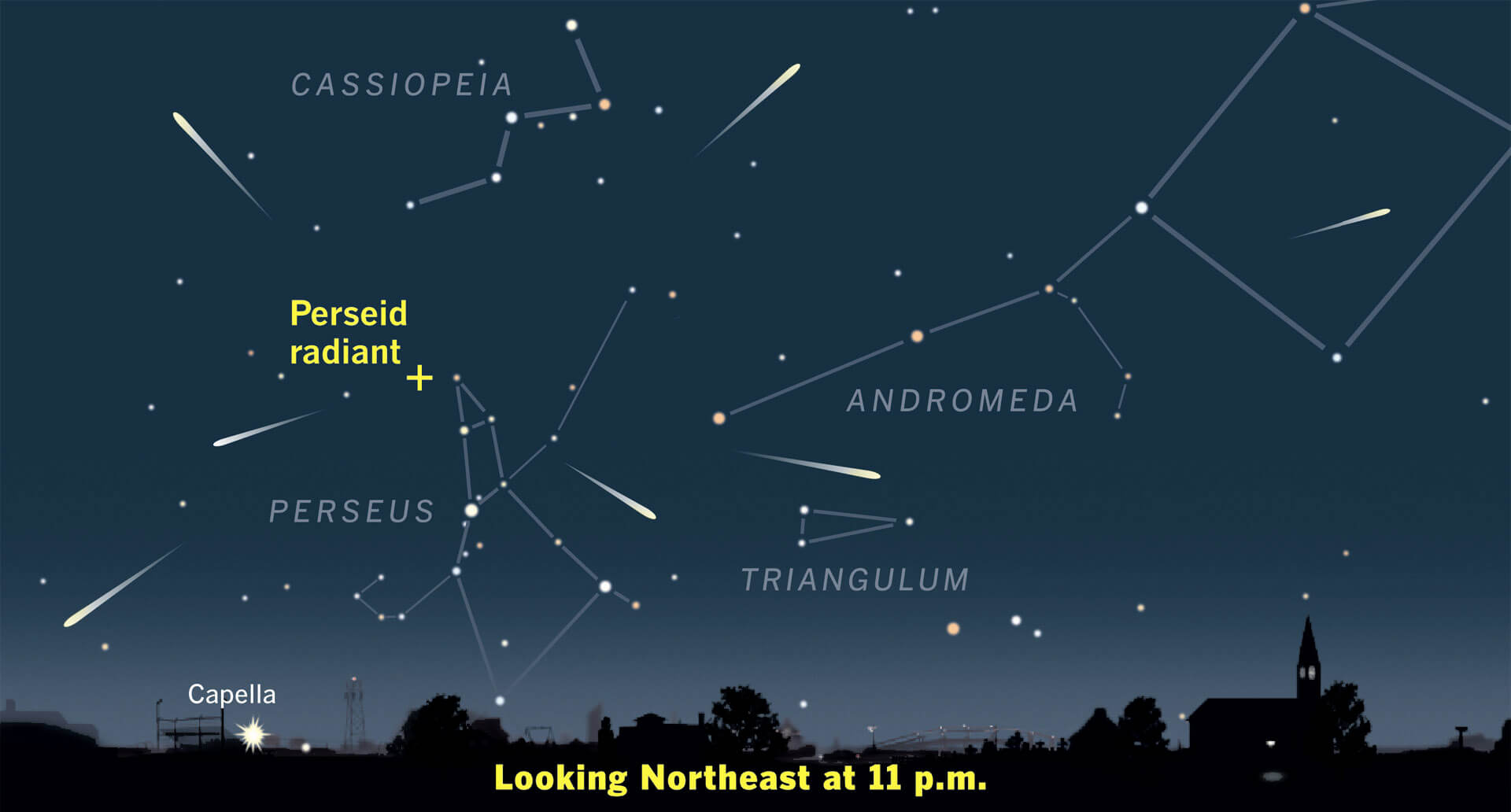
The Perseid meteor shower reaches its peak on August 12–13, when Earth passes through debris left behind by Comet Swift-Tuttle. As these tiny particles enter Earth’s atmosphere, they heat up and produce the bright streaks of light known as meteors. Spectroscopy allows scientists to study the light produced by these meteors and identify the chemical elements present in the particles, providing insight into the composition of material from our solar system.
🪐 August 14–16: Venus at Greatest Eastern Elongation
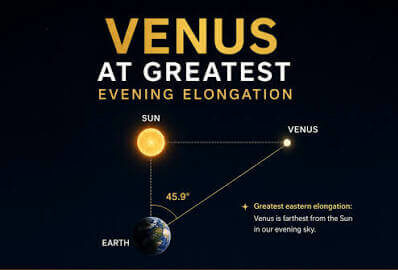
Venus reaches its greatest eastern elongation in mid-August, making it especially easy to spot in the evening sky after sunset. At this point, Venus appears at its greatest angular distance from the Sun as viewed from Earth. By studying Venus’s reflected light with spectroscopy, scientists can investigate the composition of its atmosphere and identify gases and other atmospheric compounds. Spectroscopic observations of planetary bodies like Venus help researchers better understand the conditions and chemistry of our neighboring worlds.
🌕 August 27–28: Deep Partial Lunar Eclipse
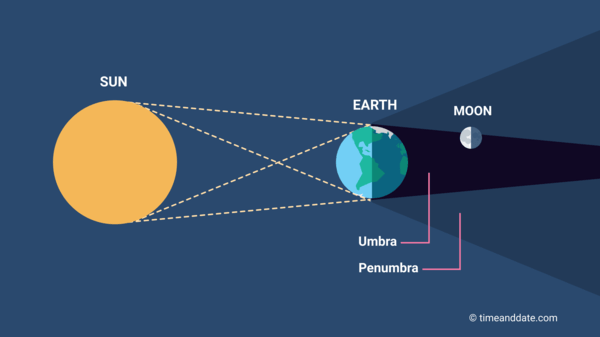
On August 27–28, a deep partial lunar eclipse will occur as the Moon passes through Earth’s shadow, creating the striking reddish appearance often associated with a “Blood Moon.” The changing color of the Moon during an eclipse is caused by sunlight passing through Earth’s atmosphere before reaching the lunar surface. Spectroscopic analysis of this light can provide information about Earth’s atmosphere, while studying the Moon’s reflected spectrum can reveal details about its surface composition. This makes a lunar eclipse an excellent opportunity to explore the interaction between light, Earth’s atmosphere, and the lunar surface.