
Thickness Measurement
Thin film thickness measurement is critical for controlling the performance, quality, and consistency of optical coatings, semiconductor devices, display technologies, and advanced materials. StellarNet thin film metrology systems utilize optical spectroscopy and reflectance-based measurement techniques to provide fast, non-contact characterization of thin films and coatings across a wide range of applications.
These systems enable researchers, engineers, and manufacturers to accurately evaluate film thickness, coating uniformity, and process consistency while reducing measurement time and eliminating the need for destructive testing methods.
How Optical Thin Film Measurement Works
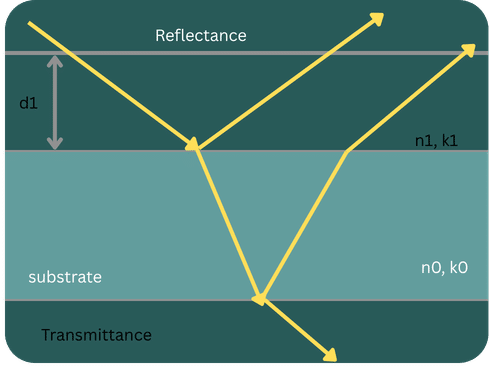
StellarNet Thin Film Measurement Systems determine film thickness by analyzing how light reflects from or transmits through one or more thin film layers. The reflected spectrum contains interference patterns that depend on film thickness, refractive index, wavelength, and layer structure. Advanced optical modeling accurately calculates film thickness and optical properties without contacting or damaging the sample.
Unlike fixed-purpose instruments, StellarNet’s modular platform allows users to configure complete measurement systems using high-performance spectrometers, stabilized light sources, reflectance and transmission fixtures, fiber optic probes, and advanced thin film analysis software. This flexible architecture supports single-layer and multilayer measurements across semiconductor, solar, display, optical coating, and photonic device applications.

Video of a Film Thickness Measurement
- Thin Film Thickness from 50um to 200um
- Real-time Spectral capture for Reflectance and/or Transmittance
- Includes large library of Materials Data
- Supports multilayer, freestanding, rough, & both thick & thin layers
- New materials easily added
- Supports Parameterized materials
- Thin Film Measurement Systems Overview
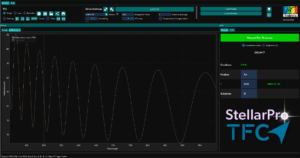
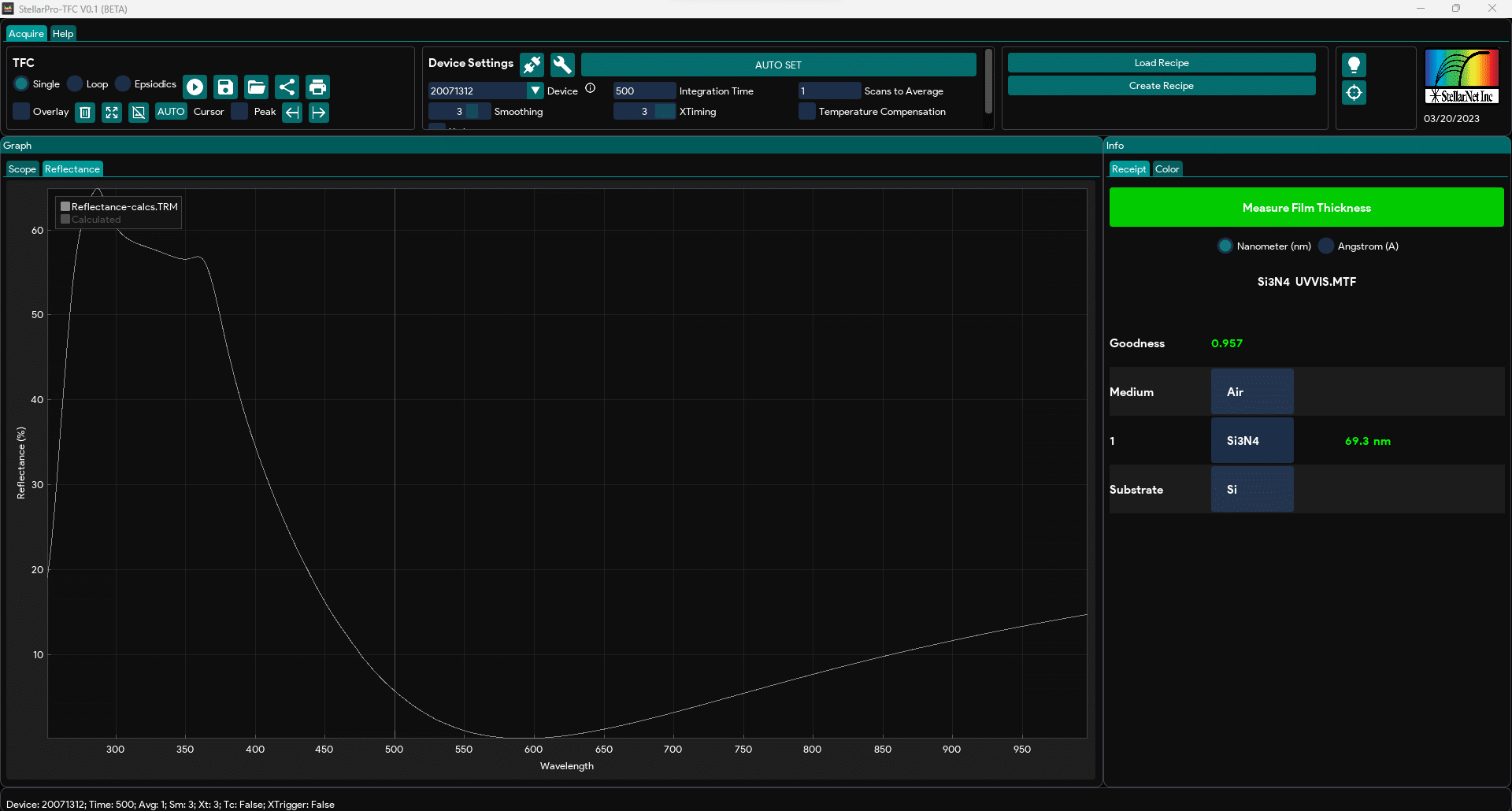
- StellarPro-TFC Software
- MQTT Server Add-on
- Accessories for Film Thickness
Thin Film Characterization Systems for Non-Contact Measurement
We offer a complete line of film thickness measurement systems that can measure from 5 nm to 200 µm for analysis of single layer and/or multilayer films in less than a second. StellarNet thin film reflectometry systems consist of a compact USB spectrometer coupled to a reflectance probe and light source. The optical properties are obtained from reflection and thickness is measured by detecting the sinusoidal fringe pattern from the sample’s specular reflectance. Several thin film systems are available to suit your thin film and/or optical measurement requirements.
TF-VIS – (Thickness Range: 10nm-75um Wavelength Range: 400nm -1000 nm)
Majority of translucent or lightly absorbing films can be measured quickly and reliably: Oxides,Nitrides, Photoresists, Polymers, Semiconductors (Si, aSi, polySi), Hard coatings (SiC, DLC), Polymer coatings (Paralene, PMMA, Polyamides), thin metal films and many more.
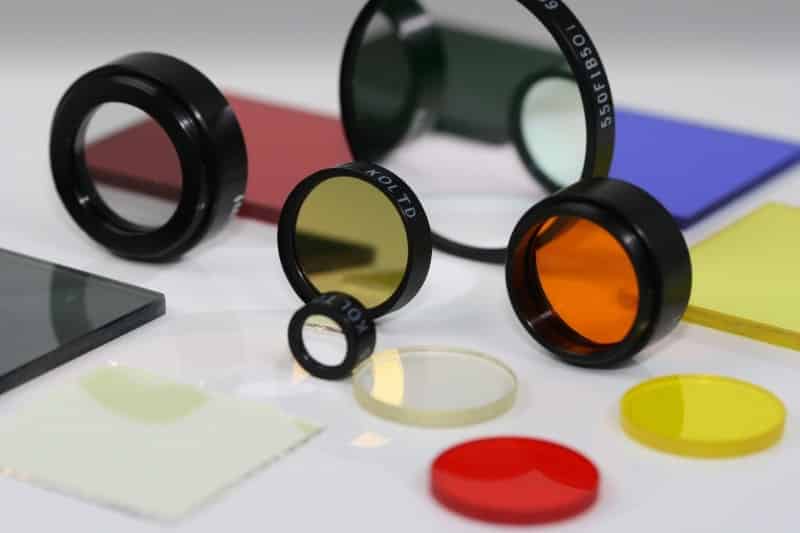
Applications include LCD, FPD: ITO, Cell Gaps, Polyamides. Optical Coatings: dielectric filters, hardness coating, anti-reflection coating Semiconductor and dielectics: Oxides, Nitrides, OLED stack.
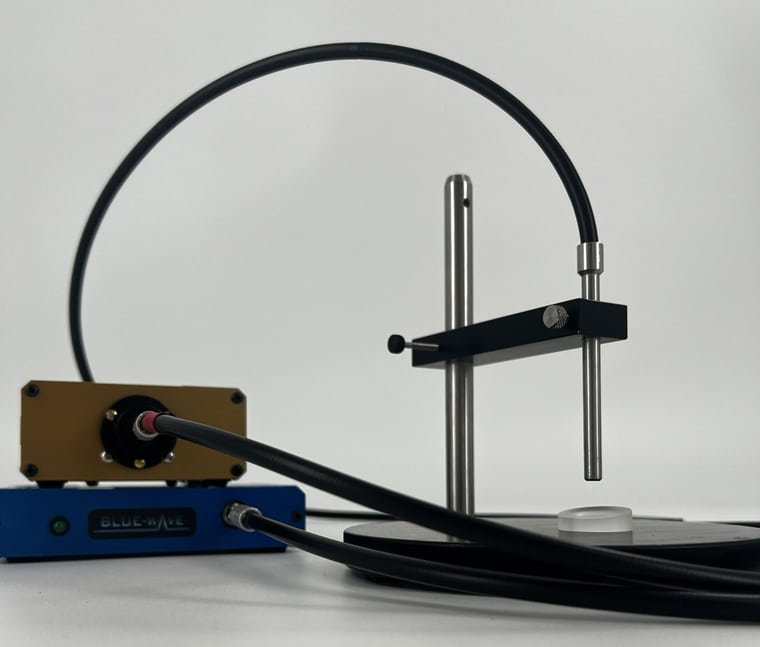
Hardware includes compact visible spectrometer, visible light source, reflectance probe, and reflectance probe holder
TF-UVVIS-SR – (Thickness Range: 1nm- 75um Wavelength Range: 200nm -1000nm)
Allows thinner film measurement down to 1nm with UV-VIS light. Hardware upgrades to UV-VIS spectrometer and UV-VIS source. Fiber optics must be enhanced with -SR (solarization resistance) in order to transmit and collect additional UV signal.
TF-UVVIS-NIR – (Thickness Range: 1nm- 300um Wavelength Range: 200nm -1700nm)
Adding a NIR spectrometer channels allows for thicker films to be measured. check out more model options in the table at the bottom of the page!
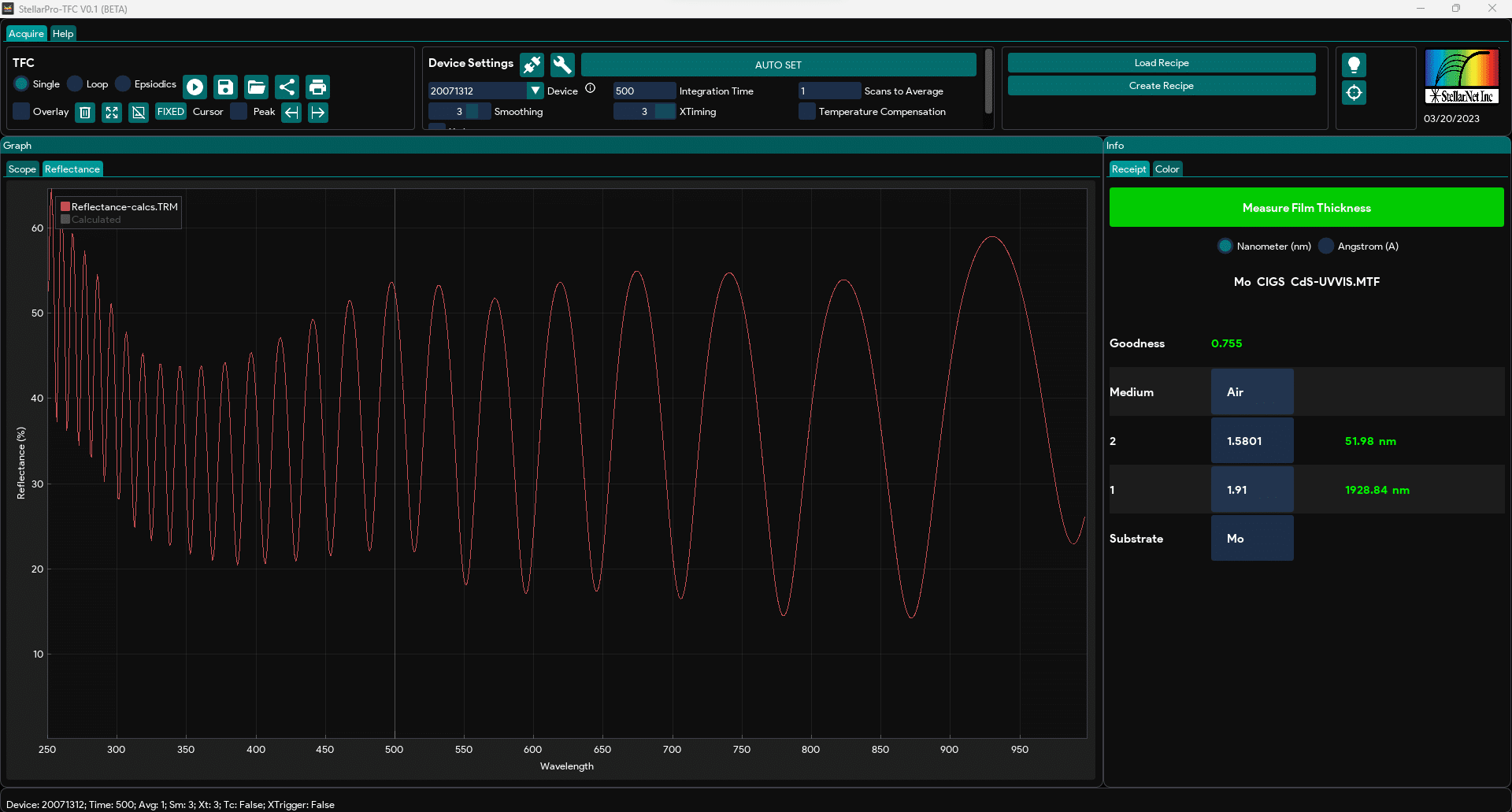
Thickness and optical constants (n and k) can be measured quickly and easily using powerful user-friendly software which make daily complex measurements quick and simple.
StellarPro-TFC software includes a large library of materials data that enables measurement of the wide range of layer structures: multilayer, freestanding, rough, thick and thin layer structures are supported. New materials can be added easily by measuring corresponding sample or importing data from the text file.
The measurement process consists of two steps: data acquisition and data analysis. TF Systems defines all the process in a measurement recipe and makes it transparent to the user. At the same time the user has the ability to store measured data and analyze it later.
StellarPro-TFC supports Parameterized materials e.g. Cauchy, Sellmeir, EMA (effective-medium approximation), Harmonic oscillator, Tauc-Lorentz oscillator, Drude-Lorentz and many more approximations. These approximations represent optical dispersion of materials in desired spectral range using few coefficients that can be adjusted. For example, oxides are frequently represented using Cauchy and glasses using Sellmeir approximation, amorphous materials (e.g. SiNx, aSi) can be represented using Tauc-Lorentz and phase-mixed materials (e.g. poly-Si) using EMA approximation.
Measurements are made using: reflectance/transmittance spectroscopy which measures the optical response of the layer structure. The user creates an optical model of the layer structure and uses data analysis to determine physical properties: the results are inferred from the best fit of measured and modeled data. TF software provides many options to easily analyze simple and most complex filmstacks, graded layers, periodic structures, very thick films, films on thin substrates, multi-sample measurements, etc. Simulation and error-estimator tools allow user better understand data and the expected precision.
During in-situ, in-line or other long running measurements conditions like surface roughness, ambient light, etc. may be changing. StellarPro-TFC software supports roughness and scaling correction that allows factoring in these effects.
From most simple, routine measurements to multilayer, multi-sample analysis – our software is ready to help!
The MQTT server add-on provides a communication interface over the internet. StellarPro-TFC software is deployed as a server and allows users to send a measurement request from any location and receive back the thickness results data.
R600 Reflectance Probe has both illumination and read fibers bundled together coupling to the system. The new, improved reflectance probe holder allows for variable distance from sample.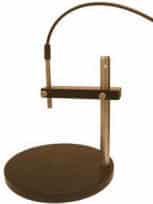
TF-STD1 Thin Film standards for thickness measurement verification. Includes Si substrate for reference with 2 additional SiO2 substrates –
100nm and 1000nm thickness.
*System prices below include probe, stand, and light source. TF-STD1 standards are an additional cost.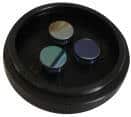
Thin Film Thickness Measurement FAQ
What is thin film thickness measurement?
Thin film thickness measurement is the process of determining the thickness of one or more thin film layers deposited on a substrate. Accurate thickness measurement is essential for controlling optical performance, electrical properties, manufacturing consistency, and product quality across semiconductor, solar, display, optical coating, and photonic device applications.
How is thin film thickness measured?
One of the most common non-contact methods is spectroscopic reflectometry or transmission spectroscopy. Broadband light is directed onto the sample, and the reflected or transmitted spectrum is analyzed using optical models to calculate film thickness, optical constants (n & k), and multilayer structures.
Can multilayer thin films be measured?
Yes. StellarNet Thin Film Measurement Systems support both single-layer and multilayer thin film analysis. Advanced optical modeling enables engineers to characterize complex film stacks used in semiconductor manufacturing, photovoltaic devices, displays, optical coatings, and photonic integrated circuits.
What industries use thin film thickness measurement?
Thin film thickness measurement is widely used in:
- Semiconductor Manufacturing
- Solar & Photovoltaics
- Display Technologies
- Optical Coatings
- Photonic Devices
- MEMS
- LEDs & MicroLEDs
- Scientific Research
- Universities & National Laboratories
What properties can be measured besides film thickness?
Depending on the material and system configuration, StellarNet Thin Film Measurement Systems can determine:
- Film Thickness
- Reflectance
- Transmission
- Optical Constants (n & k)
- Spectral Response
- Layer Uniformity
- Multilayer Structure
- Process Monitoring Data
What is the advantage of non-contact optical measurement?
Optical thin film measurement is fast, non-destructive, and does not damage delicate samples. Because the measurement is completely non-contact, it is well suited for sensitive semiconductor wafers, optical coatings, display panels, photovoltaic devices, and precision photonic components.
Can transparent coatings be measured?
Yes. Optical reflectance and transmission spectroscopy are particularly well suited for transparent and semi-transparent coatings, including anti-reflective coatings, dielectric films, transparent conductive oxides, photoresists, and many multilayer optical structures.
Can metal films be measured?
Some thin metal films and transparent conductive materials can be characterized depending on their optical properties, thickness, substrate, and measurement wavelength. Our engineering team can help determine the most appropriate configuration for your specific application.
What wavelength range is required for thin film measurement?
The ideal wavelength range depends on the film material, thickness, and substrate. StellarNet offers configurable Thin Film Measurement Systems covering UV, Visible, and Near-Infrared wavelengths, allowing systems to be optimized for a wide variety of applications.
What is the difference between reflectance and transmission measurement?
Reflectance measurements analyze light reflected from the sample surface and film interfaces, while transmission measurements analyze light passing through the sample. Depending on the material, thickness, and substrate, one or both techniques may be used to improve characterization accuracy.
Why choose a modular Thin Film Measurement System?
Unlike fixed-configuration instruments, StellarNet Thin Film Measurement Systems feature a modular architecture that allows users to configure spectrometers, light sources, reflectance and transmission fixtures, microscope accessories, and fiber optic probes for specific materials and applications. This flexibility supports research, process development, manufacturing, and future system upgrades as measurement needs evolve.
What sample types can be measured?
StellarNet systems can measure a wide range of samples, including:
- Semiconductor Wafers
- Optical Components
- Solar Cells
- Display Glass
- Thin Film Filters
- Photonic Devices
- Glass Substrates
- Silicon Wafers
- Sapphire Substrates
- Transparent Polymer Films
Can Thin Film Measurement Systems be customized for my application?
Yes. Every thin film application has unique measurement requirements based on material properties, film thickness, substrate type, wavelength range, and measurement geometry. StellarNet’s engineer-owned team works directly with customers to configure complete Thin Film Measurement Systems tailored to their application.
How accurate are optical thin film thickness measurements?
Optical thin film measurement accuracy depends on factors such as material properties, film structure, optical models, wavelength range, and signal quality. When properly configured, spectroscopic reflectometry provides highly repeatable, non-contact measurements suitable for research, process development, and manufacturing quality control across a wide range of thin film applications.
What Can Be Measured?
StellarNet Thin Film Measurement Systems are designed to characterize a wide range of transparent and semi-transparent thin films used in research, process development, and manufacturing. From single-layer coatings to complex multilayer structures, our systems provide rapid, non-contact measurement of film thickness and optical properties across numerous materials and applications.
Typical measurable materials include:
- Silicon Dioxide (SiO₂)
- Silicon Nitride (Si₃N₄)
- Photoresists
- Indium Tin Oxide (ITO) & Other Transparent Conductive Oxides (TCOs)
- Dielectric Thin Films
- Optical Polymers & Protective Coatings
- Anti-Reflective (AR) Coatings
- High-Reflectivity (HR) Mirror Coatings
- Optical Filter Coatings
- Beam Splitter Coatings
- Perovskite Thin Films
- CdS & CIGS Solar Cell Layers
- OLED & Display Thin Films
- Multilayer Optical Film Stacks
Don’t see your material?
Our engineer-owned team works directly with customers to develop custom thin film measurement solutions for new materials, multilayer structures, and emerging applications.
Why Choose a StellarNet Modular Thin Film Measurement System?
| Traditional Fixed System | StellarNet Thin Film Measurement Systems |
|---|---|
| Fixed wavelength range | Configurable UV, VIS & NIR wavelength ranges |
| Limited hardware options | Modular spectrometers, probes & fixtures |
| Difficult to upgrade | Expandable as applications evolve |
| Single-purpose configuration | Supports semiconductor, solar, display, optical coatings & photonics |
| Closed architecture | Flexible, engineer-configured solutions |
Explore our Thin Film Thickness Applications



Technical Information Request
BSA Mediated Stabilized Dispersion of Hydrophobic Organic Nanoparticles Produced by Pulsed Laser Fragmentation in Liquid
Akiko Sunada, Tomosumi Kamimura, and Ryohei Yasukuni | Journal of Laser Micro Nanoengineering | August 1, 2026 | 10.2961/jlmn.2026.02.2009 Abstract The complex synthesis of nanopharmaceuticals still faces hurdles regarding stability, sterilization, storage, and...