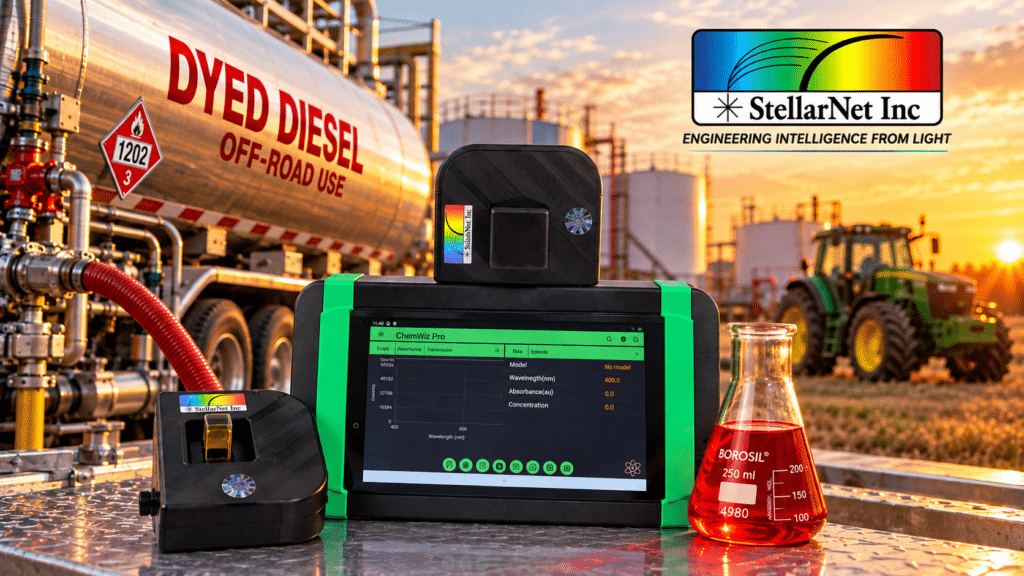
Red dyed diesel—also known as red diesel, off-road diesel, dyed diesel, or farm diesel—has suddenly become a national topic. On October 5, 2026, President Donald Trump signed an executive order temporarily allowing dyed diesel to be sold for and used on U.S. highways through December 31 while directing Treasury to consider deferral of certain applicable federal excise-tax payments. The order also provides relief from the normal federal penalties associated with selling or using dyed diesel for highway purposes during that period.
Behind that policy story is an interesting analytical question: How do you determine whether diesel contains red dye—and how much is actually present? The answer is visible spectroscopy.
What Is Red Dyed Diesel and Why Is It Red?
Under normal U.S. rules, diesel intended for qualifying tax-exempt or off-highway applications is marked with red dye so that it can be distinguished from conventional taxed highway diesel. Typical applications include agricultural equipment, construction machinery, generators and other qualifying off-road uses.
The dye is generally added within the fuel distribution system, including at terminals and refineries before the product is sold. Testing can therefore occur at both ends of the process: petroleum companies can verify that fuel has been properly dyed, while government fuel-compliance personnel can analyze fuel to determine whether dyed product is present where it should not be.
The primary dye used for U.S. tax-exempt diesel is Solvent Red 164. ASTM D6258 specifies that tax-exempt diesel satisfy the dye requirement at a concentration spectrally equivalent to 11.1 mg/L of Solvent Red 26. Solvent Red 26 is used as the analytical reference because it is available in certified-pure form; Solvent Red 164 incorporates alkyl groups that improve its solubility in diesel but has a very similar visible spectrum. ASTM specifically identifies the method for both verifying dye addition at terminals or refineries and detecting dye in taxed product intended for highway use.
This is what makes red diesel an interesting spectroscopy application. The regulatory marker is present at only milligram-per-liter concentrations, but it produces a strong optical response in the visible spectrum that can be measured quantitatively.
Measuring Red Dye Concentration with Visible Spectroscopy
ASTM D6756 is specifically titled Standard Test Method for Determination of the Red Dye Concentration and Estimation of the ASTM Color of Diesel Fuel and Heating Oil Using a Portable Visible Spectrophotometer. The current D6756-25 method covers dye concentrations equivalent to approximately 0.1–20 mg/L of Solvent Red 26 in No. 1 and No. 2 diesel fuel and heating oil. It also addresses an important analytical complication: the underlying diesel itself can have different colors, so quantitative testing must distinguish the dye response from the natural optical characteristics of the base fuel.
Solvent Red dyes absorb strongly in the visible region. Rather than simply determining whether a fuel sample “looks red,” a spectrometer records absorbance as a function of wavelength. Measurements across the visible spectrum allow changes associated with the dye to be distinguished from the broader background of the diesel sample and related quantitatively to calibrated standards. That is where full-spectrum spectroscopy becomes particularly useful.
StellarNet’s ChemWiz Handheld Absorbance Spectrophotometer can combine a research-grade spectrometer, light source, cuvette sampling and analysis software in a compact configuration for laboratory or field chemical measurements. The system is designed to collect complete absorbance spectra and perform concentration measurements rather than measuring only a single optical point.
For a dedicated fuel-dye analyzer, the platform covers 350–1150 nm, while the VIS2 configuration covers 380–780 nm with higher spectral resolution. The spectrometers use 16-bit electronics, provide signal-to-noise performance up to 1000:1, and are designed for portable, laboratory, process and field measurements.
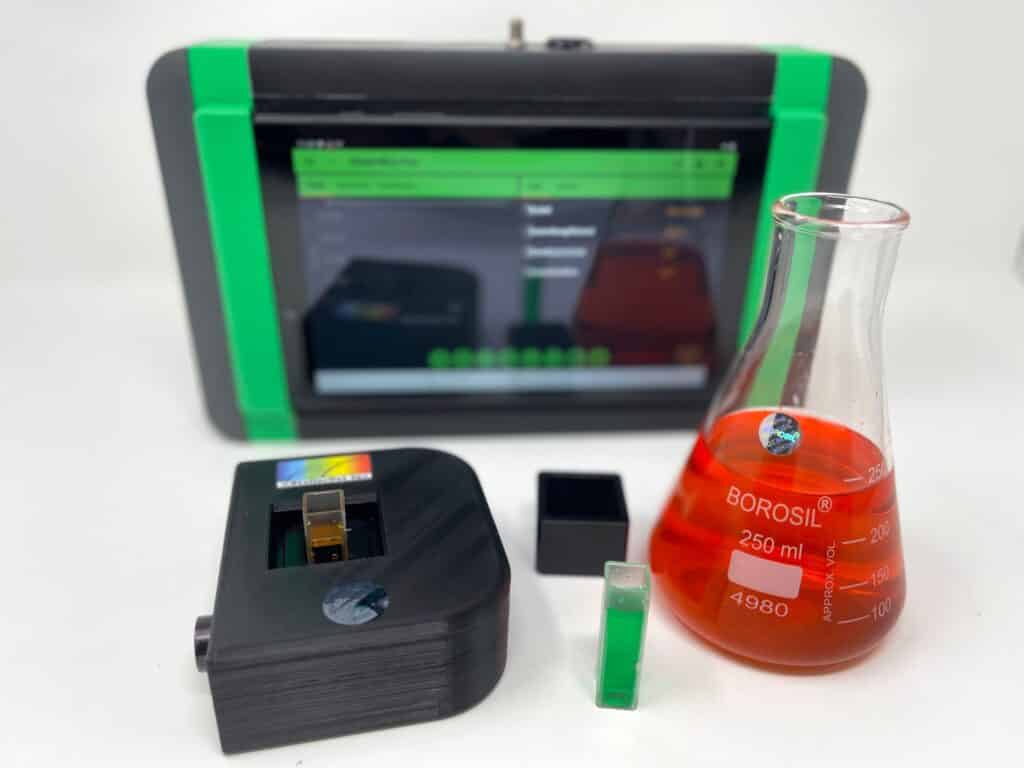
A StellarNet ChemWiz visible absorbance analyzer can combine a spectrometer, light source and cuvette sampling for full-spectrum analysis of liquid samples.
A practical red diesel calibration could compare undyed diesel with samples containing increasing concentrations of certified dye standard across the ASTM measurement range. As concentration increases, the corresponding visible absorption changes can be measured and modeled, allowing an unknown fuel sample to be reported quantitatively rather than simply classified by eye.
Who Tests Red Diesel—and Why 2026 Is Different
Red dye testing has traditionally served two related purposes. Fuel terminals, refineries, distributors and petroleum laboratories may need to verify that the correct amount of dye has been added to tax-exempt product. Government and fuel-compliance organizations may test diesel from distribution systems, storage tanks or vehicle propulsion tanks to determine whether dyed fuel is present and at what concentration. ASTM D6258 explicitly identifies both terminal/refinery verification and detection of dyed fuel in product intended for on-road use as applications of the method.
The federal diesel excise tax is 24.4 cents per gallon, meaning the temporary federal treatment can represent about $61 on 250 gallons, $244 on 1,000 gallons, or $2,440 on 10,000 gallons. The White House describes the federal impact as approximately $60 on a 250-gallon fill and says the savings could be higher where states take corresponding action.
There is an important qualification, however. The October 5 executive order does not simply permanently eliminate the federal diesel tax. It directs Treasury, subject to its statutory authority and required determinations, to defer certain federal excise-tax obligations incurred from October 5 through December 31 without penalties or interest. Treasury is also directed to explore lawful ways to eliminate the obligation to repay deferred amounts. Separately, the order directs the IRS not to impose specified dyed-diesel highway-use penalties during that period.
That temporary change creates an unusual situation for the fuel industry. Dyed diesel that historically signaled off-road or tax-exempt use can now circulate legally in highway applications during the relief period. Unless the policy is extended or otherwise changed, the current relief ends December 31, 2026.
At that point, quantitative fuel-dye testing may become particularly relevant again. Trucks, storage tanks and distribution systems could still contain dyed fuel introduced during the temporary relief period. Fuel suppliers and regulators may therefore need to distinguish between the simple presence of residual red dye and concentrations associated with dyed fuel. How agencies handle that transition will depend on subsequent Treasury, IRS and state guidance, but quantitative measurement provides substantially more information than a visual inspection alone.
Full-Spectrum Red Diesel Analysis
Red dyed diesel demonstrates how a relatively simple optical measurement can have important consequences throughout an industrial supply chain. A small concentration of Solvent Red dye creates a measurable visible-spectrum signature that can be used for fuel quality control, dye concentration verification and regulatory testing.
ASTM already recognizes visible spectroscopy for these measurements. StellarNet’s broader family of UV-VIS spectrometers provides compact fiber-optic instrumentation for laboratory, industrial, OEM and portable applications, while the ChemWiz platform provides a pathway toward packaging spectroscopy, sampling and quantitative analysis into a purpose-built analyzer.
The current dyed-diesel policy has made an otherwise specialized analytical measurement suddenly relevant to a much wider audience. Whether the goal is verifying dye addition at a fuel terminal, measuring an unknown diesel sample, or understanding what happens when normal highway-fuel rules return, portable visible spectroscopy provides a quantitative way to answer the question that color alone cannot: not simply whether the diesel is red, but how much dye is actually present.
References