
Raman Spectroscopy of Pillow Lavas from the Anaga zone Tenerife Canary Island-September 2011
E Lalla, As Caramazana, As Arrana, et al. -Journal of the Spanish Society of Mineralogy
Some lava deposits have been reported on Mars by Martinez-Alonso et al (2008), showing similar characteristics to those of terrestrial pillow lavas. Pillow Lavas are an unequivocal sign of volcanism in an aqueous environment. Pillows are found in a wide variety of shapes including near-spherical bulbous pillows, flattened pillows, elongate and tubular pillows, and trapdoor pillows. They are probably the most abundant lava structural type on Earth. However, this kind of structure shares a concentric geometry and large central cavities, butthey have differences in mineralogy, on the degree of crystallization, and the jointing. The main reason is that the interiors cool more slowly than the quenched glass rind, being more crystalline. Progressive crystallization at slower cooling rates toward the interior produces a variety of rock textures, and the interiors of large pillows may be almost entirely crystalline (Kenish et al.,1998). Studying and understanding the pillows lavas could help us to understand the past of Mars… The detection was performed with a CCD Andor DV420A- OE-130. Furthermore XRD (with XRD diffractometer Philips PW1710), IR- Spectroscopy (PerkinElmer Spectrum 100 FT-IR spectrometer) and LIBS (Porta-Libs from Stellar Net) were used.
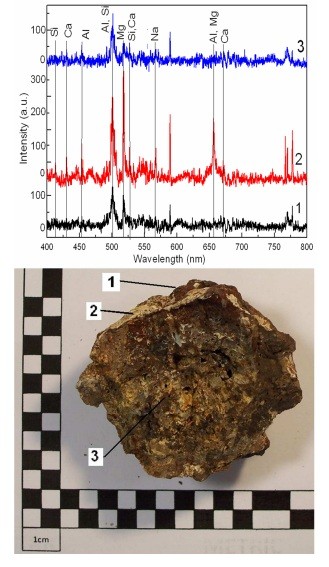
fig 5. Laser Induced Breakdown Spectrometry of Pillow Lava Sample. On the Spectra is only shown the most intense peaks. (1) Brown External Face (2) White External Face (3) Red-Brown Internal Face