Abstract
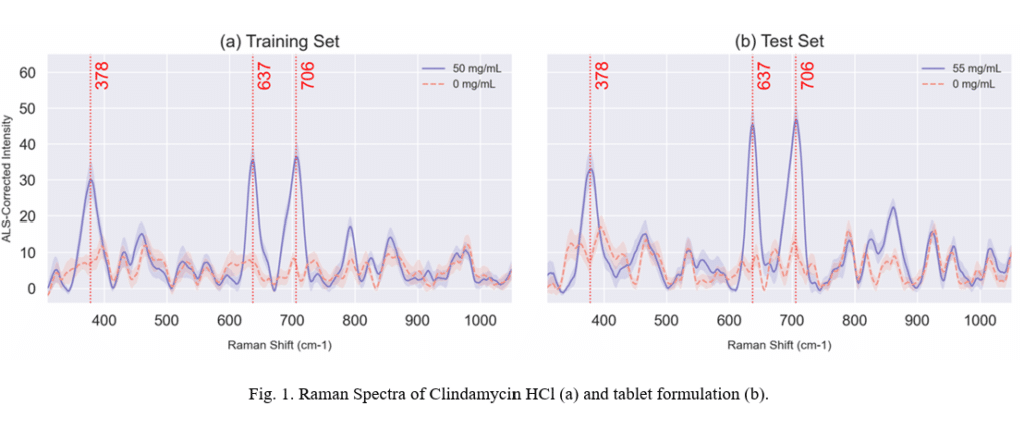
Raman spectroscopy offers a powerful, non-destructive tool for pharmaceutical quantification, particularly in environments where traditional techniques like HPLC are limited by throughput and sample preparation demands. However, the quantification of low-concentration compounds remains challenging due to weak Raman scattering and high background interference. This study evaluates the use of portable Raman instrumentation coupled with Support Vector Regression (SVR) to quantify clindamycin across various concentrations. Spectral preprocessing steps included Savitzky–Golay smoothing, Standard Normal Variate (SNV) normalisation, and blank subtraction (ΔSNV) to enhance analyte-specific signal fidelity. Three SVR-based models were developed using full spectra, chemically meaningful fingerprint bands, and coefficient-filtered features. Models were evaluated through grouped cross-validation, bootstrapping, and external testing on formulations prepared in different solvent matrix and derived from distinct clindamycin sources (commercial tablet vs. analytical-grade standard). The top performing model achieved R² values exceeding 0.98 with root mean squared errors below 2.85 mg/mL. Blind sample predictions, made on fully unseen data, fell within 95% confidence intervals of the true concentrations, demonstrating strong model robustness.
StellarNet System:
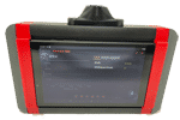
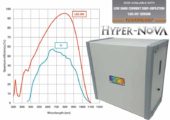
All spectral measurements were acquired using a StellarNet Quasar-TEC-X2 Raman spectrometer, coupled with a RamuLaser-785 excitation source. This compact, modular system is designed for field and benchtop applications, combining flexibility with analytical-grade performance. Its architecture consists of a 785 nm laser, a high-throughput fibre-coupled spectrometer, and a thermoelectrically cooled CCD detector. The setup is particularly suitable for quantitative Raman spectroscopy due to its low baseline drift and stable long-term operation.