Quantified oxygen evolution at microelectrodes- December 2012
KP Rataj, C Hammer, B Walther, MM Lohrengel – Electrochimica Acta, 2012
The anodic oxygen evolution on Cu, Co and Mo was investigated under potential control in flow-through micro cells by fluorescence quenching of dichlorotris(1,10-phenanthroline)ruthenium(II)hydrate. The experiments were carried out in concentrated chloride and nitrate solutions up to extreme currents of 70 A/cm2. The amounts of oxygen were compared to the anodic charge and yielded oxygen efficiencies. In concentrated nitrate electrolyte, this efficiency is >70% for Cu around 1 A/cm2 and decreases to less than 20% at larger current densities, indicating strong Cu dissolution. The reduction of oxygen is due to the formation of supersaturated product films with low water content. Co dissolves in active state without oxygen evolution up to 10 A/cm2 but then shows some tendencies of passivation with oxygen evolution. Mo dissolves as molybdate with 5% oxygen in nitrate and even less in chloride. … 2.3. Spectroscopic set-up. A blue LED (450 nm, Phillips Luxeon K2) was used as high efficiency power source. The fluorescence light was coupled under 90° via glass fibre to the spectrometer (UV-Vis Black Comet, Stellarnet Inc).
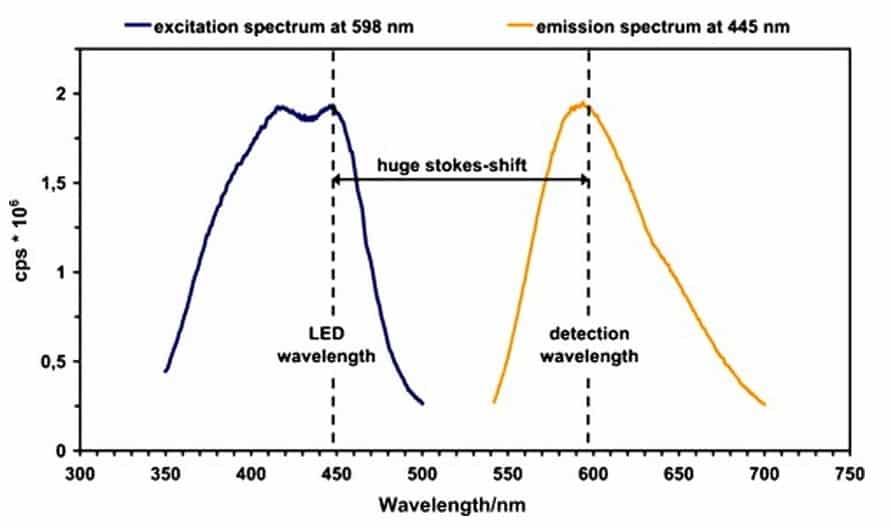
Fig. 1. Excitation and emission spectrum of dichlotris (1,10-phenanthroline)ruthenium(II)hydrate in de-aerated water.
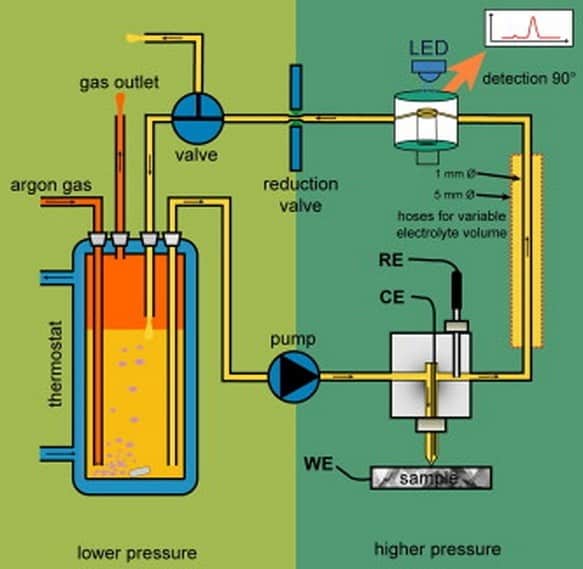
Fig. 2. Scheme of the complete experimental set-up for oxygen quantification.
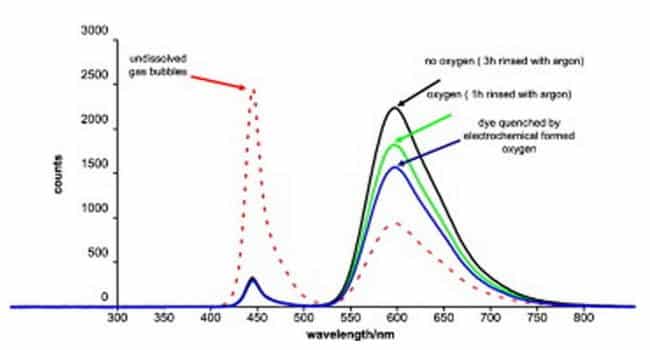
Fig. 3 ( a little blurry) Dispersion and fluorescence signals of Ru(II)phen. The electrolyte was rinsed with argon until the count maximum was reached (598 nm). Dispersion at 445 nm (dashed line) means non-dissolved gas bubbles.