Ileana Ielo 1, Federica De Gaetano 1,Elpida Piperopoulos 2,Giovanna De Luca 1, and Sabrina Conoci 1,3,4
16 January 2025 | 1) Department of Chemical, Biological, Pharmaceutical and Environmental Sciences, University of Messina, Viale F. Stagno d’Alcontres 31, 98166 Messina, Italy 2) Technology and Research on Energy, Environment and Safety Materials, Department of Engineering, University of Messina, Contrada Di Dio, 98166 Messina, Italy 3) Department of Chemistry “Giacomo Ciamician”, University of Bologna, Via Selmi 2, 40126 Bologna, Italy 4) Institute for Microelectronics and Microsystems, National Research Council (CNR-IMM), Ottava Strada n.5, 95121 Catania, Italy
Abstract
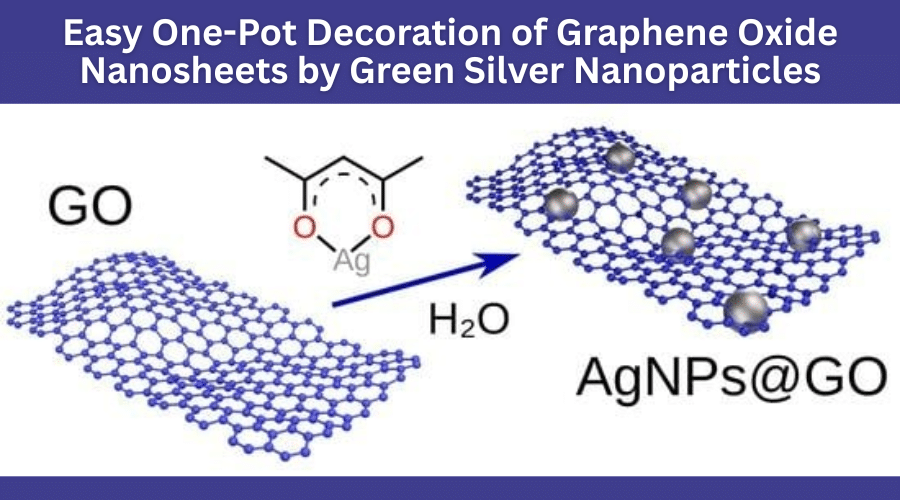
In this study, we developed a facile one-pot synthesis of a nanocomposite consisting of silver nanoparticles (AgNPs) growing over graphene oxide (GO) nanoflakes (AgNPs@GO). The process consists of the in situ formation of AgNPs in the presence of GO nanosheets via the spontaneous decomposition of silver(I) acetylacetonate (Ag(acac)) after dissolution in water. This protocol is compared to an ex situ approach where AgNPs are added to a waterborne GO nanosheet suspension to account for any attractive interaction between preformed nanomaterials. The systems under investigation are characterized by UV/vis absorption spectroscopy, dynamic light scattering (DLS), zeta potential (Z-Pot), and scanning electron microscopy with energy-dispersive X-ray spectroscopy (SEM-EDX). The stability of the AgNPs@GO composite suspension is tested as a function of GO concentration (0–67 μg/mL) while maintaining a constant Ag content (14.4 μg/mL), exhibiting excellent stability over time up to an Ag-to-GO mass ratio of 0.58.
Keywords: silver nanoparticles; graphene oxide; one-pot nanoparticle synthesis; green nanoparticle synthesis; nanocomposite
Introduction
The graphene manufacturing Industry, particularly focused on graphene nanomaterials, holds immense potential for significant economic impact worldwide. While it is still in its early stages of commercialization, the global graphene market is projected to reach a value of USD 200 million by 2026 [1]. The increasing need for advanced materials in various industries, including the development of antibacterial coatings [2] and quantum technology devices [3], is driving this growth. Among graphene-based nanocomposites, silver nanoparticles/graphene oxide nanosheets represent a promising class of nanoarchitectures with diverse applications in fields ranging from electrocatalysis [4,5,6,7] to biomedicine [8,9] or sensing [10,11]. The unique properties of silver nanoparticles (AgNPs) and graphene oxide (GO), including high surface area, electrical conductivity, tunable surface chemistry, and (bio)active properties, synergistically contribute to the enhanced performance and multifunctionality of the nanocomposite material [5,6,12,13,14]. Ensuring the chemical stability of such nanocomposites, e.g., their ability to maintain their structural integrity, prevent agglomeration, and resist chemical degradation under various environmental conditions, is paramount for their practical utilization, processability, and long-term efficacy [15]. In this context, finding simple routes for fabricating Ag-decorated GO nanosheets and investigating the chemical stability of their suspensions is essential for elucidating the behavior in real-world applications and guiding the development of robust and reliable nanomaterials.
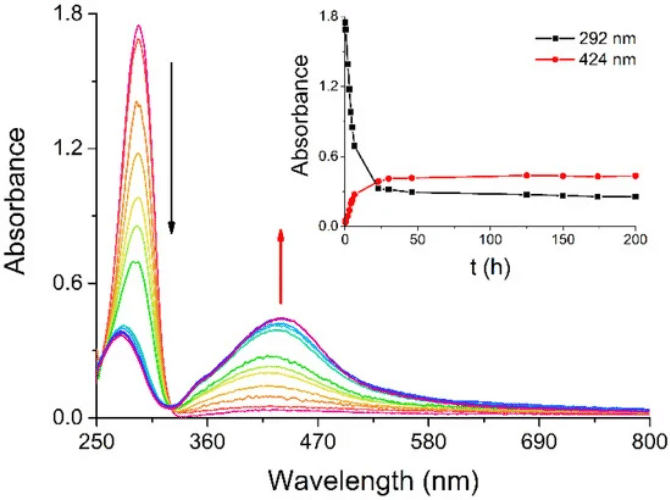
Figure 1
UV/Vis spectral change observed during the kinetics of the spontaneous AgNP formation from Ag(acac). Inset: absorbance of the spectra in the main graph measured at fixed wavelength (292 and 424 nm) vs. time.
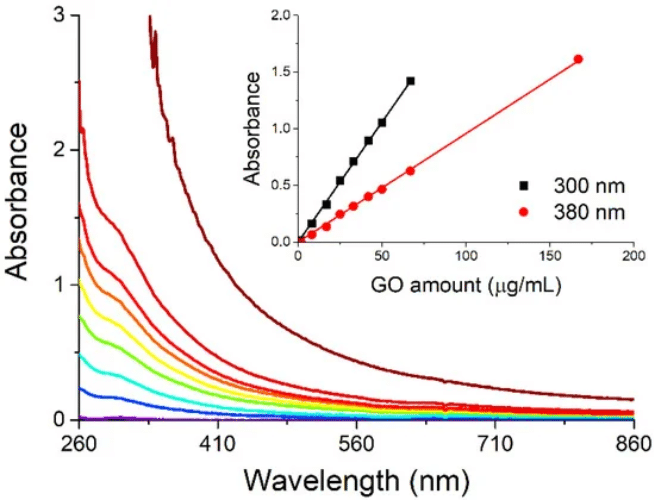
Figure 4
UV/Vis spectra of GO suspensions in UPW as a function of nanosheet concentrations (0–167 µg/mL). Inset: absorbance of the spectra in the main graph measured at fixed wavelength (300 and 380 nm) vs. GO concentration.
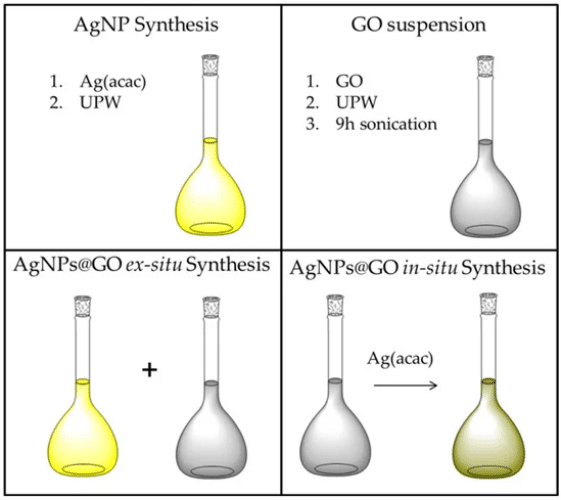
Figure 8
Schematic representation of AgNP synthesis; GO suspension preparation; AgNPs@GO ex situ and in situ synthesis.
Among the synthetic methods for preparing AgNPs, we chose one that may yield particles with high surface reactivity, such as the protocol devised by Giuffrida et al., which leads to naked AgNPs in water [16]. As reported in the literature, the absorption band observed at 292 nm for a water solution of silver(I) acetylacetonate (Ag(acac)) slowly decreases in intensity while a broad new band forms around 424 nm, in the region typical for AgNPs (Figure 1) [16,17].
The spontaneous decomposition of Ag(acac) has been monitored by UV/Vis spectroscopy to examine the kinetics of AgNP formation at room temperature and determine the time required for their complete synthesis. AgNP nucleation begins within the first minutes, as indicated by the overall spectral change (Figure 1) and the plots of the absorbance at the absorption maxima vs. time (Figure 1, inset), with the reaction being substantially over after about 23 h from Ag(acac) dissolution.
Materials and Methods
“Characterizations: UV/Vis absorption spectra of all the suspensions were measured in 1 cm PMMA cuvettes with a Stellarnet BLACK-Comet-SR diode array spectrophotometer (StellarNet Inc., Tampa, FL, USA) equipped with a combined deuterium/tungsten halogen lamp (Stellarnet mod. SL5) and a multimodal fiber optic cable (length: 1 m; diameter: 1 mm; optical range: 190–1100 nm). The samples were gently inverted once to homogenize them before recording the spectra…”