Display Measurement Features 
- Optical performance tests for LCOS, LCD, OLED, & other flat panel displays
- Display Measurement Systems include a miniature spectrometer, a fiber optic cable (or direct attachment), a light collecting accessory/lens assembly, and a NIST traceable intensity calibration
- Reliably measure Display output intensity in Candela/m^2 (nits), xy chromaticity, color purity, contrast, specular and diffuse reflection, and a variety of other measurements
- All sizes of display modules and panels from micro/mobile displays such as cell phones and tablets to large LCD TVs. Likewise systems can be configured for dim light emission as well as extremely bright
- Display Measurement Systems Overview
- NIST Calibrations
- Setup Diagrams
- Night Vision Compatibility Testing
The StellarNet spectrometers are great tools for low cost, routine analysis of all types of displays and monitors. The increasing use and popularity of flat panel displays for televisions, computer monitors, laptops, automotive displays, cell phones, and mobile devices of all kinds requires accurate, fast, and cost-effective methods for measuring color, luminance, and various other output parameters. In R&D applications there is a continuing need for low cost and easy-to-use measurement systems that can be applied to all sorts of display sizes, brightness, and technologies — LCD, plasma, OLED and LED.
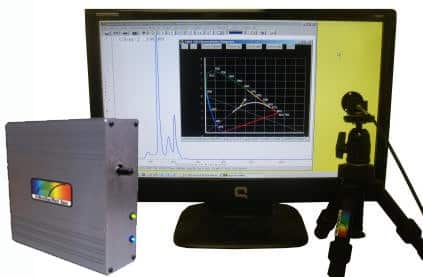
Display Measurement Systems include a miniature spectrometer, a fiber optic cable (or direct attachment), a light collecting accessory/lens assembly, and a NIST traceable intensity calibration CHOOSE FROM THE SYSTEM OPTIONS BELOW
In manufacturing, accurate, repeatable, quantitative measurement methods are needed to replace traditional human inspection techniques. Also, StellarNet’s line of low cost spectrometers are small, portable, and robust which allows for a more economical solution to the larger benchtop display measurement alternatives. Likewise, multiple spectrometers can be deployed in production facilities, taken into the field, and transported easily from one location to another increasing the ease of inspection and quality control.
- Low cost – Ruggedized – high performance
- High dynamic range and system flexibility
- Many light collecting accessories and calibration options
- Shock-proof – Permanent alignment
- Easy to use SpectraWiz Software included free
- USB-2 interface to all Windows PCs
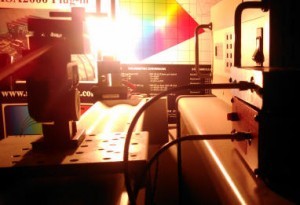 The factory performs calibrations for the appropriate wavelength range of your spectrometer using NIST traceable calibration lamps (calibration service IRRAD-CAL must be ordered with spectrometer and proper measurement accessories)
Fast delivery: most system can be calibrated and shipped within 1 week after receipt of order.
Absolute calibration: accuracy within 10% at detector integration setting used for calibration.
Certificate available: documentation with NIST traceable serial numbers.
If the user has an appropriate irradiance calibration source lamp, a field re-calibration can be easily performed using the included SpectraWiz software.
- Fast delivery: most system can be calibrated and shipped within 1 week after receipt of order
- Absolute calibration: accuracy within 10% at detector integration setting used for calibration
- Certificate available: documentation with NIST traceable serial numbers.
- If the user has an appropriate irradiance calibration source lamp, a field re-calibration can be easily performed using the included SpectraWiz software
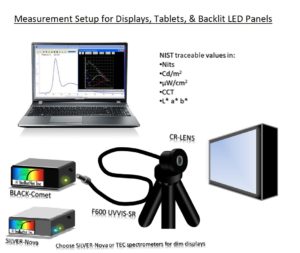
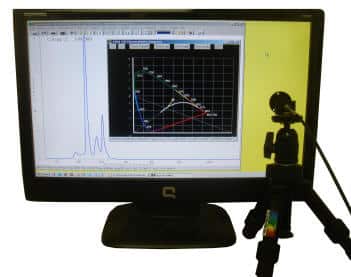
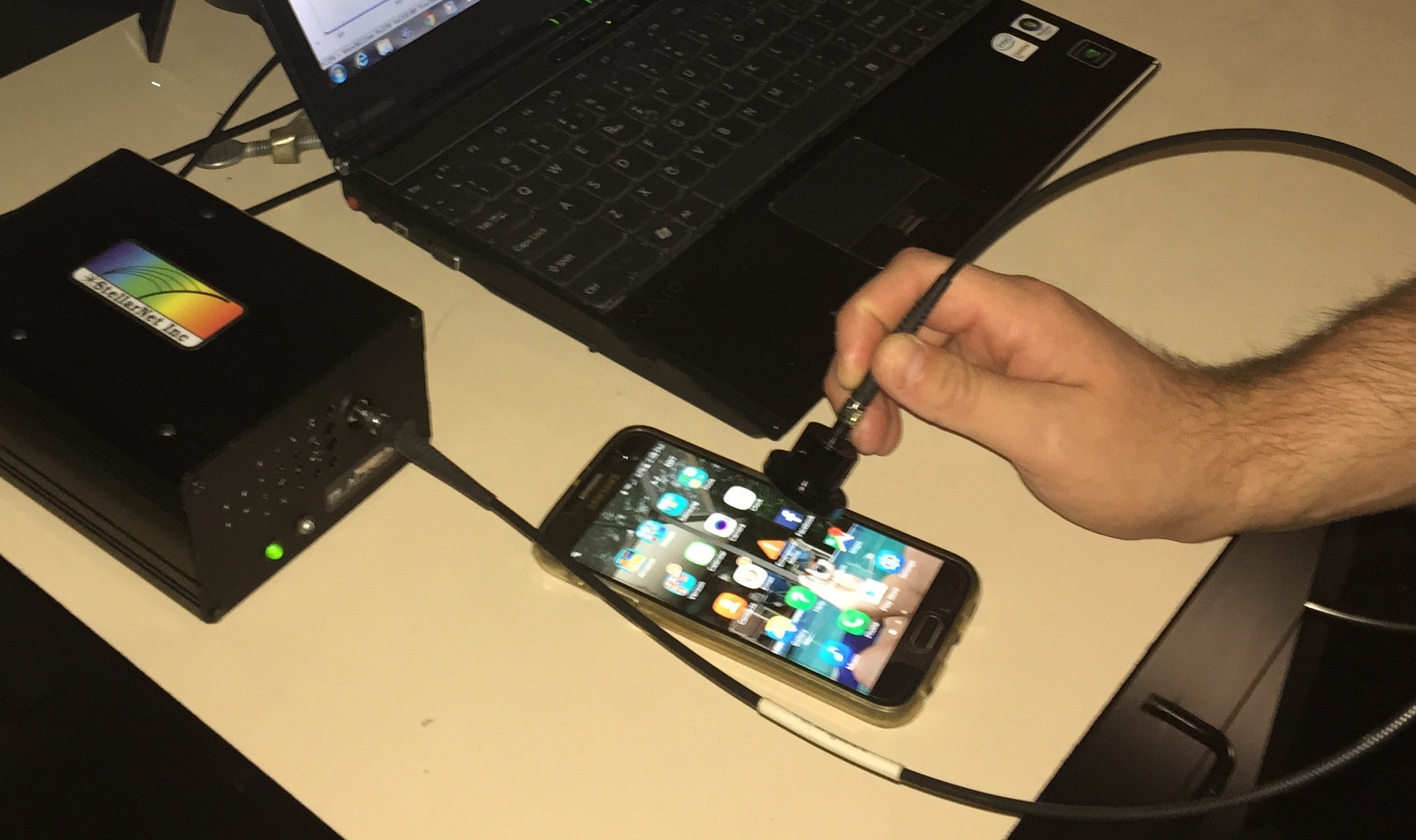
Experimental Setup for Quality Analysis of Displays, Tablets, and Backlit LED Panels. Choose SILVER-Nova or TE Cooled Spectrometers for dim displays
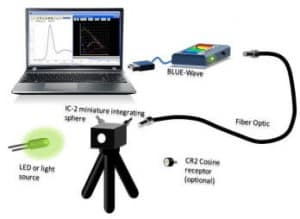
Experimental Setup for Laser, Laser Diode, and LED characterization. Larger Spheres such as IS6 and IS12 can be used in place of low cost IC2.

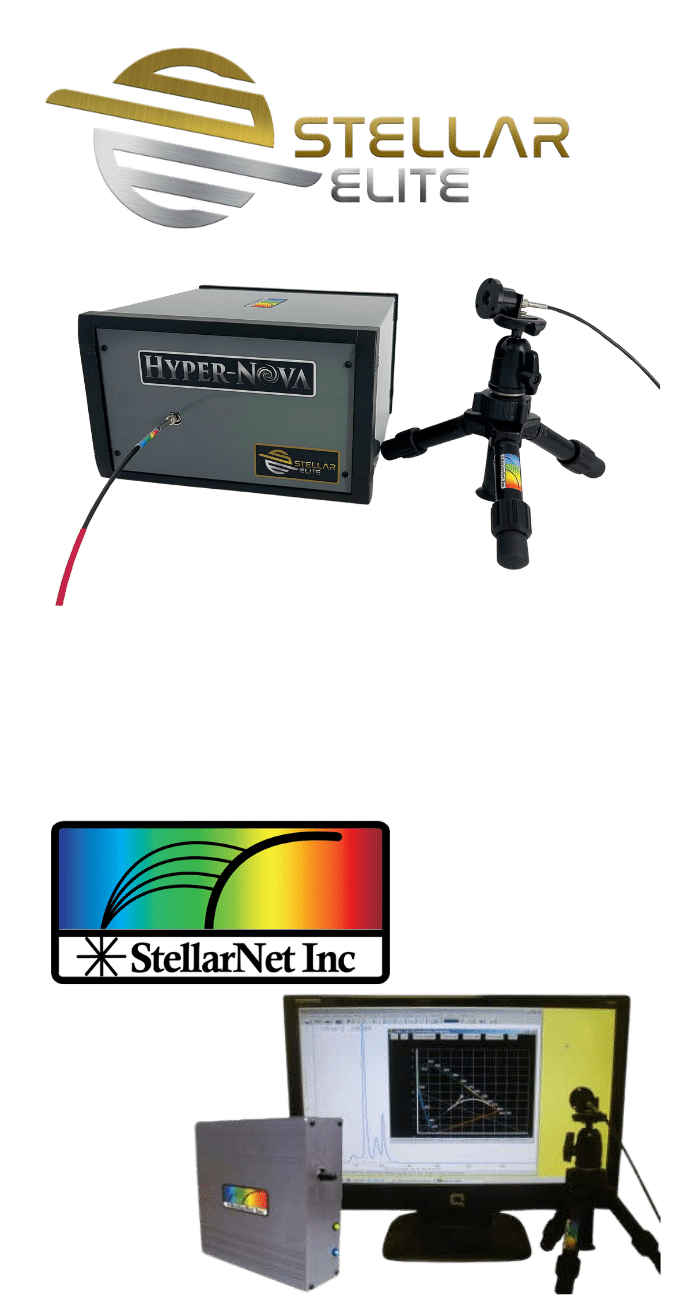
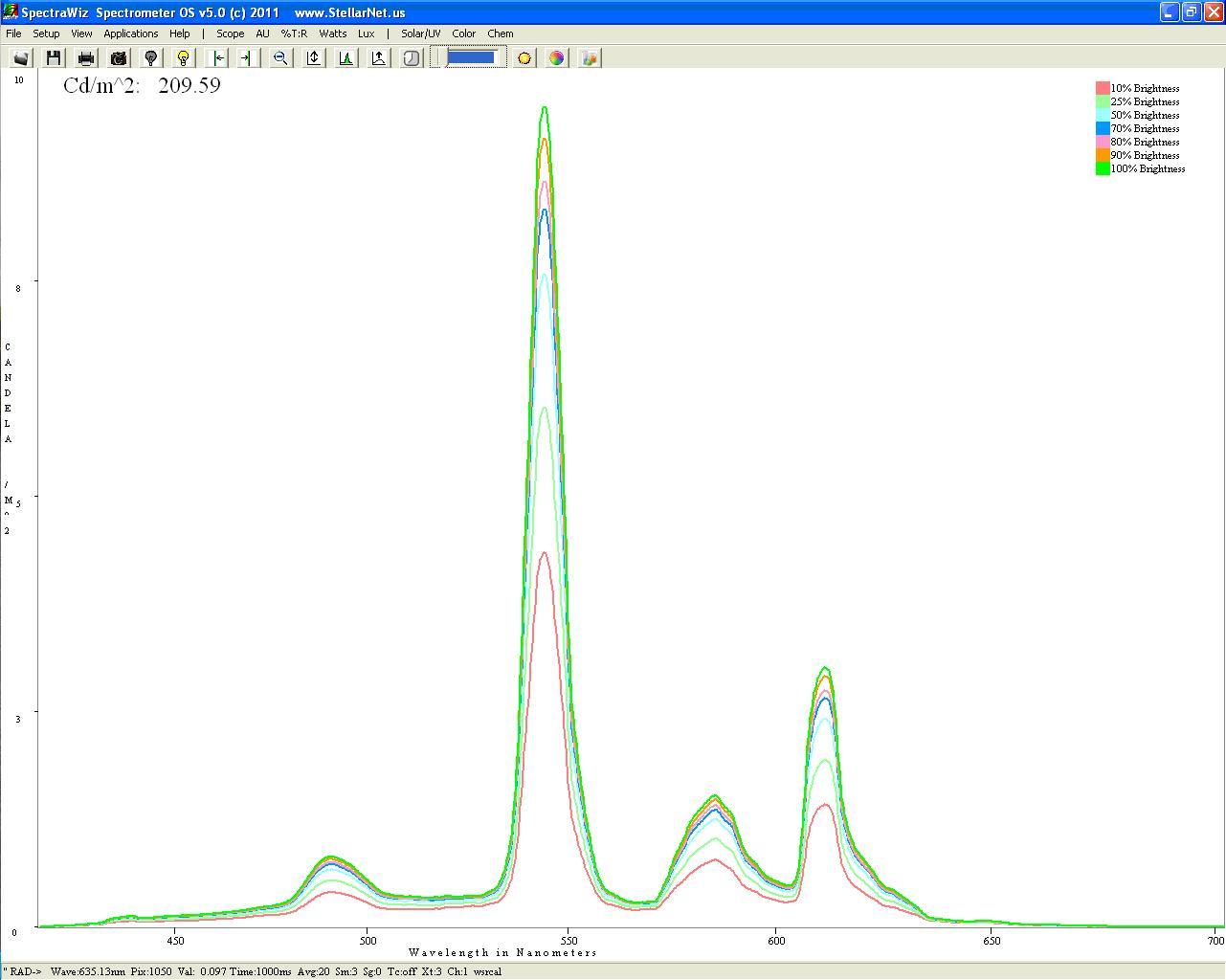
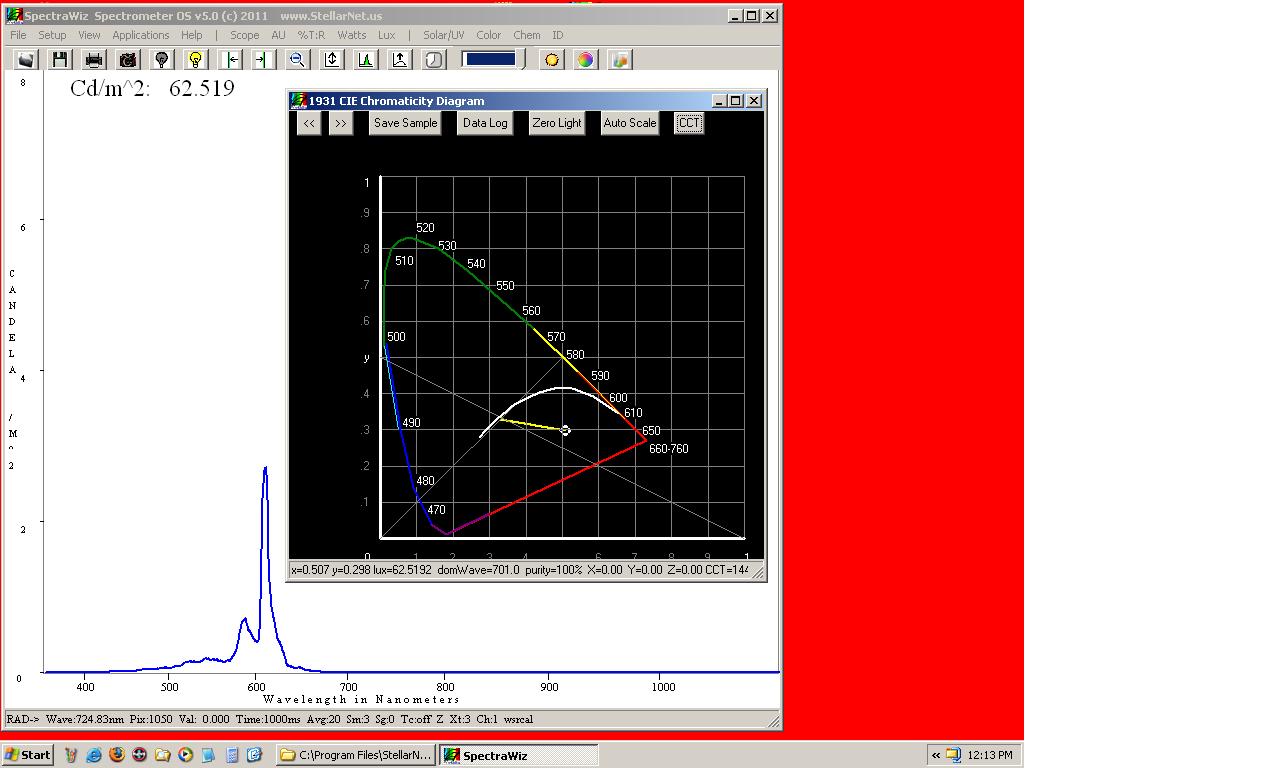
Display Measurement Sample Spectra
Display Measurement System Options and Pricing
Preconfigured Display Measurement System Options
Display-System
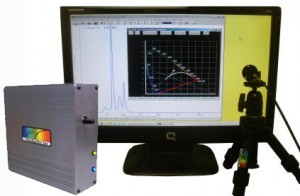
Preconfigured SpectroRadiometer system routine analysis of all types of displays and monitors. System consists of a SILVER-Nova spectrometer, F600-VISNIR fiber optic cable, CR2 cosine receptor, CRLENS, RAD-CAL Radiance calibrations in (W/m^2/sr/Cd/m^2), RAD-CAL low light calibration, & RAD-CAL-DOC NIST traceable certificate. Go to Display page for more configurations…
Buy from Online Store$6,800.00
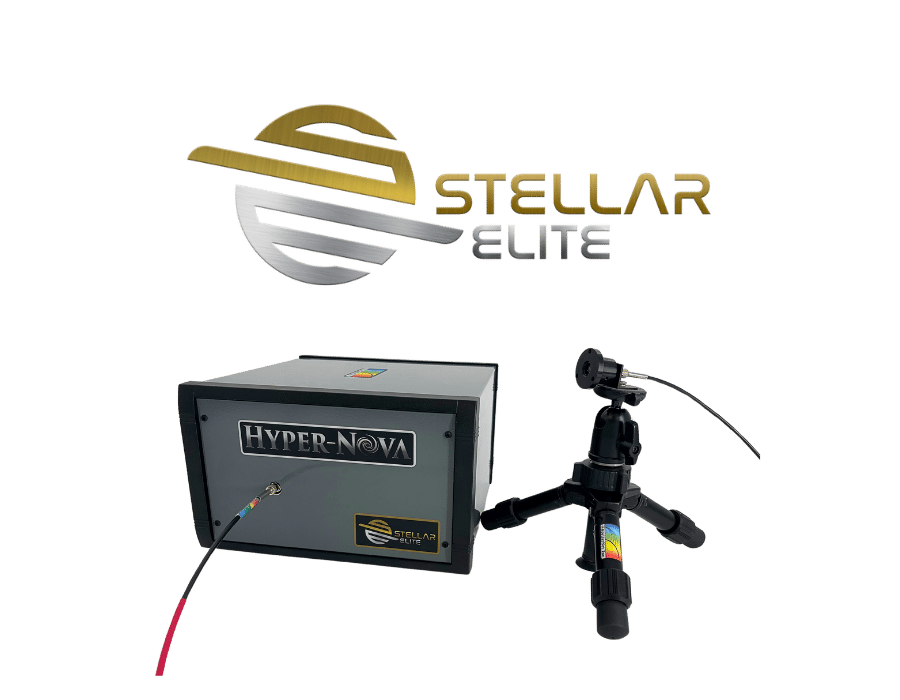
StellarElite Display System
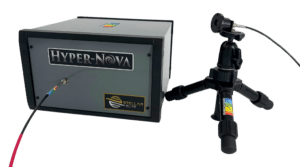
StellarElite Display System with broadband spectral range and deep cooling offers the highest performance when it comes to display measurement. Systems are calibrated for radiance and offer the lowest light detection capability with Low Dark Current (LDC) Technology. Great low illumination detection for backlit displays and even for astronomical and dark sky applications! System consists of a HYPER-Nova spectrometer, F600-VISNIR fiber optic cable, CR2 cosine receptor, CRLENS, RAD-CAL Radiance calibrations in (W/m^2/sr/Cd/m^2), RAD-CAL low light calibration, & RAD-CAL-DOC NIST traceable certificate. $29,455.00
Stellar-RAD 
The StellarNet Handheld-Radiometer measures illuminance, chromaticity, dominant wavelength and the complete spectral distribution of all visible light 350-1100nm (with options for Infrared or Ultra Violet). Full spectral data is collected using <1nm research grade optics. It has a 5x7“, touch-pad tablet interface that’s both ergonomic and user-friendly. UV upgrade for 250-1100nm range for $500. $4,200.00
Spectrometer Options for Measuring Displays
BLUE-Wave
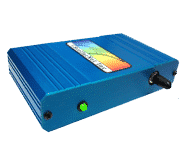
Visible spectrometer 350-1150nm (UV options available) $3,200.00
BLACK-Comet
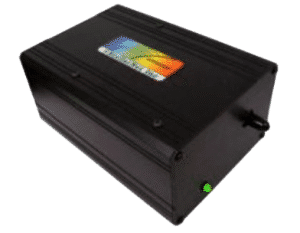
Concave Grating spectrometer for UV-VIS. C (190-850nm) or CXR (280-900nm) $3,450.00
BLACK-Comet-SR
Super Range Concave Grating spectrometer for UV-VIS-NIR. C -SR (200-1080nm) or CXR-SR (220-1100nm) $3,950.00
BLACK-Comet TEC Upgrade
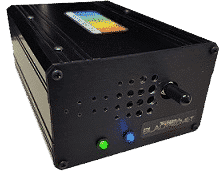
Thermo Electric Cooler (TEC) upgrade for low light LED testing to improve measurement sensitivity and detection capability. TEC reducing noise effects over %50 at long exposures and includes a sealed and isolated detector enclosure with specialized heat sink and air flow design for added stability and cool operation. Read More... $1,750.00
SILVER-Nova

High Sensitivity "Super Range" spectrometer for UV-VIS-NIR 200-1100nm. Includes UV detector upgrade, detector lens assembly, composite grating technology, and super cooled TE detector. Interchangeable Slit upgrade – Now available! $1,750.00 $5,175.00
HYPER-Nova
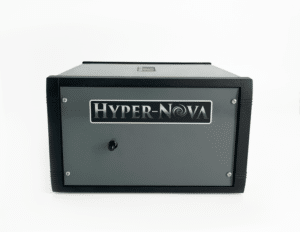
HYPER-Nova UVIS high performance spectrometers use a Low Dark Current (LDC) technology to provide lower background noise than is possible with traditional font/back-illuminated detectors. HYPER-Nova’s CCD detector is vacuum sealed and cooled to -60 °C with peak quantum efficiencies up to 95% $27,500.00
Radiometric Accessories
F600-VISNIR Armored, 600um diameter single strand, multimode fiber optic cable with black PVC jacket and 2 SMA conectors-2 meter length for wavelength range 400-2200nm. $200.00
CR2 Miniature cosine receptor for UV-VIS–NIR, 1/4 inch diameter with fiber optic cable attachment for irradiance measurements. Calibration performed using NIST traceable lamp operating from 200-1700nm. Buy Online $200.00
CR2-AP Aperture for CR2, allows intensity measurement of sources that are 10 times brighter. $200.00
Col-Tubes Cosine receptor holder with field of view reducing extension tubes. Can be used as a tripod or handheld pointer (gun) for the cosine receptor accessory. Comes with a set of 3 field of view reducing “collimating tubes” with 10, 20, and 30 deg FOV. Custom lengths also available. Buy Online $250.00
CRLENS Cosine receptor lens assembly reduces the field of view from 180 degrees to a small spot. Adjustable focus allows variable distance from target surface $295.00
CR2-TP miniature Tri-Pod stand for CR2 with 3 folding legs, setup any orientation, case included. $75.00
Calibration Services
IRRAD-CAL Irradiance calibration service in Watts/m^2 using NIST traceable lamp that covers 300-1100nm. Requires fiber optic cable and cosine receptor attachment such as CR2, IC2, IS4, IS6, IS8, or IS20. $350.00
RAD-CAL-SR Radiance calibration in Watts/sr/m^2 for Candela (Cd/m^2/nm) – requires CR2-LENS $350.00
IRRAD-CAL-Low Description: Low-light level calibration to measure 10x lower intensity emissions. Please specify wavelength range needed. Certification document not included. Please Note: Calibration replacement file costs $125.00.
$350.00
RAD-CAL-SR-Low Radiance calibration in Watts/sr/m^2 for low light Candela (Cd/m^2/nm) – requires CR2-LENS. Low light calibration performed with Lens assembly only $350.00
IRRAD-CAL-Fast Expedited Calibration Service guaranteed <1.5 weeks. Contact for availability $550.00
IRRAD-CAL-DOC Optional Calibration Certificate with details of calibration instrumentation and date and signature of calibration technician $175.00
RE-CAL Annual NIST traceable calibration service, instrument inspection, and x-axis realignment. Choose one from any of our offered calibration services including IRRAD-CAL for spectral irradiance, RAD-CAL-SR for spectral radiance, RAD-FLUX for radiant flux, and low light calibration options. Each additional calibration is $350 with an option for a calibration certificate. $700.00
IRRAD-CAL-Replacement File Copy of original calibration file supplied in electronic format by e-mail and/or replacement USB key. $150.00
*Note: actual spectrometer range can be smaller than range described for radiometric calibration
*Please contact a StellarNet sales representative about more spectrometer configurations
*Annual recalibration discounts and recalibration packages available
Display Measurement System Specifications
Preconfigured System StellarElite Display Measurement Standard StellarNet Display Measurement
Spectrometer Model: HYPER-Nova SILVER-Nova
Wavelength Range: 300-1100nm 300-1100nm
Slit Size: Interchangeable 25, 50, 100, 200 50um
Spectral Resolution: <1nm (with 50um slit) <1nm
Measurement Range: 0.009-20000 Nits 0.1-17500 Nits
System Dynamic Range:
(min to max signal)75db 68dB
Receptor Type: Cosine Receptor Lens Cosine Receptor Lens
Integration time: 10ms to 8 minutes 10ms to 60s
Wavelength Accuracy: <0.25nm <0.25nm
Power Accuracy: +/- 3%, NIST Calibrated +/- 5%, NIST Calibrated
Color Accuracy: +/-0.001 (reference standard lamp) +/-0.001 (reference standard lamp)
Color Repeatability:
xy
CRI
CCT"+/- 4.97E-05
+/- 0.009
+/- 0.2+/- 0.000328
+/- 0.02
+/- 1.5
Power Repeatability:
Cd/m2 or Nits
bright light0.01% 0.05%
Power Repeatability:
Cd/m2 or Nits
low light @ 1 minute exposure1% 5%
Software included: StellarPro, Python SDK StellarPro, SpectraWiz, & All Customizable SDK
Included Spectroscopy Software
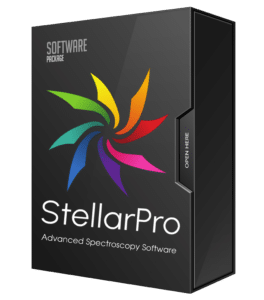 Our new StellarPro Software for Windows/Mac/Linux is a combination of our popular SpectraWiz software with advanced tools and an application module style interface, be prepared to have your mind blown. Built-in modules for Radiometry, Colorimetry, Chemical Absorption/Kinetics, Chemometrics, Spectral ID, Raman, Multichannel, Haze, & Thin-Film.
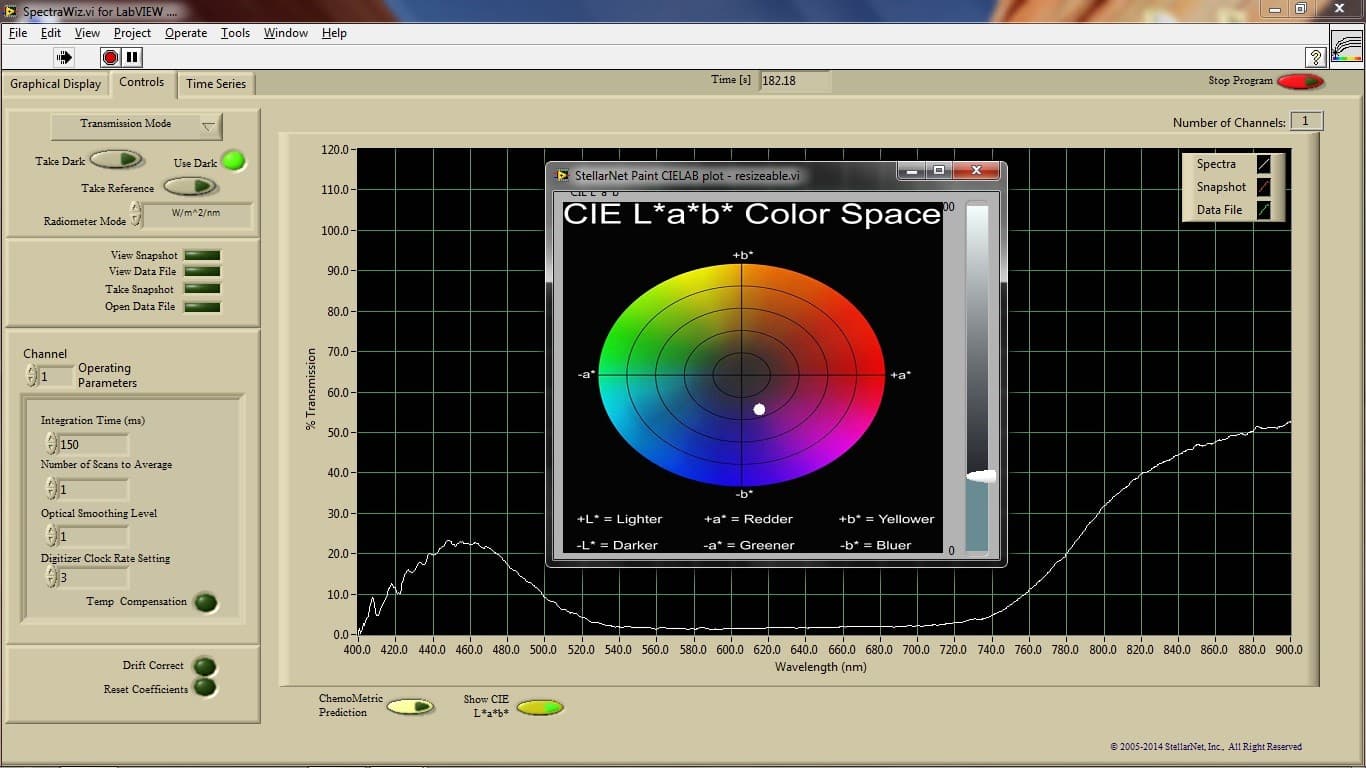
Free SpectraWiz Software The powerful SpectraWiz® spectrometer software is provided free of charge with every spectrometer instrument. This includes drivers and customizable software for Windows. The SpectraWiz software is considered the “Swiss Army Knife of Spectroscopy” and may be used to accurately measure wavelength emissions, reflectance, transmission, absorption, concentrations, and absolute intensities. In addition to real-time spectroscopy, SpectraWiz® has built-in applications for SpectroRadiometry, SpectroColorimetry, ChemWiz chemistry lab concentration analyzer, and UV level monitors. Download SpectraWiz Software FREE
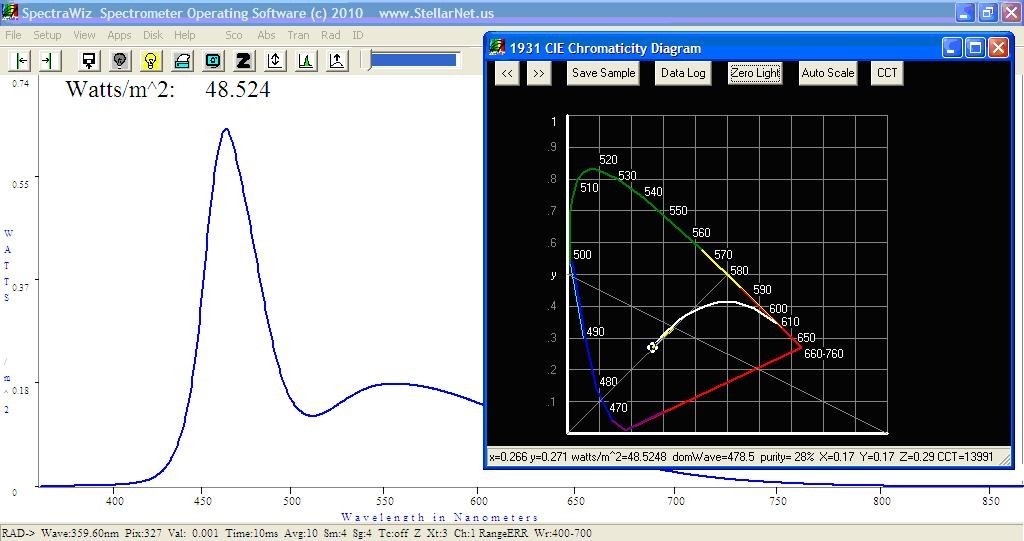
SpectraWiz Software Suite for LED Measurements
- Absolute intensity measurements Watts/m2
- µm watts/cm2
- PSD
- Lumens/m2 — LUX
- Moles per second — PAR
- Footcandles /m2
- Radiant Flux (watts) / Luminous Flux (lumens)
- CIELAB xy Chromaticity, dominant wavelength, purity
- Correlated Color temperature (CCT)
- Set Power Spectral Density (PSD) range
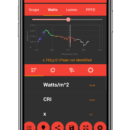


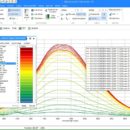


StellarRAD for iPhone and Andriod – Light Spectral Analysis App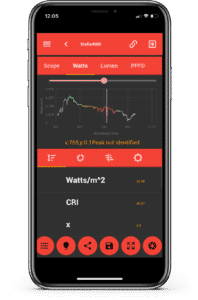
The StellarRAD App for all WiFi-enabled StellarNet spectrometers (zAP2 WiFi upgrade) makes real-time light measurement quick and easy. Acquire full spectrum analysis of LEDs, lamps, lasers, solar or grow lights, and just about any type of luminaire from ultra-violet through the visible and near-infrared!
This intuitive app lets users control their spectrometer and capture basic and more advanced light measurement parameters such as spectral irradiance and lumens. Colorimetric analysis such as CRI (color rendering index), CCT (correlated color temperature), xy chromaticity, and much more are included. Easily save and export your data and full spectral graph as an .IRR text data file, screenshot, and/or PDF report with all parameters listed.
SpectraWiz MobileTM for Linux/RasPi
The SpectraWiz MobileTM for Linux/RasPi is designed to run directly on the SMART-Control spectrometer interfaces or can be packaged for your your requirements. Using the local access point or WiFi you can easily log in and run applications for General Spectroscopy, Radiometry, Colorimetry, and Concentration analysis.
The easy to use applications are written in python and provided free with purchase of a SMART-Control spectrometer upgrade. Source codes can be purchased separately and can be further customized to suite each user’s requirements. OEM customers can add their logos or additional computations and industrial customers can set their spectrometer and stream their data to PLCs or other process monitoring platforms. SMART-Control devices support RS232, 4-20mA Analog, 26 pin digital I/O, Ethernet, I2C and other options available upon request.
Interface Options
Standard Interface
The system includes a high speed plug & play interface using USB-2 connection.
zAP2 WiFi Upgrade The zAP2 WiFi upgrade enables WiFi access to any spectrometer. Now use our new StellarRAD App on your iPhone or Android device. zAP2 WiFi upgrade can be added to all new and some old spectrometers in the field. Once added, the spectrometer runs as normal receiving power from the computer’s USB; if 5VDC power is connected directly to the BLUE-Wave, the zAP2 WiFi powers up and you can connect your device. Also, the zAP2 enables USB over IP and you can run SpectraWiz wirelessly on your Windows computer. $600.00
SMART-Control Interface Upgrade
The SMART-Control device offers communication flexibility and application specific customization for any StellarNet spectrometer. This add-on interface includes an integrated CPU with 1GB RAM and many communication protocols such as RS232, SPI, 4-20mA Analog for PLCs, Digital I/O, Ethernet, Wifi and many other options. The SMART-Control allows customers to move their spectrometers into process or OEM environments and stream their selected real world data. $2,000.00
Technical Information Request
Composite films produced from upcycling of tropical fruit seeds are capable of monitoring shrimp freshness
Tram Anh Ngoc Le, Wei Ning Chen Published: 15 January 2024 | School of Chemistry, Chemical Engineering and Biotechnology, Nanyang Technological University, SingaporeAbstractMany tropical fruit seeds are disposed of as waste but have high values for food applications....